
OK, they haven’t yet landed The Big Kahuna” and it may well be that Nick Kurtz’ asking price for an extension is prohibitive — even if fair. But you can’t say the A’s aren’t making good on their wish to
‘hang onto their young players’ in this new era of homelessness and anticipation.
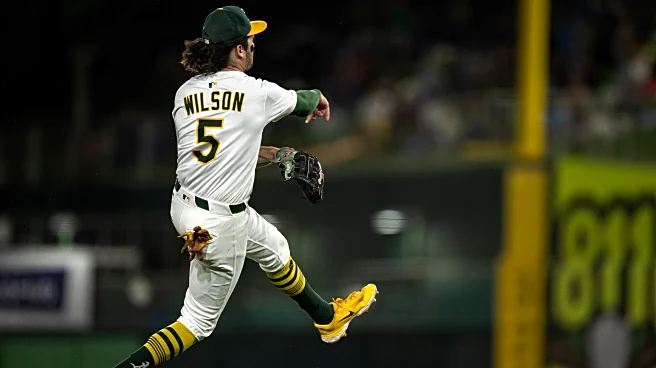
Jacob Wilson becomes the fourth player in 2 off-seasons to sign an extension, following Brent Rooker, Lawrence Butler, and Tyler Soderstrom. And with the last 3 you’re looking at contracts going well beyond free agency, 2 to 3 years depending on club options.
What’s easy to tell on the surface is how fans feel about having their favorite and best players committed to long term. It’s hard to find fans who aren’t pleased to see the best talent extended with terms that are affordable season to season.
Who “Wins” The Extension?
What’s harder to say is whether a given deal is “team friendly” or “player friendly” because extensions are somewhat like insurance policies. Your $500 premium payment to State Farm starts to look cheap when you incur $5,000 in damage that is paid for, minus a modest deductible. But $500 also stings as an expensive sunk cost as you drive without incident for 2 years and $12,000 of premiums.
As is the case with casinos, with insurance companies “the house” always wins. A given gambler at the Roulette wheel might win a small fortune and a given driver might come out ahead one year while his insurance company takes a loss on him. But across every gambler and every driver, as bets are put against winnings and premiums are put against claims, there is an underlying truth: the casinos and insurers are coming out ahead.
But what about Rooker, Butler, Soderstrom, and Wilson, signing deals that are way under their market value current and projected, as a measure of insurance against losing their earnings when a tendon pops or a career unexpectedly Gelofs.
There are two basic truths with regard to extensions. One is that all things being equal the team is getting far more value than they are paying and are paying less than they would have had they gone season to season using arbitration and free agent contracts to procure the same years. The other is that the player is flat out guaranteed that so long as he stays away from 14 year old girls he will earn the tens of millions no matter how well he performs or how often he can take the field.
It is a bit subjective how valuable it is to have $70M in hand (as Wilson will) instead of the strong likelihood of earning considerably more over that same time without the insurance policy. There are just too many variables, such as…Is what’s behind door #2 $80M or $200M? How big are the risks of injury/performance significantly impacting my career? How much does $70M impact my family’s/their family’s long term stability to where it’s worth emphasizing “that first $70M for sure”? How much am I confident I can earn with my next contract with an extension?
Nice Problem To Have
Now these are all “first world problems” as it would take most of us over a thousand years to match earnings of $70M, which is a rather long time to work. And Wilson will earn those $70M just in time to celebrate his 30th birthday (I’m guessing he won’t have to settle for going to Chuck E. Cheese.) He will then be poised for another huge payday.
From The Team’s POV
Sure the A’s will pay Wilson a lot more then next 2 seasons than they were poised to. Minimum salary is less than a 1/10 of the $10M AAV his new contract provides. But then the A’s will come out fine over the 3 arbitration seasons, which would have seen Wilson earn less than $10M and then more, and certainly the team makes out like bandits if they get Wilson’s first 2-3 post-FA years at $10M/year.
They’re also stuck with an albatross if one of their extended players performs like Anthony Rendon and either puts up horrific stats, is always injured, or in Rendon’s case both. And they are now stuck with it for 2 more years than they would have been. That’s the trade off of certainty vs. “going year to year”.
“WAR, What Is It Good For?”
Here’s where the A’s stand to be the big winners in an extension. Just as Wilson is banking on being able to earn another big contract as a 31 year old free agent, the team is banking on Wilson being generally healthy and effective (same with Rooker, Butler, and Soderstrom).
Wilson, injuries, horrible July playing through injury, and all, was worth 3.5 fWAR in 2025. By current calculations of “1 WAR = $9M of value” that means he was worth $31.5M. Now he may improve or he may regress, but since we don’t know which is in the cards let’s just say he moves forward as a 3.5 WAR player through his 20s.
7 years x 3.5 WAR = 24.5 WAR.
24.5 WAR x $9M value per WAR = $220.5M of value
That’s against the $70M the A’s will pay him whether his puts up a total of -0.6 WAR or 300 WAR.
From this vantage point, if you trust this “core 4” to be just basically healthy and productive the A’s look like they will make out like bandits — with the caveat that they were going to enjoy some tremendous surplus value if they just let the pre-arbitration years play out and that major injuries or sudden shifts in performance are not that uncommon.
Brent Rooker: 5 years/$60M plus a vesting option
Lawrence Butler: 7 years/$65.5M plus a club option ($20M/$4M buyout)
Tyler Soderstrom: 7 years/$86M plus a club option ($27M/$2M buyout)
Jacob Wilson: 7 years/$70M plus a club option ($27M/$2M buyout)
Which of the extensions do you think are good one for the team to have gambled on? How would you rank them from 1-4? Opine away knowing this is not a mathematical science, but rather an art — though rarely have the arts been so well funded.