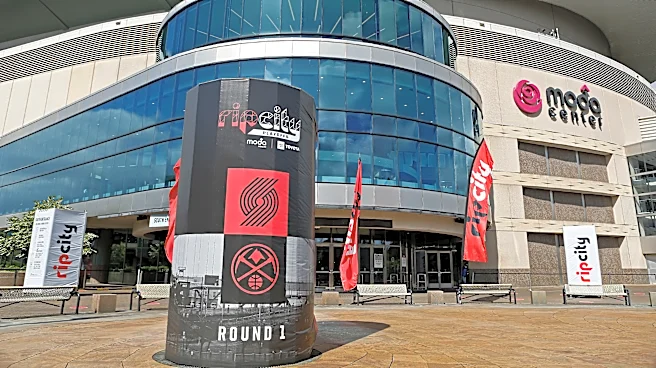








Negotiating is hard, and it’s not always fun. When the stakes are of the 20-year and $600M variety, it’s perhaps unsurprising that the Portland Trail Blazers and the City of Portland do not yet find themselves on the same page.
However, those pages may be even further from each other than we might expect, according to Jason Quick of The Athletic:
“I think we are very far apart,’’ said a team source Sunday, one of two within the Blazers who were granted anonymity to discuss the situation freely.
On Friday,
the city of Portland sent the Blazers a term sheet for a 20-year-lease agreement. If the Blazers agree to the terms, the team would receive $600 million in public funds to renovate the Moda Center. Of significance, the city is asking the Blazers to pay $3 million annually for a property tax offset, which would escalate over time. Additionally, the deal would require the Blazers to hire union workers and set caps on project-cost overruns.
“The term sheet is a non-starter,’’ the source said. “I don’t know why they sent it to us, because they know very little of the stuff we would agree to. They are playing politics at this point.”
The Trail Blazers’ board of directors meets Monday and will address the term sheet to determine a course of action.
The City’s draft term sheet – a non-binding list of expectations that can be used as a starting point in more formal negotiations to follow – does not include any private financing of the $120M the City would contribute to the $600M project, but does include the following:
- Non-relocation commitment: A binding 20-year agreement requiring the Trail Blazers to play all home games at Moda Center.
- Labor harmony agreements: Requirements for labor peace agreements to support a stable workforce.
- Financial protections: Caps on public funding, limits on eligible expenses and safeguards against cost overruns for the City, State and County.
- Payment: A $3 million annual property tax offset payment from Rip City Management, escalating over time, with proceeds shared among the City, County and Portland Public Schools.
- Community benefits commitments: Community event access, local hiring, sustainability standards and partnerships with Albina-based organizations.
- Maintenance: The team would “keep and maintain the Arena and Arena Site in compliance with a benchmarked operational standard.”
The City’s draft term sheet itself was not without controversy, as the Portland’s Mayor and some members of its City Council are not on the same page:
[Portland City Councilor Mitch] Green said some media reports suggest City Council “sent” terms to the team. “Not the case,” Green wrote, adding that councilors were briefed on “high level themes” for the first time during an executive session that ran from 9:30 a.m. to 1 p.m., where members asked questions based on a PowerPoint from the city administration.
Green said council reconvened for a public meeting at 2 p.m. and adjourned at 6 p.m. He wrote that at 4:23 p.m. — while councilors were still in chambers — members received a draft term sheet in their inboxes with an email indicating it had also been shared with the Portland Trail Blazers “for our situational awareness.”
Portland City Council will take an Aug. 12 vote on a final version of the term sheet, and both the City and Multnomah County must commit funding before Dec. 31 to qualify for the additional $365 million in state funding committed earlier this year. Two Multnomah County commissioners recently called for a “reset” in the County’s process to find and commit its share of the funding (about $88M).
It’s possible that Oregon’s 2027 legislature could take this issue up again beginning Jan. 17, but it would leave less time to agree on funding, complete bonding authority, do the work, and complete renovations before the April 2030 NCAA Women’s Final Four set to be hosted by the Moda Center.