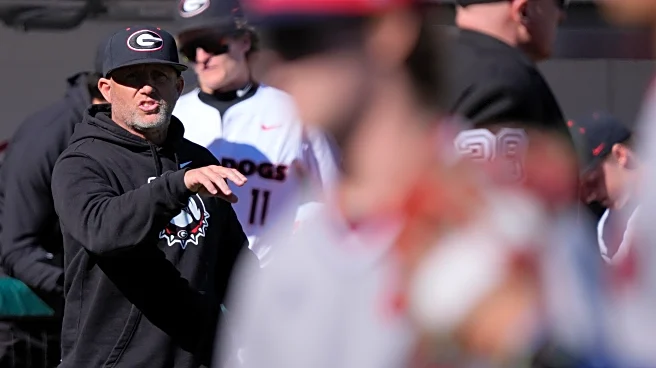




Good afternoon, Dawg fans. With the 2026 College Football season officially coming to a close Monday night and the College Basketball season nearing its midway point, that can only mean one thing: baseball season is fast approaching. The Georgia Bulldogs baseball program is gearing up for what they hope will be another impressive year in Athens.
Wes Johnson and his Diamond Dawgs are coming off a solid 2025 campaign, finishing 43–17 overall and 18–12 in SEC play. Georgia’s season, however, came to
a heartbreaking end in the Athens Regional, falling to Oklahoma State 11–9 on a walk-off home run. Following that loss, the Dawgs saw significant roster turnover, with nine players selected in the 2025 MLB Draft back in July. Eight of those nine draft picks were pitchers, forcing Georgia to be aggressive in the transfer portal to help reload its pitching staff.
Below are the pitchers who have transferred to the Dawgs:
Caden Aoki (RHP): USC transfer, Big Ten Medal of Honor winner.
Andrew Behnke (LHP): Tennessee transfer.
Teddy Brennan (LHP): George Washington transfer.
Tommy Ellisen (RHP): UConn transfer.
Caleb Jameson (LHP): Baylor transfer.
Lane Pearson (RHP): West Georgia transfer.
Brad Pruett (RHP): ECU transfer.
Matt Scott (RHP): Stanford transfer.
Dylan Vigue (RHP): Michigan transfer.
Joey Volchko (RHP): Stanford transfer.
This group brings a wide range of experience from power conferences, mid-majors, and academically elite programs. Caden Aoki headlines the class, bringing leadership accolades and high-level experience, while Andrew Behnke adds valuable SEC familiarity after his time at Tennessee. The left-handed additions provide important balance, and the sheer number of arms should allow Georgia to be flexible as roles within the pitching staff begin to take shape throughout the season.
The Dawgs also landed two of the top two-way players in this year’s transfer portal class: LHP/OF Kenny Ishikawa and 1B/RHP Bryce Calloway.
Ishikawa transferred to Georgia after spending time at Seattle University. Standing at 5’11, 195 pounds, he put together an impressive offensive season, batting .318 with eight home runs, 32 RBIs, and a .982 OPS across 52 games. On the mound, Ishikawa appeared in 19 games, posting a 4.21 ERA with 73 strikeouts. He is expected to contribute both at the plate and on the mound, giving Georgia valuable versatility.
As for Bryce Calloway, there is plenty of excitement surrounding his arrival in Athens. Standing at 6’4”, 265 pounds, Calloway possesses natural light-tower power. Last season at the University of New Orleans, he hit an impressive .390 with 18 home runs and a massive 1.206 OPS. While listed as a two-way player, Calloway primarily served as a closer on the mound. That said, he is expected to be predominantly an offensive piece for the Dawgs and should slide in as the primary first baseman, allowing Tre Phelps to move back out to the outfield.
Speaking of Tre Phelps, he should be at the forefront of returning production. After filling the First Base role at times throughout last season, Phelps is expected to return to the outfield, where he is projected to play at the next level defensively. His versatility, experience, and steady offensive production should make him one of Georgia’s most important returners, and if he reaches expectations, he should be hearing his name called in the first-round of this year’s draft.
Another key returner is Kolby Branch, who has provided athleticism and consistency in the middle of the infield over the last two seasons. Branch also has plenty of pop in his bat, clubbing 30 home runs over the last two seasons. His ability to impact the game both offensively and defensively gives Georgia a reliable everyday option and helps anchor a lineup that blends returning talent with new additions. His experience will be especially valuable as younger players and transfers adjust to the grind of SEC play.
From a schedule and outlook standpoint, Georgia once again faces the gauntlet that is SEC baseball. Weekend series against conference foes will test the depth of the pitching staff early and often, making the transfer additions all the more critical. Non-conference play should provide opportunities for the staff to experiment with rotations and bullpen roles before SEC play ramps up.
Ultimately, the 2026 season will likely hinge on how quickly the revamped pitching staff comes together. Losing eight pitchers to the MLB Draft is no small task to overcome, but Georgia’s aggressive approach in the portal suggests confidence in this new-look staff. If the arms settle in and the offense continues to produce, the Diamond Dawgs have the pieces to not only return to postseason play but potentially make a run to Omaha.
Georgia will begin their 2026 season on February 13th in a three-game series at Foley Field against Wright State.