
Don’t look now but the Georgia Bulldogs have been to back to back NCAA Tournaments under the leadership of Mike White. In this history of Georgia Basketball, dating all the way back to 1905 (granted the NCAA Touranment hasn’t been around that long but stick with the point), the Men’s basketball team has never been to three straight NCAA Tournaments. They went to back to back tourneys in 1990 and 1991, in 1996 and 1997, and in 2001 and 2002. Then, of course, the 2025 and 2026 NCAA Tournaments.
And
last season White flipped the script on what the Bulldogs were trying to do. After toiling away at a middling pace for the first three years, White juiced both sides of the ball. Going back to how his early Louisiana Tech teams played, with high pressure up the floor and early run outs on offense. Georgia went from an averaged paced team to one ranked 12th in the country for tempo.
This requires a deeper roster, and White leaned into his rotation. Nobody played more than 70% of the minutes, and 11 players saw at least 24% of the minutes available. That’s 11 guys playing more than 9.5 minutes a game, with nobody over 27 minutes. It was a changeup, and it worked. They started 13-1, skidding a bit to 17-8, but then closed strong with five wins in six games to close the regular season.
So what’s next for Mike White and the Bulldogs?
Previous SEC Previews:
- 14.South Carolina Gamecocks, 4-14
- 15. Ole Miss Rebels: 4-14
- 16. Mississippi State Bulldogs: 3-15

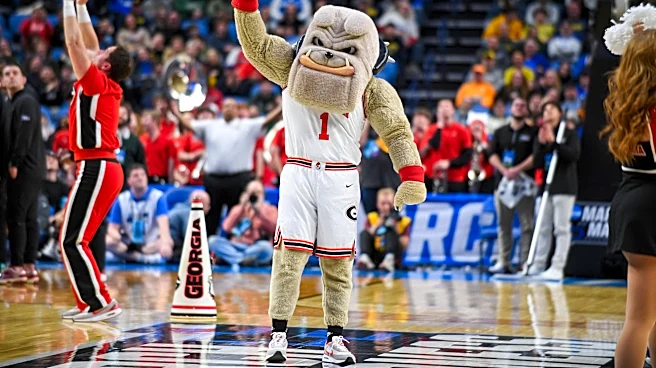
Georgia Bulldogs
- Last season: 22 – 11 (10-8 in conference) #35
- The Masses Prediction: 13th in conference
- SEC Media: 11th in conference
- Analytics Average: 11th in conference, 36th overall

HEAD COACH: Mike White | 5th Season, 78-57
I’ll reiterate a point I made last year, Mike White has made Georgia not bad.
Considering how poorly the Tom Crean era went, that’s a pretty good scenario. They’re operating more like the program did under Mark Fox, only with the league better, which means teams in the middle are going to the NCAA Tournament instead of vying for an NIT bid.
For now at least, that’s probably more than enough to keep White operating in Athens. After all, football is king there, and the bar for keeping your job is more in the ‘don’t be embarassing’ stage. Frankly there are programs and fan bases that care a lot more about basketball than Georgia does, and several of them are now losing to the Bulldogs on a regular basis. Just last year they took down Arkansas, Missouri, LSU, Kentucky, Texas and Alabama.
But in the KenPom era the program has never finished inside the top 15, and their KenPom program ranking is currently 60th. Operating each of the last two years inside the top 40 might just be what they want. But this is White’s 12th season as a head coach in the SEC and he’s attempting to win more than 11 games for just the second time. To his credit, his two worst seasons were the first two in Athens when he went 6-12 in back to back years.

As I said last year, back to baseline. If White steers this team to the NCAA Tournament (remember… expanded field!) it’ll be for the first time in school history. So while that sounds great, he’s made sure the program is just competitive within the league, which is as good as it’s ever been.
It will be interesting to see if he’s able to push top 25 or top 20 in the next few years. There are some good recruiting wins that could help the program get the boost it needs to push out of the middle of the pack.
LOST PRODUCTION
2nd in % minutes, 55.85% | 2nd in % points, 53.85% | 2nd
in % possessions, 53.91%
One of the things we remarked as a good sign for Georgia last season was their portal haul skewed younger than most everyone else. While the rest of the league, and really college basketball, went after the most experience they could assemble, Georgia went the other way. They added five transfers, and just one of them (Justin Bailey from Wofford) was in his last season of eligibility. The problem is two of the other four turned around and re-entered the transfer portal at the end of last season. The bigger loss was Jeremiah Wilkinson, a certified bucket getter, Wilkinson transferred to Arkansas for his junior season, after playing his freshman season at Cal. Wilkinson was the leading scorer for the team last season, dropping in 17.4 points per game. Former St. Mary’s guard Jordan Ross and freshman wing Jake Wilkins both left for Cal.
Perhaps the biggest loss was also the most sizeable, when Somto Cyril entered the transfer portal for a massive payday in Miami. Cyril was the only one consistently providing interior defense or rebounding for a Georgia team that really struggled in both areas last season. An excellent finisher around the rim, Cyril’s block rate was also 12th in the country, and his offensive rebounding rate was excellent.


Marcus “Smurf” Millender was perhaps the biggest surprise out of the transfer portal last year for the Bulldogs. Everyone knew Wilkinson was a high level scorer, but nobody knew what to expect from the diminuative point guard when he transferred in from Texas-San Antonio. But the Texas native fit right in with Georgia, he saw a decrease in minutes (mostly due to White’s deep rotation) but his efficiency went up. He kept his good outside shooting, hitting over 38% of his threes, and had an assist rate over 25%.
The other transfer who stuck around was Kanon Catchings, the nephew of Tamika Catchings, a 10 time WBNA All Star. Catchings always teased with his size and skill level. But he struggled to find a level of consistency. It looks like he was on the brink of figuring out his immense talent at different times last year, as he upped his scoring to 13.9 points per contest in conference play. The trick though was eliminating the lows: 2 points against Auburn to open play, 3 points at Texas, 3 points at Oklahoma, 3 points against Oklahoma. Then in the NCAA Tournament he had a goose egg. But he had 23 points at Mississippi State, 32 against Alabama, and 23 at LSU.
The transfer portal brought a bit of a mixed bag with Penn State (and former Tennessee Vol) Freddie Dilione. As a scoring combo guard Dilione was solid for Nittany Lions, even though they didn’t win many games. He was high usage and his shooting numbers were so-so, but he still remained mostly efficient. They’re also hoping James Scott can provide some the interior defense missed by the exit of Cyril. And the freshmen class isn’t carrying a lot of weight in terms of ranking expectations, there isn’t a single top 100 recruit.
But the heart and soul of the Georgia Bulldogs is the Knoxville, Tennessee native Blue Cain. A fan favorite in Athens, Cain has been a fixture in the rotation since his freshman season when he and Silas Demary gave Georgia fans hope for the future despite a rough first year. Since then Cain has only increased his role and value, he’s still not a ball dominant player, and he struggled with his outside shot last year, but he just does a lot of the little things well. He rebounds, he competes on defense, and plays with effort, and despite his slumping outside shooting, still posted good efficiency numbers.


With Millender, Cain, and Catchings all returning, the starting rotation is most of the way figured out. The question will be if Mike White decides to keep playing smaller and start Freddie Dilione V with the other guards, and continue to get beat up on the glass, or go a bit bigger and try one of his many options on the interior.
Losing who they lost, it doesn’t seem likely Georgia will deploy the same type of rotation they did a year ago. They legitimately played 11 guys. White has typically been a guy who will play a deeper rotation, but this group begins to see a whole lot more questions once you get past the 8th man in the rotation. Maybe the players will provide answers, but what’s more likely is they’ll just lose minutes to the guys White knows he can count on.
The front court will likely see a rotation of Kareem Stagg, James Scott, Andrew Osasuyi, and David Ugonna Ike. Cain, Catchings, Millender, and Dilione are all consistent and reliable enough for White to just keep them on the floor a whole lot more. Brady Dunlap, a SLU transfer and former St. John’s wing, is a high level shooter who isn’t much of a defender. If he’s on the floor it’s to help space the floor.
If any of the freshmen are able to crack the guard rotation, I think you consider that a win.


For a team looking to take another step forward, 8 Quad 4 games at home isn’t what you want to see. But it certainly is interesting the existence of 8 Q4 games along with the combination of North Carolina on the road and Duke on a neutral. There’s also their annual matchup against Georgia Tech, which is on Tech’s home floor this year. The ESPN Events Invitational “Magic Group” will see the Bulldogs take on Cincinnati and UCF. So despite a hefty amount of home Q4s, the rest of the schedule has some good balance. You’d think 11 wins in the non-con is the minimum here.
Then having Florida as a permanent rival presents challenges, but certainly there’s no better win you can collect in the SEC than taking down the Gators. The other home and homes are Oklahoma and South Carolina, two teams that aren’t unbeatable on the road, and who Georgia should also beat at home. The road games aren’t terrible. They open at Ole Miss, travel to Auburn, Arkansas, Tennessee, Texas A&M, and Alabama. Two of those might be gettable. Then the home games are Texas, Mississippi State, LSU, Vanderbilt, Kentucky, and Missouri. The good news here is at least four of those games should be Q1, and at least two of those games should be wins. If you can nip two more I think the Bulldogs are in the tournament conversation.
THE RULING
The bulk of the expectations for Georgia relies upon retention. Something most programs don’t really rely on these days, but the Bulldogs have the 2nd most production returning, next to only Florida (who returns like everyone).
The concern here is they lost a heavy driver of offense in Wilkinson, and a heavy interior presence in Cyril, and didn’t replace either with anyone close to the same quality of player.
On the inside, it’s mostly going to be by committee, and hoping you get something extra from either a freshman, or St. Bonaventure transfer Andrew Osasuyi. James Scott has been solid defensively in the past, but even he had trouble holding down a spot consistently for a bad Ole Miss team last year. There’s also Kareem Stagg, who managed to work his way out of, and back into the rotation during the season. He played well enough to be on the floor for about 45% of the minutes in the last 3-4 weeks of the season.
I think a lot of this lands in the lap of Kanon Catchings.
If Catchings is able to but who he was about half the time last year, and turn that into 90% of the time, he’s replacing the level of production vacated by Wilkinson. And there just aren’t many 6’9 wings who can move and shoot like he can, when he’s playing well and confidently.
Cain and Millender are good enough at the point and two guard spots that they’re really just needing someone to be the top guy. Then Dilione has enough experience to be a solid guy in the guard rotation.
But White is going to have to pair down his rotation and let his best guys go. If Cain, Catchings, and Millender are leading the way in minutes, Georgia should be a shoe in to beat these expectations.
My Results: Georgia Bulldogs — 12th in Conference, 6-12
About the preview: a number of respected basketball bloggers were asked to submit one pick for the entire league schedule game by game. The game by game option allows us to account for the unbalanced schedule when addressing any kind of power rankings. Each set of picks are reflected in “the Masses” picks. Included in “the Masses” are various SEC media members who made picks at my request, as well as additional credit given to the analytics projections, and national media outlet predictions.
Additionally, instead of relying solely on KenPom.com for the analytics site projections, we’re taking the average of the four main sites (EvanMiya.com, BartTorvik.com, Haslametrics.com and KenPom.com) to give a closer consensus picture. These are weighted a touch for reliability.
The projections: In an attempt to be as accurate as we could be, we increased the amount of analytics used to make individual projections which influenced how these teams slotted in order. Matt Watkins used an in-depth method for projecting the entire SEC transfer list, we then mixed in EvanMiya.com’s BPR projections, and BartTorvik.com’s preseason individual projections to round out the expected production based upon how each coach routinely uses his rotations.
GLOSSARY
* – an asterisk denotes a walk-on player
GP – Games Played
%min – percentage of total available minutes played, does not account for time missed due to injury
%poss – percentage of team possessions the player is responsible for ending a possession, whether by making a shot, missing a shot not rebounded by the offense or committing a turnover. For returning players this is noted as a percentage of total team possessions. For newcomers it was total possessions when that player was on the floor, better known as Usage Rate.
ORtg – Offensive Rating, similar to a points per possession but averaged out over 100 possessions. So it’s how many points a player would score if they were responsible for 100 possessions.
BPR – Bayseian Performance Rating, a single player efficiency metric created by Evan Miyakawa to determine both offensive and defensive impact when a player is on the floor.
PAR – Points Above Replacement, a Rock M+ proprietary rating measuring projected on-off impact adjusted for time on the floor.
PPG – Points Per Game, RPG – Rebounds Per Game, APG – Assists Per Game: All traditional statistics used to measure player production.
For newcomer player rankings, we used EvanMiya.com’ s rankings for transfers, and 247sports.com ‘s Composite Rating for Freshmen and Junior College signees.