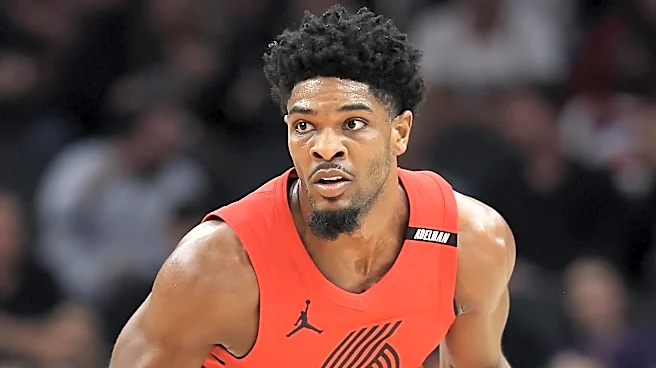

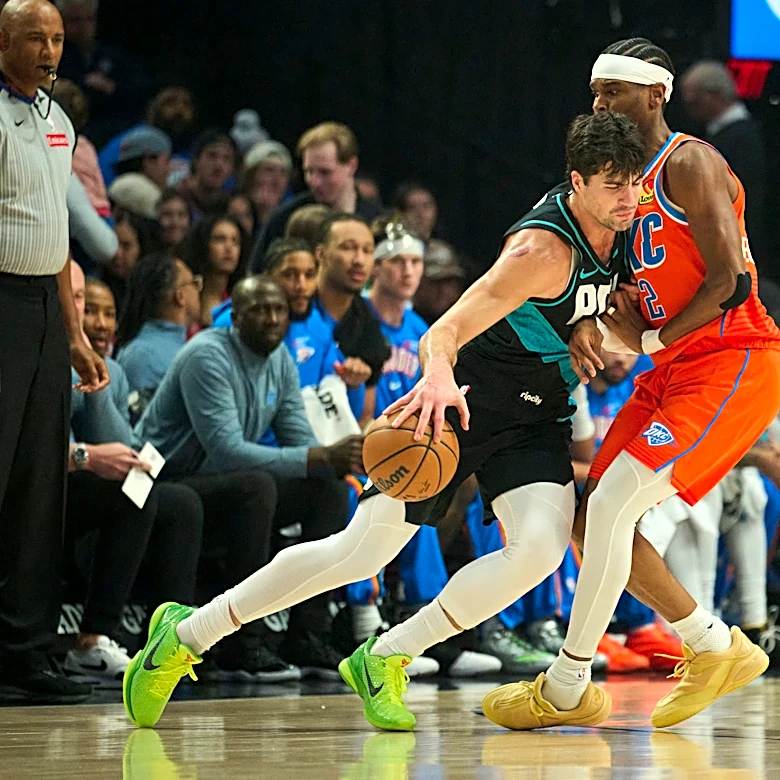

The Portland Trail Blazers’ season has generally gone pretty well so far, with one glaring exception. Guard Scoot Henderson has become a lightning rod in the early going, catching heat for turnovers and inconsistent offense which is standing out next to the performances of his teammates.
Today’s Blazer’s Edge Mailbag question takes a look at the Scoot Question in an oblique way. Take a look.
Hi Dave,
What’ll you gimme for Scoot and a 1st? Kidding/not kidding.
When is the right time to move on from a
player? The Blazers have a history of holding onto players longer than some other teams would. I guess there is always the fear of them blossoming elsewhere, but while there are a few notable “ones that got away” there are many more who played their best ball in Portland but hit the ceiling. It’s understandable and even honorable to stick with somebody given the personal side of these relationships. But the Blazers seem less aggressive in these situations than some of the more successful franchises.
Fans are always asked for more patience in the NBA. When is the time for bold action?
Organtoe
This is why General Managers get the big bucks. Every time we want to think about trading Scoot Henderson we remember Norman Powell and Jermaine O’Neal. Parsing out the right player and opportune time isn’t a strict science. It’s a combination of factors.
The most obvious is talent. What about this player is distinct or irreplaceable? Players with replicable skills are less crucial, obviously. In Scoot’s case, you have athleticism, body size, and by most accounts, work ethic.
Draft position and ceiling can also factor into that “irreplaceable” category. Teams are usually reluctant to give up on players they spent high draft picks on. That’s protected Scoot so far. But time to develop quickly morphs into sunk-cost fallacy the farther a player gets along in his career. By the end of their rookie-scale contract, the golden halo of high draft position starts to dim. That’s about where Scoot is now. I won’t say that there’s zero effect, but he won’t be able to ride being the third overall pick in the 2023 NBA Draft into a lucrative new deal.
Having established unique contributions and promise, you ask what’s not working. This is critical. I believe it’s one of the main departure points between fans and professionals.
Fans lean towards trades instinctively. Front offices need reasons to make a deal. If nothing is going wrong, if the cost of keeping a player isn’t high, and if there’s no clearly better return available, why in the world would you make a move? You have to convince a front office person that a deal is beneficial and necessary before it makes sense.
Think of it like buying a car. The NBA Draft is like getting a new car at a steep discount. Sure, there could be problems with it, but hey…why not? Most new cars are going to be good. If they’re offering you that kind of bargain, why not take a flyer? You could end up with the ride of your dreams! If not, it probably still has some value as a trade-in a year or two down the road.
Making a trade is more like getting a used car. You’re going to look at that transaction more suspiciously.
First, we need to ask if there’s a real reason to get rid of the car you already have. If it’s breaking down, repair costs are high, it’s getting old, it’s been in a wreck, or you just don’t like it, then sure…that’s going to put you into the market. But if nothing is really wrong with your current car—even if it’s just a reliable, mediocre one—you need more convincing to swap it for someone else’s used car. You’re not sure if that car is going to be better. You’re not sure what problems you might be inheriting. (Why are they selling their vehicle? Is it breaking down, getting old, or they just don’t like it?) You definitely want to do research, test drive, and make sure you’re getting a sound exchange.
The vibe between these two kind of purchases is totally different. Naturally, you’re going to go slower and more carefully with the used-car purchase than the discounted new. That’s the same way front offices are with trades.
We, on the other hand, are their children, going, “Dad! Dad! Did you see the Maserati on sale on Facebook Marketplace for only $13,500 with just 4600 miles?!? We should trade our boring old sedan for it!” Ok, kid, but why is that other car so cheap? And why has it only been driven 4600 miles in ten years? Cuz I need to actually get to work in this car and if that one doesn’t run, we’re up the creek.
Like the skeptical dad, we need a convincing reason to make a deal, especially if—as is being suggested here—it’s because a player just isn’t panning out rather than addressing a team need. In fact, I’m going to suggest that the reason has to be overwhelmingly convincing in that case. Unless the player in question is a locker-room pariah or community eyesore, the kind of deal you’re talking about almost never gets done.
Here’s why.
I can show you reasons to doubt Scoot Henderson’s performance so far this season. He’s shooting 33% from the field, 17% from the arc, committing 2.6 turnovers and 2.7 fouls per game against only 1.2 assists. That’s a problem. In his fourth year, you’d think he would be better.
There are mitigating circumstances:
- Scoot is playing better off-ball than on-ball. He’s actually looked decent as an off-guard. He’s just run into a buzzsaw when trying to lead the offense.
- The Blazers have plenty of guards who can run the point anyway. There’s no strict need to play Scoot as a lead guard or find a replacement for him at that position.
- Micah Nori is Scoot’s third coach in four years. That’s tough for a player who needed incubation to develop. Stability may turn Scoot’s work ethic into better results.
- It’s still early in the season anyway.
- Deni Avdija’s turnovers have also spiked recently. That coincides with injuries to the roster and a lineup shuffle which left the team adjusting. Defenses now focus in tighter on Portland ballhandlers, to the Blazers’ disadvantage. Both Scoot and Deni have suffered. That’s less about ability than system.
But let’s say those mitigating circumstances don’t play in strongly enough to change our minds. We’ve had enough of Scoot. This latest stretch is enough to convince us that we don’t want him anymore.
Let’s go back to the very first sentence of your question: What’ll you gimme for Scoot and a 1st?
Why? Why would I do this?
Even if I don’t like Scoot’s play much, you’re suggesting I enter the used car market with a car that I, myself, admit doesn’t work well. I haven’t got any selling points. I don’t expect much trade-in value. So now I have to throw in one of those new-car discount coupons on top of my trade-in just to make a deal work. But I’m not getting a new car back. I’m getting someone else’s used car with all of the questions and potential problems discussed above.
There definitely is a sunk-cost fallacy in holding onto a player too long just because you drafted him high. There’s also an attendant one we don’t talk about, which is thinking you have to trade him for value (even if it costs you more to do so) just because you once thought he had high value.
In this case, that fallacy is going to cause you to trade a draft pick along with the player you’re frustrated with for a used-car player that probably isn’t of high value (because you traded Scoot for him) and that you didn’t need in the first place (you’re making this trade because you dislike your own player, not because you really burn to have that other one). The player you’re bringing in under those conditions probably isn’t going to change the course of your franchise. But the draft pick might have. Either way, you spent a real asset just to make yourself feel better about not having a player. That’s a bad deal.
Let’s say every feeling or analysis we have about Scoot is both valid and justified. They might not be, but we’ll go for it for the sake of this thought experiment. Even if that’s 100% true, it’s much easier just to stop feeling bad now, appreciate what Scoot can bring to the table, give him the season to try and work it out, then just choose not to make him a qualifying offer next year if things don’t improve. You can “trade away” Henderson without losing a first-round pick simply by setting him free into the NBA universe and using that roster spot to sign someone else. That’s way better than spending the pick to get a mid-season rent-a-player just to convince yourself that you finally extracted value out of your former pick.
If the Blazers were already contemplating a trade and they need to throw in Scoot to make it work, everything we’ve said above would be a super-convincing reason to part with him in their quest to get better. But if the Blazers are contemplating a trade just to get rid of Scoot because they feel he’s underperforming, they really shouldn’t do that. And they probably won’t. That’s not a sign of reticence or foolishness. (If we were to find foolishness in the process, it’d be drafting him in the first place. Once you’re committed to that player, you might as well commit soundly.) Instead it’s a sign that, even if their willingness to commit is coming to an end, they’re not going to spend even more resources now trying to erase past imperfections that won’t disappear even if a deal gets done.
Thanks as always for the question! You can always send yours to blazersub@gmail.com and we’ll try to answer as many as possible!