

You love Pete Nance. I love Pete Nance. The Milwaukee Bucks love Pete Nance. Yet, here we are. Life support.
Nance’s story is one of perseverance and it doesn’t take much digging to work out why. From the beginning, his NBA career has been in and out of the ER. Heck, his personal transaction list even looks like an ECG:
- January 18, 2023: Signed a 10-day contract with the Cleveland Cavaliers.
- September 13, 2023: Signed an Exhibit 10 contract with the Cleveland Cavaliers.
- October 21, 2023: Waived by the Cleveland Cavaliers.
- February 19, 2024: Signed a two-way contract with the Cleveland Cavaliers.
- October 19, 2024: Waived by the Cleveland Cavaliers.
- December 3, 2024: Signed a two-way contract with the Philadelphia 76ers.
- January 7, 2025: Waived by the Philadelphia 76ers.
- January 14, 2025: Signed a two-way contract with the Philadelphia 76ers.
- February 6, 2025: Waived by the Philadelphia 76ers.
Signed, waived. Signed, waved. Up, down. Up, down. Then, just when you think he’s stable:
- February 27, 2025: Signed a two-way contract with the Milwaukee Bucks.
- March 23, 2026: Converted from a two-way contract to a regular contract by the Milwaukee Bucks.
Full-blown arrhythmia:
- July 3, 2026: Waived by the Milwaukee Bucks.
- July 8, 2026: Signed a multi-year contract with the Milwaukee Bucks.
Oh, and that contract is non-guaranteed—and therefore the easiest way
for the Bucks to start to solve their roster crunch. Talk about a heart attack.
Naturally, then, Nance’s value is hard to pin down. How can he be trusted in the playoffs if he can’t be trusted with a guaranteed contract? And if that makes your blood boil—or increases your blood pressure—you wouldn’t be alone. After all, on court, Nance is a stud; every coach’s dream player.
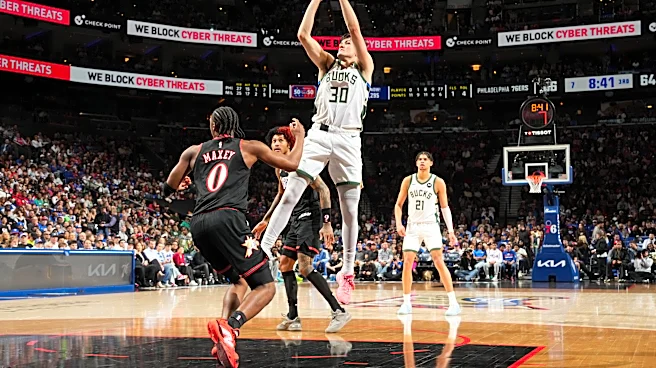
Offensively, Nance is the ultimate glue guy. Need the right extra pass? He’ll make it. Need movement off ball to free up space? Or a screen to right a broken possession? Nance has you covered. And from a process point of you, he’s elite; you’d be hard pressed to find a clip of him making the wrong decision.
He has some game too. Beyond the little things, Nance is a marksman from deep, boasting a career 42% mark from three and an elite overall true shooting percentage (career 61.8%; 63.9% last year), making him both a valuable spacer and pick and pop threat. In turn, he’s a fine cutter, timing his off ball movement well, and a savvy passer who seldom turns it over (11.6% turnover rate). But he almost never gets to the line—just 11 times last year and 15 total in 68 career games—and can too easily become Hollow Man. But, hey, that’ll happen when you’re limited to a lowly 13.5% usage percentage.
On the defensive end, Nance is, you guessed it, solid. He won’t wow you with on-ball thievery or come-out-of-nowhere blocks, but he’ll hustle and play the angles and fight hard. Having said this, his board work leaves a lot to be desired. Last year, his total rebound percentage (9.6%) was closer to his point guards than his bigs: Cole Anthony was at 9.3%, Kevin Porter Jr. 8.9%, and Ryan Rollins 8.0%, while Jericho Sims was at 15.9% and Myles Turner 11.2%. Part of this is size, part of it is athleticism. Both of these contribute to Nance’s pedestrian block (1.9%) and steal (0.9%) rates, too, and also limit his defensive versatility—he’s not someone who can guard up or down all that effectively. But, again, he’s steady, thanks in large part to his nous.
So, while Nance may be destined for an NBA career in and out of proverbial health care, it’s fitting. Primum non nocere.
Pete Nance does no harm.
Now that Nance has flatlined, who’s next?