



Under Sean McDermott, the run defense was always a distant second priority to the pass defense. While I do vehemently defend the notion that pass defense is more important, things can get out of hand. The 2025 season was when I think many of us felt the run defense needed some attention. The recent addition of Mike Danna got me thinking about it some more so I decided to do a deep dive on third down run defense in particular, and…
It ain’t good.
Lay it on us, how bad was it?
You’re likely used to seeing some of the stats on the Buffalo
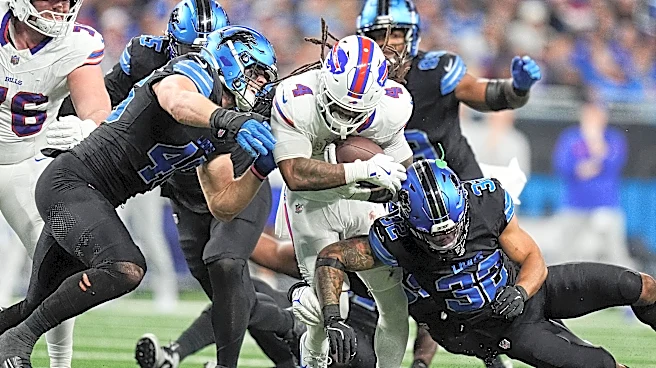
Bills defense and specifically run defense. Like how they allowed 136.2 yards per game, 28th in the league. Or worse yet, their 20th ranked yards per play allowed sitting at 5.14 yards per attempt. I’m going to level with everyone though. I’m OK with a few big runs making those numbers look worse. I’m fine with a subpar rushing yards per attempt or game stat. Not THIS subpar mind you, but run defense isn’t my big priority.
For context into that thought process, as bad as those numbers are, the Buffalo Bills were only 1.5 points per game allowed away from average. Let me clarify that further, that’s 1.5 points allowed LESS than league average, aka on the right side of average. They ranked 12th in that metric which most experts tell me is pretty important. They were 13th in points per drive and less than two percentage points away from perfectly average when it comes to third-down conversion rate.
We’ll come back to conversion rate in a moment. The point I’m getting at is even one of their worst run defenses in the entire McDermott era did not tank the entire team defense. It merely resulted in average play. So about that third-down conversion rate…

OK, what the heck is that chart? As noted above, I don’t mind subpar rushing defense, but one thing that will always bother me is giving up conversions on third down. So when a team is particularly bad at this, it’s a big deal to me. The Bills were particularly bad when it came to run defense on third and short.
That was pretty easy to determine. Take a look at the highlighted Bills line and see the 96% conversion rate against them on 3rd & 1 situations. Buffalo only stopped one 3rd & 1 rush attempt in the entire regular season. That’s not a bad reflection of their total 3rd & 1 performance either as teams only attempted a pass three times (sixth fewest attempts against in the NFL). The 3rd & 1 is the most important set of numbers here as the other distances don’t have anywhere near as many data points for most teams.
I point that out because you might think that a rush on 3rd & 1 is pretty automatic. Not so. Those scenarios equated to an average league-wide conversion rate of 72%, but the Bills were abhorrent in this area. On 3rd & 2 and 3rd & 3, while the data points are few enough where validity starts to tank, you still can’t hide the fact that Buffalo was simply not good at defending “and short” situations against the run when it truly mattered.
So how did Buffalo’s third-down conversion rate end up pretty average? Shockingly enough, the Bills forced more “and long” situations than I would have figured. The most common distance for rushing attempts against Buffalo was 3rd & 1 with 23 attempts. At six attempts against them, 3rd & 2 was the second-most common distance.
Now compare that to 3rd & 10 or longer. Buffalo forced 58 attempts at 3rd & long. Pass attempts beyond 3rd & 5 for Buffalo were largely a success. No distance beyond 5 yards had greater than a 43% success rate.
The Sean McDermott era is now in the past with the Joe Brady tenure just beginning with defensive coordinator Jim Leonhard likely to bring change. I don’t need him to bring a dominant run defense with him, but I sure as heck wouldn’t mind a massive improvement on third and short.