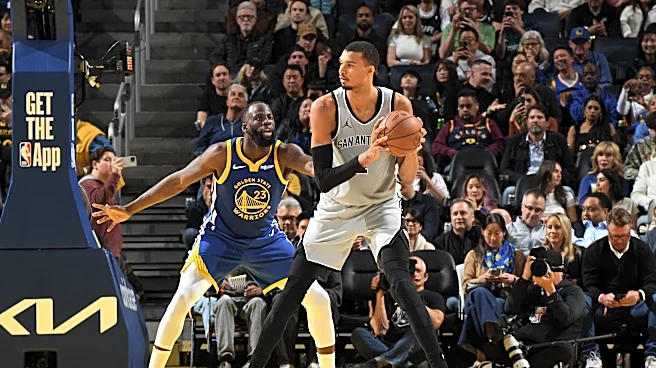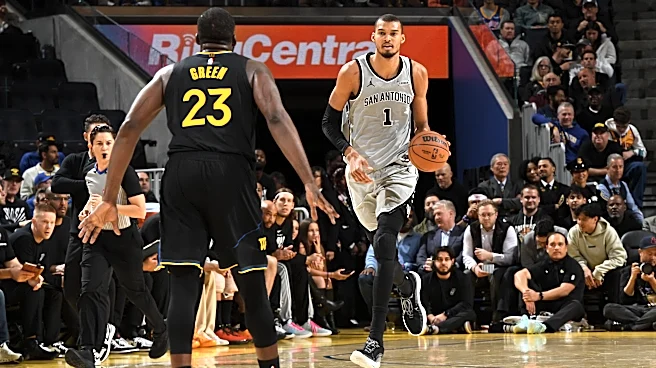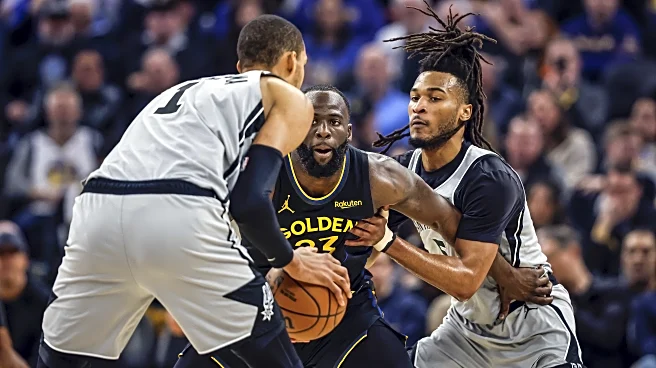




If I wanted to make this post as short as possible, I would simply direct you to my last article covering the Spurs’ win over Chicago, as superficially these two games have some striking similarities. This includes very similar final point totals (129-114 vs. the Bulls, 127-113 vs. Golden State) and almost mirrored box score stats from Wemby. Furthermore, both games felt kind of similar as I was watching them, in that the Spurs seemed to be comfortably in control most of the time, but not winning
by as much as they should be. In the case of Chicago, San Antonio’s slow start was a letdown; last night against the Warriors, the smudge on the crystal was a disappointing third quarter.
I must remind myself to be more appreciative. After all, the Spurs have been collecting double-digit losing streaks for much of the past several seasons, so complaining that their current easy victories aren’t always perfectly crafted for all 48 minutes while they are on their second double-digit winning streak of this season betrays a lack of perspective that I’ll have to work on. This is especially true given that each minute with Victor on the floor is becoming increasingly jaw-dropping, and the box scores produced continue to contain many interesting highlights:

- Another similarity between this game and the contest against the Bulls was the Spurs’ foul excellent foul differential (-6 in both cases). This was the driving force behind San Antonio generating a +12 FTA margin. Although the Spurs’ FT% was slightly worse than Golden State’s (-3.33 percentage points), their substantial advantage in volume allowed San Antonio to score nine more points from the charity stripe.
- Edges in offensive opportunity were a common theme for the Spurs in this game, partly due to the Warriors’ proclivity for fouling, but also because of San Antonio’s advantage in boards (+9 TRB, +6 ORB) and their shot selection. Ultimately, the Spurs enjoyed FGA, 3PA, and FTA margins of +7, +12, and +12, respectively. Since the start of the 2012-2013 season, there have been just 12 other regular season games (out of 16,811) in which the winning team had differentials as large or larger in all three of these areas.
- Unfortunately for San Antonio, most of the team outside of Wemby was lacking in shooting efficiency relative to Golden State, which managed to shoot 48.84% from the field and 40% from distance despite missing almost all of the most critical players in their rotation. In fact, since the start of 2012-2013 just ONE other regular season victor has won by 14+ points with FG%, 3P%, and FT% differentials as bad or worse than -1.53, -8.09, and -3.33 percentage points, respectively. That other occurrence was an April 2, 2019 game in which OKC triumphed over the Lakers 119-103.
- Despite this lack of efficiency, San Antonio’s edge in volume won out, as the Spurs managed to build on their advantage from the free throw line by outscoring the Warriors by five from the field.
- Bonus fact #1: Last night, Victor Wembanyama became just the eighth player since the start of the 1996-1997 season to score 41 points in a regular season game in under 30 minutes of play with no more than 22 FGA and eight or fewer FTA. This has actually happened nine times overall since 1996-1997, with Klay Thompson being the only player to accomplish the feat twice.
- Bonus fact #2: Not really related to anything, but Shai Gilgeous-Alexander has never scored 41 points in under 30 minutes of play, and in the 22 games where he has scored that much his minimum number of free throw attempts has been nine.
What are Team Graded Box Scores?
Very briefly, these box scores grade winner-loser differentials for basic box score statistics, with the grade being based on the winning team’s differential relative to other NBA winners during a defined reference period. Think of it like a report card for understanding how a given winner performed relative to other winners. The reference period used runs from the start of the 2012-2013 season to the latest date of play, including only games in the same season category (i.e., regular season and playoff games are not compared to each other).
Data Source: The underlying data used to create these box scores was collected from Basketball Reference. In all cases, the data are collected the morning after the game is played. Although rare, postgame statistical revisions after data collection do occur and may affect the results after the fact.