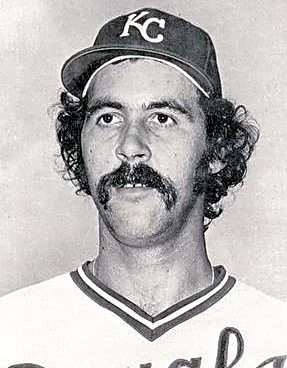

In the late 1970s and early 1980s, there was perhaps no better rivalry in MLB than the Yankees and Royals. They seemingly met every postseason in the ALCS for the right to represent the Junior Circuit in the World Series, the Yankees usually coming out on top of those yearly meetings. A mainstay of those matchups, and one of the few players to play for both teams during that period, the Yankees chapter in Doug Bird’s story was one of unfortunate timing.
James Douglas Bird Born: March 5, 1950 (Corona,
CA) Died: September 24, 2024 (Asheville, NC) Yankees Tenure: 1980-81
James Douglas “Doug” Bird was born on March 5, 1950, in Corona, CA. He was an accomplished high school pitcher whose six-foot-four frame and live arm enticed scouts before even applying to college. He has the rare distinction of being one of the few players drafted four different times. Cleveland attempted to draft him in the 29th round of the 1968 MLB June Amateur Draft directly out of Pomona High School, but he turned down that offer. Seven months later and after moving to Louisville, KY, the Seattle Pilots selected him in the eighth round of the secondary phase of the 1969 MLB January Draft, but again he declined. That summer in the June Amateur Draft, the Pilots again selected him in the eighth round only to have their advances rebuffed.
Bird enrolled in Mount San Antonio College in Walnut, CA, in 1969, right around the time of the MLB expansion that saw the establishment of the Royals, Pilots, Padres, and Expos. Only after a conversation with Royals scout Spider Jorgensen which convinced him that he “had a better shot signing with an expansion team than going to four years of college,” did Bird acquiesce, and he joined the newly-minted Royals in the third round of the secondary phase of the 1969 June Amateur Draft.
Bird debuted as a starter in the minors and experienced immediate success, pitching to a 1.84 ERA with 149 strikeouts in 147 innings with Class-A Waterloo. The following year, he repeated the level and won 15 games while pitching to a 3.41 ERA across 182 innings. 1972 saw the beginning of his transition to the bullpen, and by the time he hit Triple-A at the end of the season, he was used exclusively as a reliever.
Not expected to compete for a roster spot in 1973, Bird forced his was into the the conversation by pitching 13 scoreless innings in spring training including a combined no-hitter of the Tigers alongside Steve Busby. Needing bullpen help at the end of April, the Royals handed Bird his MLB debut on April 29, 1973, and he pitched a scoreless two-thirds of an inning in the sixth against Detroit. With some major league experience under his belt by the time summer rolled around, Bird was handed the closer role. Despite some initial struggles, Bird finished off his debut campaign strong with the Royals embroiled in the heat of a pennant race in the AL West. He made 54 relief appearances in the regular season, with a 2.99 ERA in 102.1 innings while finishing fourth in the AL with 20 saves, leading manager Jack McKeon to say of his rookie pitcher, “There’s no question about it, Bird’s our No. 1 reliever.”
Though his save totals declined in the next two seasons, Bird remained a reliable reliever for Kansas City, pitching to a 3.00 ERA, 3.09 FIP, and 226 strikeouts across 160 appearances totaling 300 innings in his first three seasons in the bigs. With the acquisitions of relievers Marty Pattin and Mark Littell and given Bird’s ability to throw multiple innings in relief, Bird was inserted into the starting rotation in 1976. He led all AL starters that season with a minuscule 3.8-percent walk rate, finishing the year with a 12-10 record in 39 appearances (27 starts), pitching to a 3.37 ERA in 197.2 innings.
His Royals finally made the playoffs after several seasons of just missing out on the AL West crown, beginning a three-year odyssey of matching up against the Yankees in the ALCS. He made his lone appearance of that series in Game 4, brought on in relief of Larry Gura in the third, after the starter surrendered a pair of runs. He held the Yankees to a run in 4.2 innings, allowing his hitters to ambush Catfish Hunter and Dick Tidrow for a 7-4 victory to send the series to a winner-take-all Game 5, when Chris Chambliss hit his iconic walk-off home run to send the Yankees to the Fall Classic for the first time in 12 years.
Bird returned to the bullpen in 1977 reprising his role as a multi-inning reliever. He still managed to finish with a team-high 14 saves, going 11-4 in 53 appearances with a 3.88 ERA in 118.1 innings. He met the Yankees again that postseason and this time appeared in three games. He recorded the final three outs of the Royals 7-2 win in Game 1, but wasn’t as effective in his subsequent two appearances. In Game 4, he entered in the ninth with Mickey Rivers on third and one out and gave up a sac fly to Thurman Munson for a crucial insurance run in an eventual 6-4 Yankees win to force a Game 5. Then in that decisive final game of the series, Bird came on in the eighth with a runner on first an no outs after Willie Randolph led off with a single. Bird surrendered back-to-bacl one-out singles to Lou Piniella and Reggie Jackson, the latter plating Randolph to pull the Yankees to within one, 3-2. In the top of the ninth, the Yankees scored three runs off three different relievers to win the game, 5-2, and earn the chance to avenge their World Series defeat the year prior.
The following season saw Bird’s first real struggles in a Royals uniform, fully demoted from the ninth inning after Kansas City acquired closer Al Hrabosky in the offseason. He made 40 appearances and saw his ERA balloon to 5.29 in 98.2 innings, but he and the Royals still earned a ticket back to the ALCS and a rematch with the Yankees. His first appearance that series was a scoreless ninth inning in Game 1, brought in to get some work in with the Yankees winning big, 7-1. After the Royals leveled the series at a game apiece, Bird was called on again in the bottom of the eighth of Game 3. The Royals were leading, 5-4, but Paul Splittorff allowed a one-out single to Roy White, prompting Whitey Herzog to call upon his former closer. Bird sailed two fastballs out of the zone to Thurman Munson, but couldn’t sneak a third one by him, the Yankees captain crushing a 2-0 elevated heater out over the plate to the deepest part of the ball park, the ball sailing over the 430-feet sign in left-center for the game-winning two-run blast.
That would turn out to be the final pitch that Bird would throw in a Royals uniform, Kansas City trading him to the Phillies the following spring for prospect Todd Cruz after Philly suffered several injuries in their bullpen to open the season. he departed as the Royals’ all-time leader in appearances with 292. His fortunes wouldn’t improve pitching in a new city and new league, missing a month with shoulder soreness and finishing with a 5.16 ERA in 32 appearances totaling 61 innings. Philadelphia released him the following spring, allowing the Yankees the opportunity to sign a pitcher who had postseason success against them.
Bird remained in the bullpen in his first season in the Bronx and finished as the team’s third-best reliever in terms of ERA (2.66), behind only Goose Gossage and Rudy May. As it happens, the Yankees would get swept in three games in the ALCS by Bird’s former employers, the erstwhile Royal not making an appearance that postseason, but 1980 still helped to rejuvenate his career.
The following season saw Bird post his best start to a season in five years, Bird pitching to a 2.70 ERA in 17 appearances. He even earned a move back to the rotation, where he won a pair of decisions before the players’ strike brought the season to a screeching halt. When the strike was lifted, the first-place Yankees traded Bird to the Cubs for Rick Reuschel, Chicago pursuing the deal under the mistaken belief that top prospect Pat Tabler would be included as a PTBNL. Bird pitched exclusively as a starter for the Northsiders, logging a 3.58 ERA in 12 starts lasting 75.1 innings. Between the Bronx and Chicago, he made 16 starts out of 29 total appearances, going 9-6 with a 3.22 ERA and 3.42 FIP.
1982 saw Bird remain in the Cubs’ rotation as a full-time starter, but his best days were behind him. In 33 starts, Bird went 9-14 with a 5.14 ERA in 191 innings and an NL-worst 26 home runs, though he did lead all of MLB with a 3.7-percent walk rate. That winter, the Cubs traded Bird to the Red Sox for pitcher Chuck Rainey, and things only got worse in Boston. After pitching to a 6.65 ERA in 22 appearances (six starts), the Red Sox granted Bird his release at the end of the season, and he announced his retirement at the age of 33.
After a short stint in the Senior Professional Baseball Association in the late-80s, Bird retired to Southwest Florida, where he offered pitching lessons and free cage time to underprivileged and special needs children at a gym he converted into a batting cage. He passed away in Asheville, North Carolina on September 24, 2024, at the age of 74.
Bird’s relationship with the Yankees was characterized by unlucky timing. He played for the Royals teams that were the perennial losers to the Bombers in the ALCS. When he finally joined the Yankees, it came just after their championship years of that era. And when he finally had a chance to make it to the World Series in 1981, the strike interrupted his season and led to his trade from a title contender to the hapless Cubs. All the same, he was a serviceable pitcher for the Yankees in his year-and-a-half with the team, though he is more known for his postseason performances against them. He appeared in six playoff games in his career, all with the Royals against the Yankees, and he held the Bombers down to the tune of a 2.35 ERA and 1.87 FIP in 7.2 innings.
References
Doug Bird. Baseball-Reference.
Doug Bird. Baseball Almanac.
Gazdziak, Sam. “Obituary: Doug Bird (1950-2024).” RIP Baseball. November 15, 2024.
See more of the “Yankees Birthday of the Day” series here.