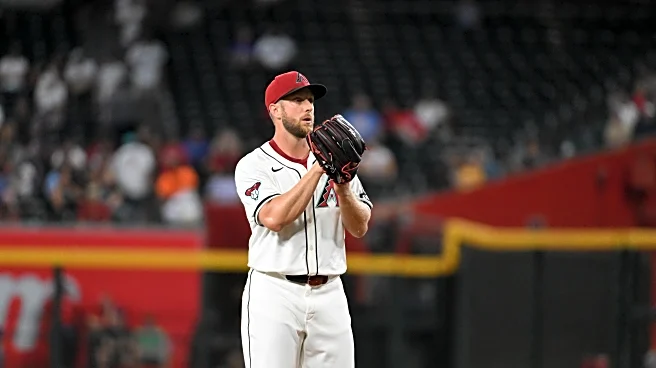

In one of the less surprising free-agent signings of the winter, Merrill Kelly has returned to the desert, signing a two-year contract with the Diamondbacks, for a reported $40 million. It’s a deal which
both sides had clearly been keen on pursuing, even before Kelly was dealt to the Texas Rangers at the deadline. The pitcher and his family are settled here in Arizona, and this new contract means they’ll get to stay here, potentially through the end of Kelly’s career – he’ll turn 39 before he hits free agency at the end of 2027. Merrill also gets a well-deserved payday, earning more between now and then, than he has over the entirety of his major-league career, which started in 2019.
Does this mean the Diamondbacks are done seeking starting pitching? The messages on that seem to be a little mixed. They do have an obvious rotation for Opening Day next year: Kelly, Eduardo Rodriguez, Ryne Nelson, Brandon Pfaadt and the other recent signing Michael Soroka. With Corbin Burnes hopefully returning in the middle of the year, that might be it. However, the fall-off after those six is certainly steep, in terms of both experience and performance. Ironically, not much further down the depth chart are two starters received from the Rangers for their short-term loan of Kelly, Kohl Drake and Mitch Bratt. But they only have 34 IP above Double-A between them.
I also note the team’s recent signing of José Urquidy, but he has not been effective in the majors since 2022. So it is possible the Diamondbacks may still look to add another starter, to counter the lack of depth. On the one hand, doing so would likely bump Soroka to the bullpen, and $7.5 million is an awful lot to pay someone to start the year throwing long relief. However, the odds are that the five-man rotation we see on Opening Day is going to be disrupted quickly. This year, a sixth starter was first used by Arizona on May 5, and that is later than usual (it happened in 2024 on April 19; 2023 = April 12; 2022 = April 17; 2021 = April 10).
My immediate reaction to this signing was it filled the most obvious hole on the roster, and so made the trade of Ketel Marte less likely. But the team will likely still be listening to trade offers for the three-time All Star. I note that Steve Gilbert wrote – and if anyone should know, he probably would – “sources indicated the signing of Kelly doesn’t have a big impact on that happening one way or the other.” That gives me pause for thought. I would be stunned if Marte was dealt for a high-leverage relief pitcher, perhaps the team’s greatest remaining area of need, even one with years of team control. Are they wanting another starting pitcher? Or perhaps a long-term solution at third-base?
Certainly, the financial side of things would appear to have become tighter. Payroll guru Jack noted after the signing of Soroka, “They likely have somewhere between $20-$30 million left to add to payroll in a year they are expected to reduce from their franchise record payroll of 2025.” We still don’t know what the breakdown is on Kelly’s contract. Is it back-loaded? Are there possibly even significant deferrals, as there were in the Marte extension? But if it is a straight $20 million per year, that would eat up most or all of the expected room to expand payroll. We can likely kiss goodbye any dreams of signing Pete Fairbanks, given how the relief market has inflated this winter.
That would leave trade scenarios as the way forward there for GM Mike Hazen. Whether that involves Marte or other trade pieces, remains to be seen. I can imagine us shipping out Alek Thomas or Jake McCarthy in exchange for a bullpen arm. Obviously, you’re not going to get a closer with a proven track record for either of those players. But as we’ve noted previously, high-priced relievers are often a waste of resources. I’d be fine with Hazen beefing up the bullpen with lower tier arms, who have a chance of performing above value. The signing of Shelby Miller, and his rise from non-roster invitee to reliable closer, is the poster child for that approach done right.
However, we should still bear in mind that the D-backs rotation, as currently constructed, is not likely to be very good. We have Kelly, Pfaadt and Rodriguez returning from last year, when the rotation finished 19th by ERA and 21st in fWAR. If you squint with some optimism, you can see the Nelson/Burnes combination next season, perhaps matching what the Burnes/Nelson combination delivered this year (34 starts and an ERA of basically three). Soroka will then replace Zac Gallen: normally, that’d seem unlikely, but Gallen only had a 4.83 ERA. Soroka should be able to improve on that: however, it doesn’t like it’ll move the needle much. Pfaadt and E-Rod pitching better might be our best hope. But is it realistic?
Right now, it feels like the rotation is probably going to be mediocre again. The bullpen (27th by ERA, 28th by fWAR) represents a much greater opportunity for gains, and we have not seen any significant activity on that front yet. We have fully documented, to ‘dead horse’ levels, Hazen’s previous struggles in that department. We will have to wait and see what approach he takes this winter. It could potentially be a last hurrah for him and manager Torey Lovullo, if the Diamondbacks end up below .500 once again.