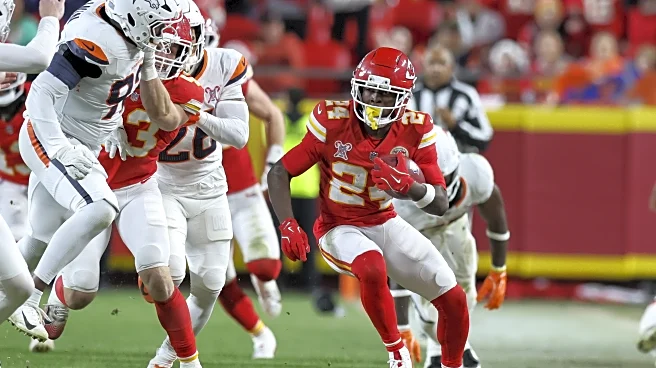


Without multiple starters on both sides of the ball last Thursday night, the Kansas City Chiefs dropped a 20-13 decision to the Denver Broncos.
Early in the second quarter, rookie running back Brashard Smith scored the Chiefs’ lone touchdown on a five-yard pass from quarterback Chris Oladokun. It marked the first score of Smith’s career, offering a glimpse of how his skill set can translate at the NFL level. While his overall stat line Thursday night was modest, both this game and his broader 2025
tape clarify how Kansas City can deploy him moving forward.
Let’s take a look.
Season production
Smith’s overall offensive workload was limited this season. He logged 157 offensive snaps and added 44 more on special teams. Across rushing, receiving, and return duties, he totaled 801 all-purpose yards, with more than half of that production coming on kickoff returns.
Within the Chiefs’ offense, Smith functioned far more as a passing-game weapon than as a traditional running back, finishing the season with 23 receptions (on 31 targets) but only 32 rushing attempts. Given his background as a wide receiver at Miami and SMU before transitioning to running back, the coaching staff tailored portions of the game plan to highlight his strengths. With Kareem Hunt and Isiah Pacheco also in the backfield, Smith’s true offensive touches were naturally limited.
Even so, compared to his backfield counterparts, Smith brings a level of speed and juice that no other running back on the roster offers — a trait that should translate into a larger role in 2026.
Pass catching
Smith’s pass-catching ability was his most impactful addition to the offense in 2025, and Kansas City consistently found ways to use him out of the backfield to move the chains.
To score his first career touchdown, head coach Andy Reid leaned on a familiar concept designed to isolate a running back in space near the goal line. Reid has relied on this running back leak concept in short-yardage and must-have situations. The design uses misdirection to pull defenders out of position and requires a back who can secure the catch in space and create after it.
As we see here, Smith motions into the backfield before the snap. Then he runs through the B-gap before releasing to the flat, while both outside receivers break inside. The action slows the Broncos’ linebackers responsible for tracking him.
Smith secures the pass and turns upfield as the defense closes in. As a linebacker meets him near the goal line, Smith dips his shoulder — flashing impressive flexibility and contact balance to finish the play.
These are the types of designs Reid teased throughout the season with Smith. He also incorporated him into the screen game.
Smith nearly pulls off this screen pass for a significant gain, but is brought down before he can fully accelerate. The play blends a traditional screen look with a Texas route, as Smith initially breaks toward the flat before snapping inside on an angle route while the offensive line releases into its blocks.
Smith can’t quite break free and is held to a minimal gain, but the design and timing are there.
Kansas City used the same concept earlier in the season with Smith, but a penalty wiped out a much bigger gain.
Compared to previous seasons, the Chiefs’ screen game was largely absent in 2025. Even so, it was clear Reid only trusted Smith with several of these designs.
Juice
The Chiefs lacked “juice” in multiple areas in 2025, but the absence of explosive plays was especially noticeable on offense and special teams.
Smith didn’t have many chances to generate big plays on offense, but he maximized his limited opportunities as a punt returner in Week 17.
The only punts Smith returned all season came Thursday night. On his second return, he showcased his burst, vision and balance as he helped set up the Chiefs to score points. Those traits stood out in a way no other player on the roster consistently matched. During his college career, Smith returned only five punts across four seasons, but with more experience, that role could expand.
True rushing attempts
Smith did not record a rushing attempt against Denver — and on the season, averaged just three yards per carry. He did, however, provide Kansas City with an option to attack outside the tackles.
Neither Pacheco nor Hunt consistently threatens defenses on outside runs at this stage of their careers, but Smith has the quick-cut ability and acceleration to stress the edge.
So far, the sample size is small — but this is an area where Smith should continue to contribute in 2026.
The bottom line
The Chiefs’ running back room is likely to look very different in 2026, but Smith should remain part of that picture. While he is unlikely to become an every-down back, his speed and explosiveness address an element the offense lacked in 2025 — and make him a valuable change-of-pace option.
If Smith continues to earn the trust of the coaching staff, his career is headed in the right direction.