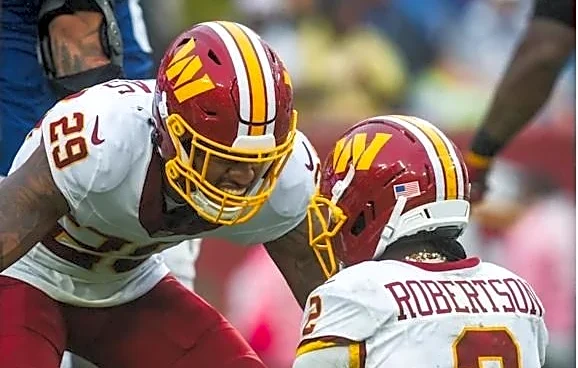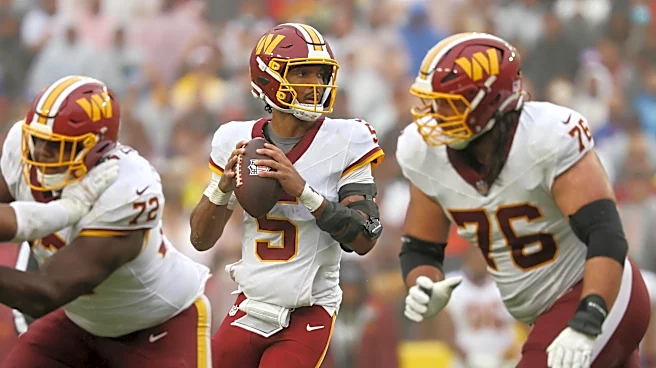



Jayden Daniels’ return to the lineup against the New York Giants was nothing short of impressive. While his legs helped keep Washington’s offense afloat, accounting for 103 rushing yards and two touchdowns, his efficiency as a passer was just as dangerous. Daniels’ 199 passing yards may not jump off the stat sheet, but he completed 68% of his passes, finishing with 17 completions. His decision-making, aggression and ball placement kept the offense moving and demonstrated how dangerous he can be when
he’s operating at full strength.
As Washington prepares for Monday night’s matchup against the San Francisco 49ers, who enter the game ranked sixth in the NFL in total defense by yards allowed per game, Daniels will need to maintain that dual-threat ability to give the Commanders a chance to secure their second win of the season.
Mental processing and pocket patience
On the first drive, Washington lines up in 12 personnel (one running back and two tight ends) against the Giants’ base 3-4 defense. After gaining 13 total yards on its first two plays, Washington faces second-and-8. Daniels does an excellent job processing the Giants’ coverage both before and after the snap.
The Commanders run a switch-release concept with their tight ends against a Cover 4 structure, with two deep safeties. Ben Sinnott does an excellent job driving the cornerback upfield and away from Chig Okonkwo, who takes the inside release and runs a seam route. The Giants maintain their coverage structure after the snap, leaving the middle of the field open and giving Daniels an immediate answer.
With the offensive line providing adequate protection, Daniels has enough time to stay with his primary read. He simply needs to deliver the ball beyond the linebacker and into Okonkwo’s path. His recognition of the coverage and ability to exploit the space allow Washington to capitalize on the defensive look.
Leverage processing and elite placement
Washington returns to 12 personnel on this next play, which comes at the start of the fourth quarter with the Commanders facing first-and-10. Daniels’ trust in Terry McLaurin is evident, but this completion stands out because he quickly processes defensive leverage and delivers the ball with precision.
Washington runs a dagger concept involving Ben Sinnott, Treylon Burks, and McLaurin. McLaurin wins at the top of his route, gaining inside leverage against his defender as he breaks toward the middle of the field. Meanwhile, the Giants use edge rusher Kayvon Thibodeaux to account for the seam threat, dropping him into hook coverage.
Daniels recognizes that Thibodeaux’s positioning leaves him unable to contest McLaurin’s dig route effectively. At the top of his dropback, Daniels delivers an on-time and accurate throw into a tight window and gets the ball out on schedule. It’s an excellent example of his ability to read leverage, trust his receiver and attack a defense before it can close the throwing lane.
Reading progressions
On the next example, Washington uses 11 personnel from an empty formation. Daniels begins his progressions toward the boundary, where McLaurin and Antonio Williams run corner and hook routes, respectively. The Giants’ deep-third and flat defenders effectively eliminate those initial options, forcing Daniels to work his progressions further.
That’s where the route combination between Okonkwo and Burks becomes important. Their routes create a two-level read, putting linebacker Tremaine Edmunds in a position where his decision determines Daniels’ next move. Edmunds stays with Okonkwo, opening the middle of the field for Burks.
Daniels recognizes the opening and delivers an accurate pass to Burks for a first down. It’s another example of his composure and processing ability. He doesn’t force the ball to his initial reads, instead allowing the coverage to dictate where he goes next.
Daniels delivered an impressive performance against the Giants, making Washington’s final overtime sequence all the more frustrating. His ability to threaten the Giants’ defense as both a passer and a runner gave the Commanders chances to win, but the game ended in a tie.
The encouraging takeaway for Washington is that a healthy Daniels gives the team a chance to compete every week. His performance against New York showed that he can win with his arm, punish defenses with his legs, and consistently make the decisions necessary to keep the offense on schedule. The challenge now is turning those flashes into a more complete offensive performance, especially with a tough matchup against San Francisco ahead.
In the full Trap or Dive film session below, I break down Daniels’ performance against the Giants, including his work as a passer and runner, as well as the areas where Washington’s offense fell short under first-year offensive coordinator David Blough.
Comment and let us know your thoughts on the state of the Commanders offense. Don’t forget to also subscribe to the Trap or Dive Podcast.