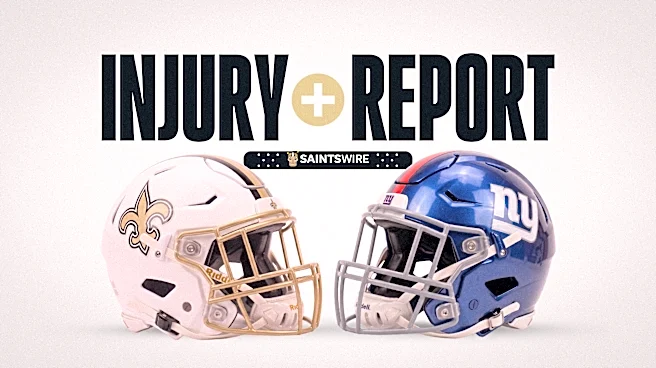




The New York Giants enter Week 6 as the leaders of the NFC East and return home after a Week 5 tie to face the New Orleans Saints.
This game marks the third time in three weeks that the Giants will underdogs to a last place team, as the 3-1-1 Giants are 1.5-point underdogs at home to the 1-4 Saints.
The Giants come into the game still looking to have their first complete performance since starting QB Jaxson Dart was lost for the season. the Giants are 2-0-1 since Dart was lost in Week 2, but have escaped
losses by the skin of their teeth each time.
The Saints, meanwhile, are reeling after a 23-13 loss to the Minnesota Vikings that saw the Vikings shut down the Saints’ offense. Can the Giants take lessons from the Vikings’ league-leading defense and get off to a fast start against New Orleans’ offense?
Stats that matter

What the Saints do on offense
When it comes to the passing game, Kellen Moore’s offensive philosophy has historically been a blend of the Air Coryell and West Coast schemes. He’s added modern twists and updates to those venerable schemes, but the foundation is the use of a West Coast quick game with Air Coryell style vertical concepts when opportunities present themselves.
They mix and match condensed and spread formations, while also asking Shough to work from under center as well as out of the shotgun. They typically use motion on nearly every play, as well as use bunch or stack sets to help secure clean releases for their receivers. The West Coast roots of the offense are evident in the structure of Moore’s passing play design. He frequently calls route concepts designed to create traffic or conflict at the second or third levels, and create receiving windows that his pass catchers can exploit.
Moore’s passing concepts frequently seem to feature half-field reads against the Minnesota Vikings, though that could be an attempt to counter the Vikings’ blitzing defense (more on that in a bit). Shough is capable of making full-field progression reads and the offense does ask him to do so, however half-field reads and quick-game passing concepts seem to be the bread and butter.
In that vein, there are instances where Shough can lock on to receivers or stare down spots from the snap, which could be an opportunity for the Giants’ opportunistic defense.
The Saints’ offense makes relatively frequent use of their tertiary receivers in the passing attack. Wide receiver turned tight end Juwan Johnson is Shough’s third-most targeted option, averaging just over 6 targets per game, while Alvin Kamara is fourth and averaging four targets per game. Both players serve as primary options in passing plays as well as check-down targets.
Moving to the running game, Kamara is the starter after Travis Etienne Jr. landed on the injured reserve after Week 3 with a hamstring injury. Kendre Miller is the change-up to Kamara as a power back, but both rnners have struggled to consistently produce. The 31-year old Kamara has averaged 3.1 yards per attempt this year, while Miller has averaged 2.9 per attempt.
But while Kamara was the starting running back, he only carried the ball three times against the Vikings. Miller, meanwhile, carried the ball 10 times.
Schematically, the Saints based their running game on outside zone concepts against the Vikings’ blitz schemes, however they did mix in gap schemes with pulling linemen. Both their line and Miller were more effective executing their outside zone runs.
Shough hunting
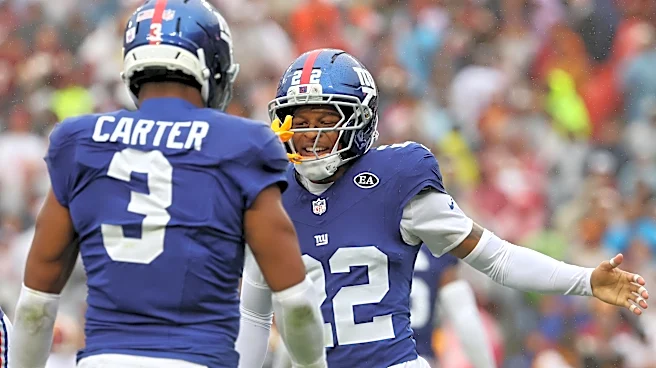
The Giants’ pass rush has been absolutely ferocious over the last two games. Abdul Carter might be the most fearsome pass rusher in the NFL right now, boasting an incredibly impressive 36% pass rush win rate despite being doubled on 40% of his rushes. His 2.22-second time to pressure is the fastest in the NFL, and he’s generating pressure — and quick pressures — at an elite rate. It isn’t a surprise that Carter also leads the NFL in pass rush wins with 31.
But while Carter is the player that that teams need to account for on every play, he isn’t carrying the by himself load both Carter and Kayvon Thibodeaux generated three quick pressures apiece, while linebacker Arvell Reese, and defensive tackles D.J. Reader, and nDarius Alexander each contributed two quick pressures. Cornerback Dru Phillips led the team with five quick pressures (and two sacks) of Jayden Daniels.
The difference over the last two weeks has been the adjustment by Dennard Wilson to use the blitz to unleash the his pass rushers. Over the last two weeks, the Giants have sent five (or more) rushers 57% of the time, and 61% against the Washington Commanders.
The Giants’ blitz rate since the second quarter against the Arizona Cardinals is (distantly) second only to that of the Minnesota Vikings. I bring that up because the Vikings gave us a blueprint for how to attack Tyler Shough and the Saints’ offense.
The Vikings sent extra rushers on 21 of 25 drop backs against the Saints, limiting Shough to just 96 yards passing (3.8 per attempt), with 2 interceptions and 1 sack.
Pressuring Shough is an excellent way to disrupt the Saints’ passing offense. Shough is, generally, an efficient quarterback who’s a favorite of offensive coaches. He is generally faithful to the structure of the offense and play design and typically doesn’t put the ball in danger. He’s a good athlete who also has a live arm that allows him to access all areas of the field.
However, Shough is, in the words of former scout Nate Tice, “Very Tua-coded” as a passer. Shough takes care of the ball, but he’s also prone to throw the ball away as a first resort. He’s below league-average in interception rate, he’s also below league average in yards per attempt and touchdown rate. He also currently has the 10th-fastest time to throw of all quarterbacks, as he would rather get the ball out or throw it away than extend the play or hold the ball for a deep pass.
The pressure and difficult coverage reads created by the Vikings’ defense brought out Shough’s tendencies to throw the ball away rather than risk going backward or turn the ball over. That’s a tendency the Giants can, and should, look to exploit with their athleticism and aggression on defense.
There are, of course, differences in how Wilson and Flores deploy their blitz schemes. Flores has woven the blitz (or five-man rushes) into the very fabric and structure of every aspect of his defense. Everything is predicated on pressure under a two-deep shell, either true Quarters coverage or Cover-2. The goal of Flores’ scheme is to create free runs for his rushers while not allowing the offense to access the deep or intermediate area of the field. This is even true for his run defense, and the Vikings frequently use the blitz to “gap out” opposing offenses and disrupt their runs.
Wilson’s blitz schemes, meanwhile, are based on using sticky press-man coverage to take receivers away while his hyper-athletic linebackers do their thing. The Giants lead the league in Cover-0 usage, calling pure man coverage at a league-high 11%. To put that in perspective, Steve Spagnuolo and the Kansas City Chiefs led the NFL in Cover-0 usage last year at just 7.6%. That’s particularly impressive considering the Giants’ defensive adjustment is only seven quarters old.
While the Vikings’ defense has been much better than the Giants, the Giants have a marked advantage in athleticism at all three levels. That could allow them to severely disrupt what the Saints want to do on defense and harass (or attack) Shough.
However, the difference in structure presents two potential areas of concern against the Saints. The first is the presence of wide receiver Chris Olave. Olave was a lone bright spot for the Saints against the Vikings, and his precision route running gives man cover corners fits. He’s also a savvy veteran who knows how to manipulate defenders to expand receiving windows as well as get calls in his favor.
The other thing to note is that the Saints didn’t deploy screen plays against the Vikings defense. The screen is one of the most effective way to slow down a pass rush, however the pure zone coverage used by the Vikings limits how effective screens can be. On the flip side, screens can be very effective against man coverage, as the sticky nature of press-man coverage also leaves defenders close to blocking receivers and takes their eyes out of the backfield.
The Giants will need to be alert to screen plays to make sure the Saints aren’t able to turn their aggression against them with their athletic skill position players.
Can the Giants stop the run?
This is, of course, the question every week for the Giants. As head coach John Harbaugh mentioned after the Giants’ tie with the Commanders, the Giants have done a solid job of stopping the run — on occasion. However, they haven’t yet found any down-to-down consistency.
When the Giants have successfully defended the run, it’s been because their stout defensive tackles have clogged the middle while their athletic defenders have penetrated and disrupted behind the line of scrimmage. However, they’ve also had a tendency to commit mental mistakes — be it poor angles, missed tackles, or both — to give up explosive runs.
Teams have also been able to exploit their perimeter with well-schemed off-tackle runs that get big blockers (such as tight ends or linemen) pulling out to their corners. We should expect the Saints to try to exploit that tendency, as it not only plays into the relative strength of their running game and the weakness of the Giants’ defense.
As mentioned above, running back Kendre Miller carried the ball more than Alvin Kamara last week, though he only has one more carry on the season than Kamara. Miller is a downhill runner and was the hot hand against the Vikings, with carries of 9, 7, and 6 yards, as well as a touchdown. He’s a similar runner to Cam Skattebo and Najee Harris with good size (6-foot, 220 pounds) and burst, but modest long speed.
If the Saints turn to Miller, they’ll likely try to get him to the edge, pairing his size and burst against the Giants’ defensive backs. The Giants, meanwhile, will need to penetrate into the backfield and disrupt Miller before he can get going.
Kamara, meanwhile, depends on his vision and short-area quickness as a runner. He isn’t as explosive as he was in his prime, but he’s still elusive enough to make would-be tacklers miss if they take poor angles. The Saints like to take advantage of Kamara’s versatility and line him up as a receiver before motioning him into the backfield. That not only helps change the math in the tackle box, but also helps to reveal the defense’s intentions. Where the Giants will be well-served to penetrate and disrupt against Miller, defending Kamara is more a matter of discipline and rallying to the ball and limiting his room to work.