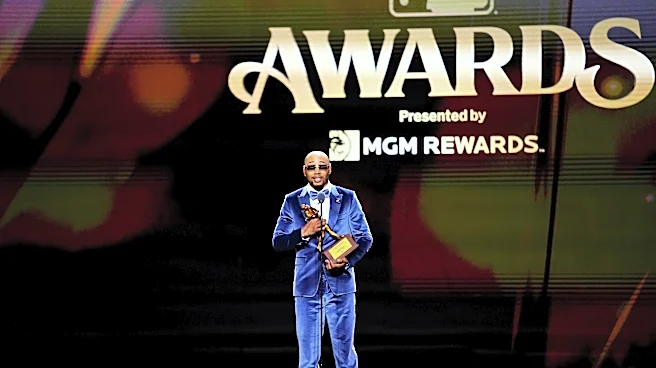


Tarik Skubal is probably the best pitcher in baseball. Since July of 2023, the lefty has posted a 2.47 ERA over 626.1 IP, backed by a 2.70 xERA, a 2.42 FIP, and a K-BB% of 26.7%, good for 21.3 fWAR. All of those metrics rank as the best in baseball over the time period in question, most by a not insignificant amount. He’s won two Cy Youngs (2024 and 2025), a pitcher Triple Crown (2024), and a record breaking $32M in his final arbitration-eligible season (2026). Skubal remains in his prime at 29 and he now
enters free agency free of the burden of draft pick compensation after being traded at midseason from Detroit to LA.
That resume arguably makes Skubal the most valuable free agent pitchers of the 2000s, if not all time. Gerrit Cole had a better platform year in 2019, but had not been as dominant over a multi-year period. Yoshinobu Yamamoto was younger but completely unproven in the majors. David Price had a longer track record of being very good but a shorter track record of being elite when he signed with Boston in 2016. Max Scherzer had a similar shape of production but hadn’t reached the highs Skubal had. Clayton Kershaw and Stephen Strasburg never reached free agency. CC Sabathia might have the most credible case, but pitching has changed so much in the last 10 – 15 years that any direct comparison to a free agent from more than 15 years ago is difficult to make. It’s unsurprising then that Skubal is expected to break all free agent contract records for pitchers, likely signing for something in the $350M – 500M range.
Despite those bona fides, I do not think this is a free agent the Mets should seriously pursue. Three primary concerns loom large; Skubal’s injury risk, the general performance of this class of player, and the Mets’ position amidst a changing CBA.
You may have noted as we lauded Skubal’s performance over the past couple years that we set a pretty arbitrary start date. That’s because Skubal missed the first half of 2023 recovering from flexor tendon surgery, which he underwent in August of 2022. Then in 2026, Skubal had another procedure, this time to remove loose bodies from his left elbow. Now, to his (and his surgeons’) credit, Skubal made a remarkably fast recovery from that procedure. But that’s two operations on his left elbow in the last four years, on top of the Tommy John surgery he underwent in college in 2016. Recall that the average shelf life of a TJS is somewhere between 5 and 10 years, a range that Skubal is now on the back end of. There are a bunch of at least orange and possible outright red injury warning signs here, even more so than for the typical pitcher.
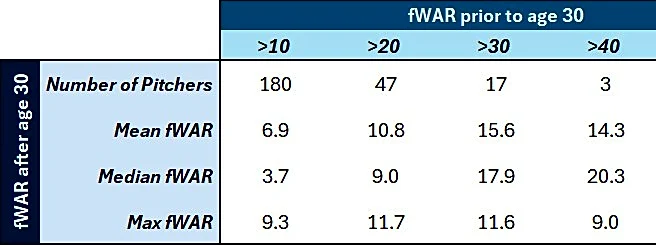
Even beyond the Skubal-specific injury risk, this class of pitchers – high-end starters entering their 30s – are a much less successful cohort than you’d expect. Here’s a view of post age-30 fWAR, segmented by the fWAR accrued prior to age 30:

Only includes pitchers who appeared in a game from 2000 – 2026
To put this into words, even if you’re a very good pitcher who has posted more than 20 fWAR prior to your age-30 season (Tarik Skubal has 24.7 career fWAR), the mean expectation of your age-30 and above career is 10.8 fWAR. It’s only a little better if we narrow things to even better players who posted more than 30, 40, or 50 fWAR prior to their age 30 season.
Sure, Justin Verlander has had an incredible run in his 30s (and 40s). So did Max Scherzer for much of the last decade. Chris Sale is still going. Zack Greinke posted nearly as many wins after 30 as he did before, and Roy Halladay in fact surpassed his pre-age-30 production. But Felix Hernandez was basically done at 30. So was Ben Sheets, and Madison Bumgarner, and Stephen Strasburg, and Brandon Webb, and Matt Cain, and Tim Lincecum. Roy Oswalt, Jake Peavy, Johnny Cueto, and David Price were just okay (<15 fWAR after age 30), and they’re roughly average outcomes for this cohort. Time and pitcher injury risk are undefeated, and the bell tolls for many pitcher’s career – or at least their time as a top-level ace – well before you’d like.
Now, we should caveat this analysis. This is an extraordinarily rudimentary look at things; more granular age cohorts or use of deeper metrics beyond surface level fWAR would surely provide a more accurate picture. This class of players also has the benefit of typically being good or injured; it’s rare that such a player is plodding along with middling but healthy production, clogging a roster spot and confounding attempts to improve the team. It’s more likely they’re either pitching like an ace or simply unavailable, and that sort of downside is preferable to the alternative.
Still, is guaranteeing a player who, by the median / mean performance of comparable players, is likely to give you ~15 wins over the remainder of their career, more than $350M a good idea? That’s more than $20M per win (again, an extraordinarily rudimentary way to look at this, but an acceptable heuristic) with significant additional downside risk, a steep price even by modern free agency standards.
Zooming out one more level, the potential changes to the CBA must be considered as well. The league’s proposals to date have included a cap-and-floor system, with a proposed cap of $245.3M. For reference, the Mets’ payroll in 2026 was more than $100M higher than that ($346.7M), and with Bo Bichette opting in none of the big money is falling off the books until next offseason.
A hard cap system is basically a non-starter for the players and it’s highly unlikely one gets adopted. There’s also a chance big spenders would be grandfathered in in some way, perhaps given a period of a few years to get below the cap. However, the current course of negotiations is headed towards harsher penalties – likely draft pick based – on the highest spending teams. If you’re the Mets, and you’re guaranteeing nearly $100M per year to Juan Soto and Francisco Lindor for the next 5 years and have other gaps in the roster that still need to be filled, cramming in yet another top-of-the-market deal seems foolhardy, if not downright impossible.
So yes, Tarik Skubal is quite possibly the best starter in baseball, and having him on the 2027 Mets would be both very fun and beneficial to the Mets’ World Series chances. But the combination of injury risk. cohort performance, and broader roster construction implications makes this one opportunity the Mets should probably pass on.