





The San Francisco Giants kicked off the two-day 2026 MLB draft with an exciting Saturday, picking up five names who could be key players for years to come. They used their highest pick since 2018 on Santa Barbara pitcher Jackson Flora, before adding a pair of prep pitchers — Carson Bolemon and Kaden Waechter — with the No. 29 and 55 picks. In the third round they made a splash with outfielder Peyton Bonds, Barry’s nephew, and rounded out the day with Hofstra pitcher Carlos Martinez in the fourth
round.
Sunday doesn’t have as big of names, but what it lacks in quality it certainly makes up for in quantity, with 16 picks ahead for the Giants. Here’s a roundup of what they did in rounds 5-10, when they stayed pitcher focused; stay tuned for rounds 11-20 later in the day!
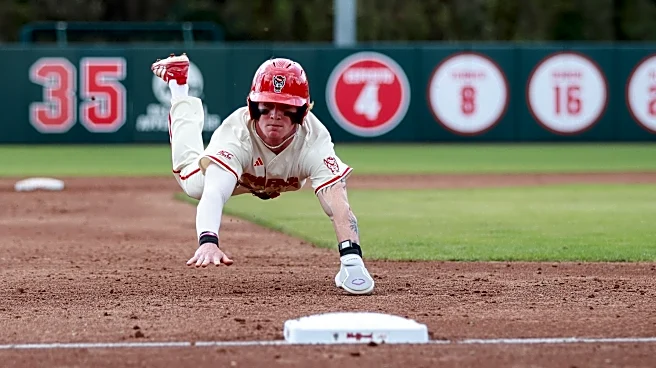
With their first pick of the day, in the fifth round (No. 150 overall), the Giants went for another player with a baseball bloodline: North Carolina State second baseman Luke Nixon. The son of Trot, a 12-year MLB veteran who had a very memorable decade-long stint with the Boston Red Sox, Luke is a contact-over-power left-handed hitter. He’s fairly small, listed at 5’10 and 162 pounds despite quickly approaching his 22nd birthday. Despite that slight frame, and despite the lack of power on the scouting report, he did hit nine home runs in 56 games last year in the ACC.
Nixon’s junior season was very strong, as he hit .367/.452/.595, good for a 1.048 OPS and a 129 wRC+ with a 14.0% strikeout rate, which earned him a ranking at No. 234 on Baseball America’s big board, as well as second team All-ACC honors. He’s a smooth fielder at second base and makes good swing decisions, and the Giants surely like his contact skills. Definitely a very Giantsy pick! That said, he seems likely to be an underslot selection, with the slot value for the No. 150 pick sitting just shy of $500,000.
In the sixth round, with the No. 179 pick, the Giants went back to the pitching well, taking McNeese State right-hander Eric Nachtsheim. Like many pitchers taken in this area of the draft, Nachtsheim has some brilliant stuff, but is a bit too hittable. Despite not playing in a great conference (he was first team All-ACCAC), Nachtsheim had a 3.60 ERA and a 4.13 FIP this season, the result of allowing 72 hits and 13 home runs in 85 innings. But living in the strike zone had it’s benefits, as he had a blissful 125 strikeouts in those 85 innings, with only 21 walks all year.
The big question for Nachtsheim is if he can develop any secondaries. To this point, he has an excellent fastball, which is mid-high 90s with strong movement and deception, and excellent command. That fastball earned him a ranking of No. 174 on Baseball America’s big board, and No. 213 on MLB Pipeline. But right now, it’s considered his only plus pitch, and possibly even his only playable pitch in the pros. If he can develop a decent secondary pitch, Nachtsheim profiles as a pitcher who could move fairly quickly as a relief option.
San Francisco stayed on the pitching train in the seventh inning, using the No. 208 pick on Jacksonville State southpaw Beau Bryans. The 22-year old has interesting mechanics, with a low arm slot and pitches that come in from a very wide angle, which led to him being used as a situational reliever earlier in his career. His fastball has touched 98, and arguably his best pitch is a big sweeping slider.
One of the intriguing things about Bryans is that he really hasn’t had much of an opportunity to prove himself. He was a junior college player in his first two seasons, and threw just 9 innings over 13 appearances as a junior at Alabama. He transferred to Jacksonville State for his senior year, where the results were mixed: he had a 3.66 ERA and a 5.16 FIP, with 78 strikeouts but 43 walks in 66.1 innings. That lack of track record, and the fact that he’s a senior, should make him an underslot candidate (his slot value is just south of $300,000). But it also points to some untapped potential that the Giants will hope to uncover.
The funky mechanics for Bryans, who was No. 200 on Baseball America’s big board, explain the control issues. But they can be a big advantage if he learns how to harness his pitches.
With their eighth-round pick, No. 238 overall, the Giants went with another pitcher, right-hander Cody Brasch from Louisiana-Lafayette. While the Giants have been known in recent years for drafting pitchers that are more funky and toolsy than overpowering, Brasch is the opposite. He’s a pure power pitcher, with a mid-90s fastball that touches 99, and a strong, power slider. He doesn’t have a ton of movement or finesse, so the Giants will have to work with him on that, as the see-ball, throw-ball-hard approach led to nine home runs allowed in just 74.2 innings last year, in a not great conference.
But there’s presumably some upside for the Giants to develop with Brasch, whose 2026 stands as his only season of collegiate baseball after missing his sophomore and junior years with injury, and spending his freshman year in junior college. Brasch worked as both a starter and reliever last year, and had a 2.77 ERA and a 4.60 FIP, with 82 strikeouts and 21 walks in his 74.2 innings. He was ranked as the No. 305 prospect in the draft on Baseball America’s big board.
In the ninth round, the Giants used the 268th selection on their third position player of the draft, Vanderbilt second baseman Mike Mancini. The left-handed hitter has more than just a marketable name with one of the Giants sponsors: he’s also a very talented and versatile player. A Little League World Series winner as a kid, Mancini hit .305/.433/.595 this year, with a 1.028 OPS and a 126 wRC+.
For better or for worse, Mancini has an aggressive approach at the plate, which led to a concerning 20.5% strikeout rate in his senior year … though he’s not averse to taking pitches, as evidenced by the 16.9% walk rate. He hits the ball very hard (he had 15 home runs in 53 games), though the Giants will need to help him elevate the ball a little bit.
Mancini, who could be an underslot signing since he was a senior and unranked on the major draft big boards, has good speed as well. He stole 20 bases last year and was caught just once, and can play the outfield in addition to the infield. Despite not being a highly-touted prospect, the Giants have to feel good about a player who put up huge numbers in the SEC (and someone that Tony Vitello has coached against). And on that note, Mancini was a second team All-SEC selection this year, behind only Texas A&M’s Chris Hacopian, who was the No. 11 overall pick this year.
The Giants rounded out the first half of the draft by using the No. 298 selection on West Virginia right-handed pitcher Ian Korn. As is not uncommon at this stage in the draft, Korn is a high makeup guy. The recently-turned 23-year old, who is a grad senior, doesn’t have stats or pitches that jump off the page, but has earned excellent marks for his competitiveness, work ethic, and attitude.
2026 was his only year in the Big 12, after four seasons at Seton Hall. He pitched in a hybrid role, making 24 appearances with just three starts, but throwing 79.2 innings. Korn racked up a 3.39 ERA and a 4.11 FIP, and while he only struck out 70 batters, he also only walked 13. His fastball sits low-mid 90s and touches 96, and he has a four-pitch arsenal with a curveball, cutter, and slider as well. While his potential in the Major Leagues is likely as a reliever, he’s the type of pitcher that the Giants usually start developing as starters early in their careers.
And that’s rounds 5-10! Stay tuned for the a recap of rounds 11-20 at the end of the draft.