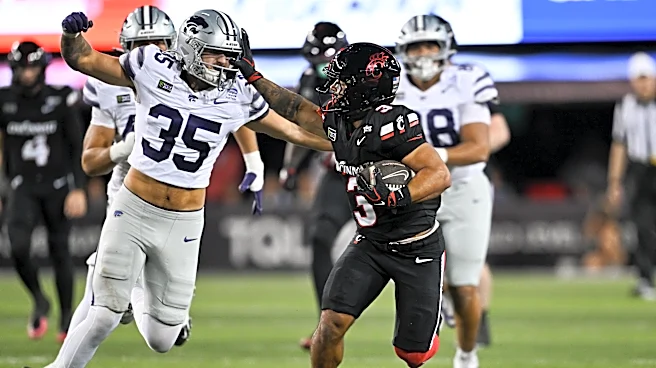




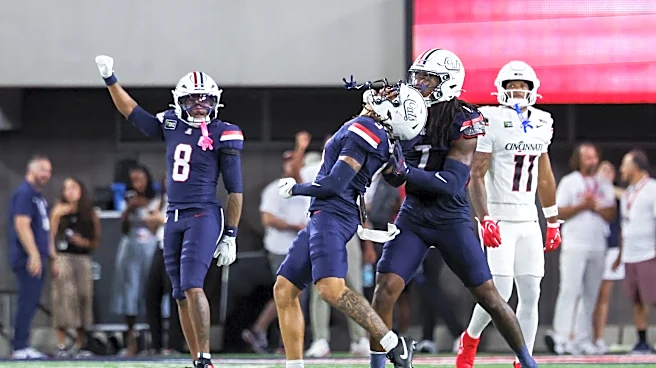
The Wildcats’ defense needed the week off to lick their wounds after Cincinnati’s rushing attack ran roughshod over the front 7. In hindsight, I underestimated Cincinnati’s offensive line and its ability to push K-State off the line of scrimmage while opening massive seams for its running backs. Cincinnati’s offensive strength matched up with Kansas State’s weakness. This defense is built for sideline-to-sideline speed but lacks some size and strength in the trenches. It’s good when the offense runs
attempts to sideline to sideline, but it turns out they’re not so good when an offense runs directly into the teeth of their undersized defensive line. Cincinnati has rushed for 1154 yards on 190 carries. They have 17 rushing touchdowns and are averaging a healthy 5.95 yards per carry. That’s not what Collin Klein wants to see from an opposing offense.
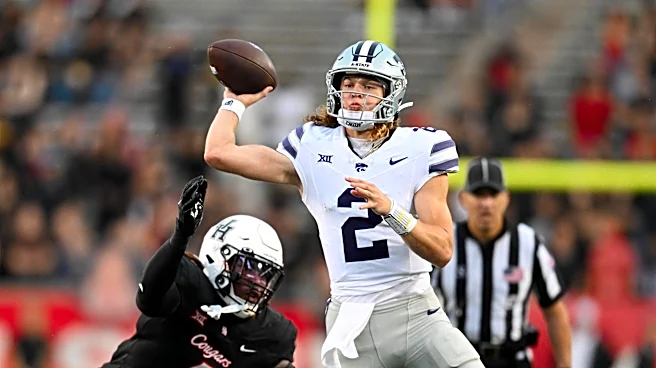
Unfortunately, it looks like the defense is facing more of the same from Houston on Saturday. Cincinnati has the nation’s 18th-ranked rushing attack, and the Cougars have the 19th-ranked rushing attack. I will say this: Houston’s 388-yard rushing performance against Southern, averaging 8.6 yards per carry, is skewing the stats. Last week against UCF, Houston ran for 155 yards on 43 carries for a much more manageable 3.6 yards per carry in their 27-17 victory over the Knights.
If Kansas State limits Houston to 3.6 yards per carry, I like their chances in this one.
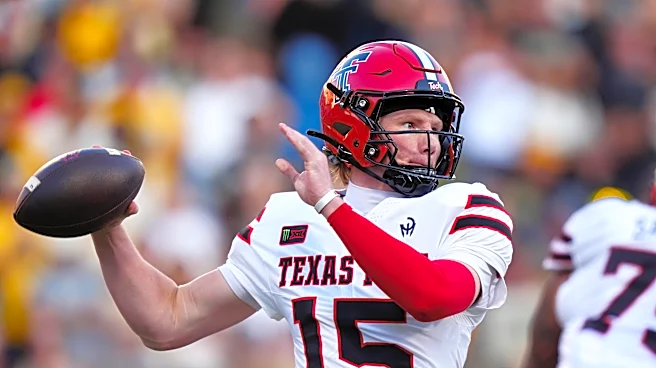
What concerns me is their 177-yard rushing game on 34 carries against Texas Tech in a 26-28 Week 3 loss. If you’re doing the math at home, that’s 5.2 yards per carry against what should be the Big 12’s most talented defensive front. Even more concerning is that they ran the ball 13 times for 57 yards using the “A” gap (between the center and guard) and 5 times for 43 yards in the “B” gap (between the guards and tackle. Cincinnati ran the ball 8 times for 52 yards in the K-State “A” gap and 11 times for 107 yards in the “B” gap. The Bearcats knocked off Kansas State by running the ball inside. Houston almost knocked off Texas Tech with similar success on interior runs. That gives me heartburn.
The Cougars split carries between Makhi Hughes, a 6’0, 210-pound power back, and Re’Shaun Sanford II, their 5’9”, 190-pound speed back. They like to run Hughes between the tackles early and then hit the defense with Sanford’s speed. One thing I appreciate about Houston’s approach to running the ball is that they don’t limit Sanford to outside runs. He’s dangerous when he gets to the outside and is averaging 11.5 yards per carry running outside the left tackle, but he’s also averaged 5 yards per carry on 14 “A” gap runs and yards per carry on 20 “B” gap runs. He’s good at tucking in behind his big offensive linemen, disappearing at the point of attack, and then popping out on the other side. They don’t let the defense key in on run direction based on which running back is in the game.
While the week off was well-timed for the Wildcats to get healthy and regroup, it doesn’t fix what I see as the defense’s fundamental issue. Travis Bates will still be a defensive end lining up at defensive tackle, and Kimari Burns will still be an undersized nose tackle on Saturday.
Now I’m going to switch from analysis to pure conjecture. The fact that Cincinnati carved up Kansas State’s run defense is indisputable. How to fix it, assuming it is fixable, is another story. The Wildcat coaching staff forgot more about football during their morning constitutional than I’ve accumulated over the last 45 years. The best answer will be whatever they come up with, and if they can’t figure it out, it’s simply an unfixable personnel issue that will need to be addressed in the offseason.
However,…
What’s the fun of having unfettered access to the internet if I don’t throw my novice opinion at a professional problem?
– Here Goes –
My solution is to go with a 3-man line and a stand-up defensive end on the weak side. I’d put Kamari Burns at nose tackle, Eli Jackson at defensive tackle, Travis Bates at strong-side defensive end, and let Gregory and Whitaker Jr. rotate at the stand-up end spot.
Whitaker Jr. struggled against the Bearcats. He had a season-low 24 snaps and spent most of his time getting blocked. If Houston wants to run the ball- and I think they will- saving Whitaker for obvious passing downs wouldn’t be a terrible idea.
Despite their struggles against the run last time out, I don’t think bringing another linebacker onto the field for nickel back JoJo Scott would be a good idea. All that’ll do is invite Houston to get a linebacker matched up on Sanford and run the wheel route for a touchdown. Strong safety Logan Bartley spent most of the Cincinnati game lined up in the box as a de facto 3rd linebacker and did a good job. I’d keep doing that.
I would make a change at the other safety spot. Koy Beasley lined up as a box defender 28 times and as a free safety 12 times. Beasley is a good free safety. He’s built like a corner, but has good instincts and, as far as I know, is the fastest player on the team based on his high school track times. What he’s not is a box safety. He made one tackle last game. That’s it. Safeties should have been racking up tackles, but Beasley couldn’t find his way to the ball carrier.
The official depth chart Kansas State releases isn’t generally worth the energy it takes to light up the pixels on your screen; however, I did notice that Wesley Fair is now listed with an “or” designation alongside Beasley. I advocated for more Wesley Fair in my defensive depth chart breakdown, and it appears the coaching staff may be keen to my way of thinking. I’d like to see Fair in the game on most first and second downs, with Beasley stepping in on obvious passing downs to patrol the deep middle.
Most teams don’t have the luxury of an experienced safety like Fair on their bench. From my perspective, Fair isn’t a starter because he occasionally gets lost in pass coverage… like lost… lost. If you bring him down into the box as an extra run defender, use him to pick up a running back out of the backfield, or utilize him as a spy on a mobile quarterback like Connor Wegman, that becomes less of an issue. There will be games where Beasley is the better option because the other team wants to pass, but Houston isn’t one of them.
Finally, I’d have the corners in off coverage early and tighten things up on 3rd down. If we’re throwing safeties into the box, getting beat deep is the real threat. If Houston wants to win the game by throwing 8-yard stop routes, I’d invite them to try. Throwing the ball carries significantly more risk than running it. Connor Wegman is a quality quarterback and has played well this season, but there’s a reason Houston has run the ball 203 times and thrown it 143 times. Willie Fritz wants to run the ball, control the clock, and use his passing game to keep defenses honest.
Another thing to consider: if Wegman is throwing the ball, he’s not running with it. He’s a true dual threat, and Houston leaned on his legs against Texas Tech. They’ll use him on designed runs, and he’ll make plays outside the offense when things break down. The Wildcat’s defense has to maintain leverage on the outside and force him to play from the pocket, instead of letting him get on the edge and put the corners in a “should I step up and make the tackle or drop off and let him run for the first down and risk getting the ball dumped over my head for a touchdown?” dilemma. Rush lane integrity will be important on passing downs.
That’s all I’ve got.
You guys are just as qualified, perhaps significantly more qualified, than I am to speculate on how to fix the run defense. Feel free to hit up the comment section with said speculation if the spirit moves you.