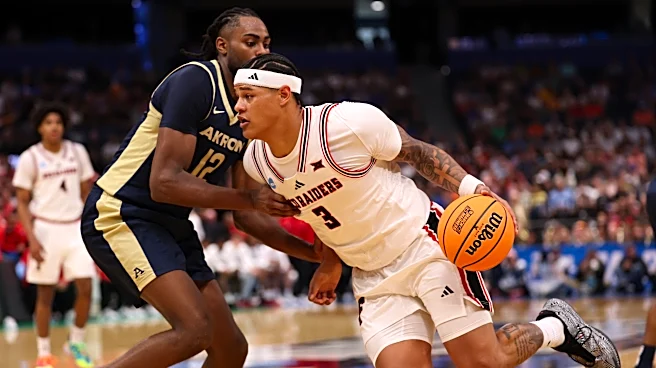





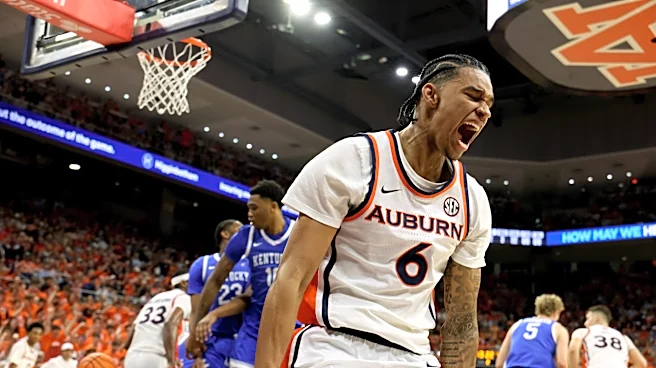
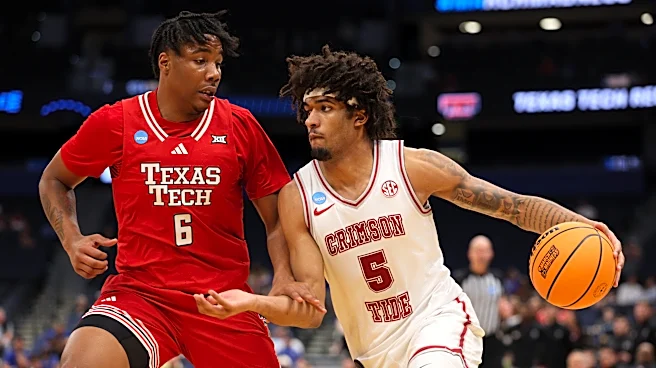
Washington added a major piece to their roster today with a commitment from Texas Tech forward transfer LeJuan Watts. The 6’6 rising senior averaged 11.8 points and 6.0 rebounds per game for the Red Raiders this past season. Watts is the brother of Husky football DT DeSean Watts who transferred in from Sacramento State a few months ago.
This will be Watts’ 4th school in 4 seasons at the college level and his 3rd within the state of Washington. The Fresno, CA native started out at Eastern Washington where
he played heavily off the bench to average 9.4 points and 4.9 rebounds per game. He followed head coach David Riley to Washington State after Riley got that job and hit career highs across the board serving largely as a point forward once Cedric Coward went down with an injury. Watts averaged 13.7 points, 6.7 rebounds, and 4.4 assists on 42.2% three-point shooting on the way to becoming one of the most highly sought after players in the portal. He ultimately ended up at TTU to replace Darrion Williams and seemed on paper like the perfect replacement fit.
Instead, things didn’t go as planned. Watts’ counting stats still ended up looking respectable but he finished with more turnovers than assists and his outside shooting numbers dropped to 32.1% against better competition and in a new system. Things unraveled a bit in conference play as Watts made just 41.2% of his 2-point attempts and 28.6% from deep against Big 12 competition. The Red Raiders were already without All-American JT Toppin by the end of the season and so Watts didn’t fall out of the rotation but both sides were ready for a divorce by the end of the year despite TTU earning a #5 seed in the NCAA tournament.
There’s still plenty of reason to think that Watts can still be a productive player. His outside shooting dipped this season but he is still at 37% for his career from beyond the arc. And Watts’ three-point percentage is actually higher against tier “A” opponents per KenPom than it is overall so it isn’t as if he can only make a shot against subpar athleticism. Where that might be a concern is with Watts’ finishing. His career two-point percentage drops from 56% to 49% against “A” competition and he shot 50.9% in the paint this year which was by far a career low.
Watts likes to play a point-forward role but there’s probably a happy medium to his usage that he hasn’t quite found yet. His assist rate was top-200 nationally as a sophomore at Washington State but he had a turnover rate that was nearly as high. Then at Texas Tech both totals dropped with Christian Anderson playing point guard but the assist rate fell more than the turnover rate such that the turnovers were at an unacceptable level. That will have to get reigned in for Washington to be successful with Watts on the floor.
There are some concerns for Watts on the defensive end. He probably functions best as a small ball power forward and his rebounding is passable for that spot but not elite. One thing that Watts definitely is not though is a shot blocker with a block rate below 1%. He has much more of a booty-ball game rather than above the rim as evidence by only attempting 4 dunks in his 110 shots in the paint. Watts had the lowest on-court adjusted efficiency defensive numbers of any rotation player for Texas Tech this year (although he had the highest offensive ones).
Whether Watts ends up playing at the 3 or the 4 depends on who else the Huskies might be able to add to the roster and whether the three bigs currently on the roster (Dzepina, Sommerville, and Traore) can take a step up. Washington is clearly still on the market for another guard (or two) but it seems reasonable to think the lineup as of today would be Beasley, Yates, Venters, Watts, and whichever of the current bigs wins the center job. There are also a few targets still possible to upgrade that starting lineup.
Watts seems like a perfectly reasonable buy-low candidate although it’s impossible to know whether the buy actually was low. His BPR per Evan Miyakawa has gone up from +2.2 to +3.6 to +4.1 over the last 3 seasons. That latter mark would’ve been the 3rd best on the Husky roster last year behind just Steinbach and Diallo. If Watts cuts down his turnover rate from 21% to closer to 15% and shoots his career average from deep then he has the chance to provide a unique playmaking option from the forward spot. If he tries to force things on a team that doesn’t seem slated right now for the NCAA tournament then it isn’t hard to imagine a scenario that evokes some Desmond Claude vibes.
Washington is sorely in need of talent and Watts was a consensus top-50 transfer in the country last year and still averaged double digit points per game on a #5 seed. He may not be the perfect player but he’s a clear upgrade over what existed on the roster already and has the upside to be one of the best players on the team.
Watts becomes the 4th transfer addition for the Huskies joining Davidson SG Parker Friedrichsen, Gonzaga SF Steele Venters, and San Francisco PG Ryan Beasley.