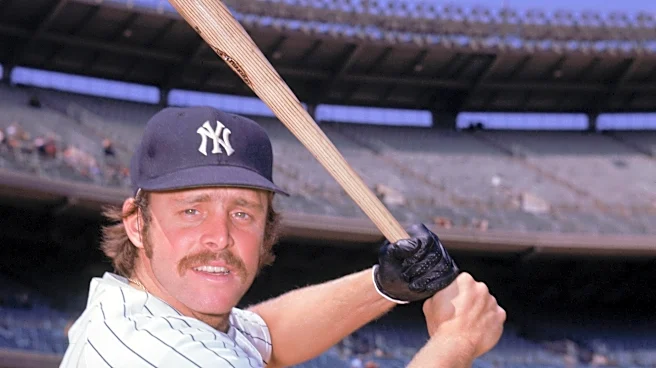

When I first signed up to do Ron Blomberg’s birthday piece, I was excited to be able to tell the story of the first man to bat in Major League Baseball as a designated hitter. As I dove deeper into Blomberg’s life, I learned I had the privilege of writing a piece about a heck of an athlete, a great teammate, and an incredible man.
Ronald Mark Blomberg
Born: August 23, 1948 (Atlanta, GA)
Yankees Tenure: 1969-76
If you do not know, Blomberg just might be one of the greatest high school athletes of his
generation. At Druid Hills High School in Atlanta, he was an All-American in basketball and baseball. Blomberg had over 125 basketball scholarship offers and another 100 from football coaches despite only playing one season. These were not just from random schools sprinkled around the country. John Wooden of UCLA basketball and Bear Bryant of Alabama football both personally traveled down to Georgia to offer Blomberg a scholarship.
To say Blomberg had options is the biggest undersell of the century. However great those offers were, Blomberg loved baseball and he loved the New York Yankees. Even growing up in the South, the pinstripes and bright lights of NYC enamored the young Blomberg. As fate would have it, during the Druid Hills graduation ceremony no less, the Yankees would use the first overall pick in the 1967 draft to select the big, left-handed-hitting outfielder who idolized and was dubbed the next Mickey Mantle.

Blomberg turned down all his college offers and signed to start his professional journey with the Yankees. That summer he went to the Appalachian League and immediately showed what made him the top pick, batting .297 with 10 home runs and 55 RBIs in 66 games. Following that success, the Yankees moved Blomberg to Class A for the 1968 season. They also started to get the teenager some reps at first base. Making two adjustments saw his offensive numbers decline, but the Yankees still saw fit to promote him to Double-A after the season concluded.
The summer of 1969 would prove to be a great one for Blomberg. After finding his swing again, he hit .284 with 19 home runs and was impressive enough to earn a September call-up to the big leagues. Blomberg made his debut on the 10th of the month and would end up playing in four games, going 3-for-6 at the plate. It was a small cup, but a cup of coffee in the big leagues!
Triple-A Syracuse would be Blomberg’s home for the 1970 and part of the 1971 seasons. Following some more seasoning in the minors, Blomberg got the call again in June of 1971. This time he would stick. In 64 games, Blomberg hit .322 with seven home runs, appearing in all of his games as an outfielder. The ever-rebuilding CBS Era Yankees finished fourth in the division with an 82-80 record.

Ralph Houk decided to move Blomberg to first base prior to the 1972 season to platoon him with the right-handed bat of Felipe Alou. In this more specific role, Blomberg slashed .268/.355/.488 with what would be his career-high 14 home runs.
Baseball—or rather, the American League—changed in 1973. For the first time at the highest level, there would be a full-time hitter in place of the pitcher in the batting order. The first man to get an at-bat listed as the starting designated hitter was none other than Blomberg, who worked a walk to force in a run at Fenway on April 6th against the Red Sox, forever cementing his place in baseball legend. His No. 12 jersey and bat were sent to the National Baseball Hall of Fame, where they are still displayed in Cooperstown.
The Yankees again struggled in 1973, going 80-82 and finishing fourth in the division. However, Blomberg had arguably his best season, slashing .329/.395/.498 and setting career-highs in hits, runs, and RBIs while appearing in 100 games and splitting time between first base and DH.
Heading into the 1974 season, first base got crowded with the likes of Chris Chambliss, Otto Vélez, and Bob Oliver. Blomberg shifted back to the outfield but appeared in most of his games that season as the DH. In 90 games, he slashed .311/.375/.481 with 10 home runs. The team went 89-73 on the season, good for second in the East, and for the first time in a while, things seemed to be looking up for the club.

Then in 1975, the wheels started to come off the bus for Blomberg. It started with a shoulder strain that was not supposed to be serious and then cost him over a month of the season. When Blomberg came back in July, he tore a muscle while taking a swing. Opting for a brace, the muscle healed and surgery was not needed. Blomberg’s final line in 1975 was .255/.336/.481 in only 34 games.
Spring training of 1976 saw Blomberg enter healthy. Unfortunately, that would not be the case by the time the team broke camp. In the final game, Blomberg hurt his shoulder again, and this time it would require surgery. Still just 27 years old, Blomberg only appeared in one game on the year. The Yankees went on to claim the team’s first pennant since 1964 but were swept by Cincinnati’s Big Red Machine in the World Series.
Blomberg initially had a clean bill of health and another solid spring training in 1977. However, again, injuries would rear their ugly head. This time, instead of the shoulder, it was the knee. Blomberg went full speed into a concrete wall and shattered his knee, literally. The collision resulted in a shattered left kneecap, four broken bones in the knee area, and torn knee cartilage. The injury required extensive surgery, which included removing half of his kneecap and removing floating bone chips. On three different occasions, surgeons had to break up scar tissue in his knee to allow it to bend while he recovered.
Needless to say, Blomberg missed the 1977 championship campaign. He had to watch from the dugout as the “Bronx Zoo” Yankees went on to win the World Series over the Dodgers. Yankees owner George Steinbrenner and his teammates held Blomberg in such high regard for helping build the team up from the bottom that he presented Blomberg with an official 1977 World Series championship ring even though he did not get to appear in a game during the season.
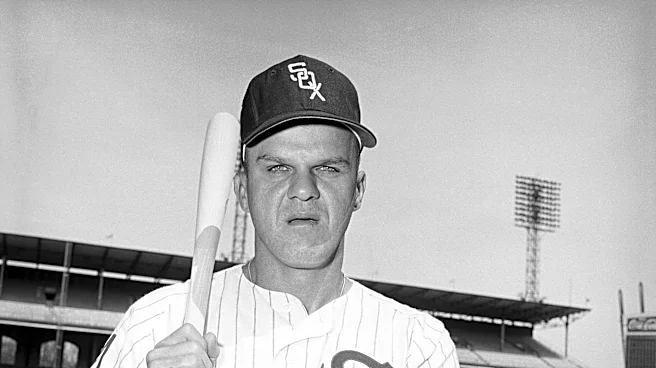
The less-than-storybook championship ended Blomberg’s time in pinstripes. Making one last comeback attempt, Blomberg signed with the White Sox ahead of the 1978 season. On Opening Day, he hit a game-tying home run in the bottom of the ninth. That would be the only real highlight for Blomberg in Chicago as he appeared in only 61 games for the White Sox in 1978, batting .231 with five home runs and 22 RBIs. The team tried to send Blomberg to Triple-A following the 1979 spring training, but he refused the assignment and was released, ending his major-league playing career.
Blomberg ended his career with a .293 average, .832 OPS, and a 140 OPS+. His career splits tell the story of why he did not play more early in his career as he slashed .304/.367/.500 against righties but only .215/.306/.272 versus lefties. Another career ended too quickly by injuries, leaving one to wonder what if.

Following his playing days, Blomberg continued to love being a Yankee. He served as a regional scout for the team and still participates in events when the team asks, including many an Old-Timers’ Day. In 2004, Blomberg was inducted into the National Jewish Sports Hall of Fame.
Blomberg has written two books. The first, published in 2008, was his autobiography, Designated Hebrew. Then in 2021, Blomberg produced The Captain and Me: On and Off the Field with Thurman Munson. This book outlines why Munson should be in the Hall of Fame, showing that all these years later, Blomberg was still going to bat for his teammates.
Happy birthday, Ron!
See more of the “Yankees Birthday of the Day” series here.