


The mood about Bills Mafia has changed in the last year or so.
Buffalo Bills General Manager Brandon Beane has been under a much higher level of scrutiny by fans of the team as the “talent versus coaching” debate began to rage through both social media and water coolers. Bills owner Terry Pegula came down definitively on the side of coaching being the main issue keeping the team from getting to the Super Bowl when he fired former head coach Sean McDermott, and clearly reinforced that opinion during
his press conference discussing the dismissal.
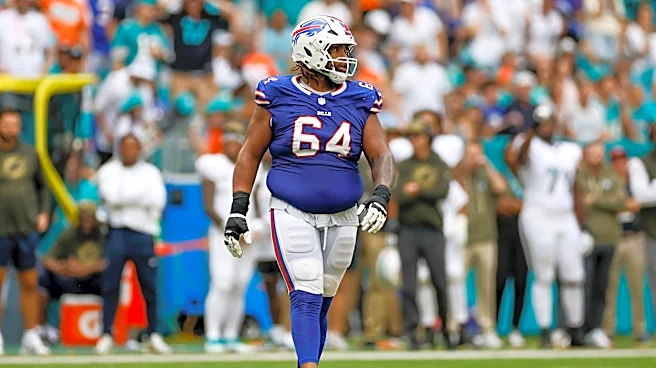
But not everybody believes it was clearly one and not the other, and that lingering sliver of blame, however large it is in someone’s mind, has led to Beane’s historic approach to contracts to come under fire. This turn showed up again after the Bills announced a four-year, $78.4 million extension with right guard O’Cyrus Torrence. There were questions about how good Torrence is, how proper and ideal resource allocation should look for a limited resource environment, and the Bills’ cap tightness over the last few years along with its most direct cause.
One of the benefits to having been both critical and complimentary of Brandon Beane’s maneuvers over the past almost-decade (there’s a Buffalo Rumblings article out there encouraging Beane to not extend former defensive tackle Jordan Phillips that attracted the attention of the lineman himself on social media) is that I don’t really have to worry about people automatically assuming that I will like the Torrence extension because I like everything the team does or that I will hate the Torrence extension because I hate everything the team does. I will admit, however, that I was a little surprised by the general tone (insert salute here) surrounding the guard’s new contract. I’m in favor; let me explain why:
I don’t believe that teams should extend “mid” players regardless of circumstance, but I don’t think Torrence is a “mid player”
The argument against a team extending an average or replacement-level player is a simple one: the probability of you finding a similar level of player in the draft for a markedly cheaper cap number in both the short and medium term is very high. The current going rate for reasonable #2 blocking tight ends is $5m – $10m in average annual contract value (AAV). Teams are picking up on this market inefficiency as well, pushing tight ends like Ohio State’s Will Kacmarek (who never had more than 11 catches in a college football season) into round two of the 2026 NFL Draft. Kacmarek’s total four-year contract value is $6.849 million. The more expensive a position gets, the more significant the value proposition is of drafting that position. This is where the addage “the greatest value in sports is a star quarterback on a rookie contract” comes from.
The same logic applies to skill as it does to position. There’s a significant value proposition delta between paying an average-level player $8m AAV versus $1.4m, and if I’m confident that I can get an average-level player in the draft, I should do that and save that money in a limited resource environment for a star-level player that I am less confident I could replace in the draft.
I don’t think O’Cyrus Torrence is a star player. I’m not sure who studies offensive line play would argue he is either. Bleacher Rerport’s Brandon Thorn, an expert in offensive line play across the league, recently released his offensive lineman rankings for the 2026 NFL season and had Torrence with a grade of 70, which qualitatively titles him as a “reliable contributor” and places him in the top 73 offensive linemen in the league and the 11st best right guard. Of the Bills newly-minted lineman, Thorn wrote:
Torrence is a durable and massive right guard with huge hands, good play-strength and a firm anchor. His width and stiff punch make him difficult for power-rushers to work through, and his snatch-trap technique gives him a reliable answer to steal leverage in pass protection. As a run-blocker, Torrence is a sturdy presence that bumps down linemen on double-team feeds, collects movement across his face and uses a nifty jump-hook technique to reach frontside shades. Buffalo’s progressively run-heavier structure has helped maximize his strengths while masking middling movement skills and below-average recovery when pulled out of position. Torrence is not a dynamic mover, but his size, anchor, strength and improving craft have settled him into solid starter territory.
Nothing in Thorn’s write-up should have anyone who’s watched Torrence extensively confused, and the classification of him as both a “solid starter” and “reliable contributor” completely tracks. I have nothing further to add about qualitative aspect of Torrence’s play that was not outlined above.
The Torrence contract is not an overpay relative to the market for players of his valuation
Just shy of 18 months ago, the Bills extended another player on the offense I would consider to be both a “solid starter” and “reliable contributor” in wide receiver Khalil Shakir. In present day, that contract ranks Shakir 33rd in the NFL among wide receivers in practical guaranteed money, per Spotrac. The recent contracts of Rashod Bateman, Romeo Doubs, Rashid Shaheed, and Wan’Dale Robinson (Baltimore Ravens, New England Patriots, Seattle Seahawks, and Tennessee Titans, respectively) have affirmed Shakir’s standing in the pecking order of contracts in the same way that the Matthew Bergeron contract with the Atlanta Falcons, the Aaron Banks contract with the Green Bay Packers, and the Robert Hunt contract with the Carolina Panthers have helped properly frame the O’Cyrus Torrence deal. None of these deals was an outlier or even a market-setter; they were simply good deals given to good players. For reference, Bergeron/Banks/Hunt were given 61/62/65 grades from Thorn in his project noted above.
I agree that there is an “optimal” resource allocation, but we don’t live in an optimal environment
If there’s one thing I love to talk about it, it’s optimization. Tweaking and tuning aspects of a team’s budget/depth chart when examining market inefficiencies and opportunities for added value can be what separates a good GM from a great one. And in a previously-mentioned limited resource environment, everything has opportunity cost. Every dollar of salary cap allocated to player X is one dollar that can’t be allocated to player Y. The cap is flexible, but it’s still finite. And so the phenomenon of the Bills having four of their five offensive line starters signed to meaningful non-rookie contracts begs the question: is this the best usage of the team’s limited cap dollars?
In the NFL Draft, one of the items that consistently gets brought of is one of positional value. Whether it’s a top ten pick on a running back, a top five pick on a safety, or a day two selection on a specialist, the question of resource allocation and opportunity cost inevitably comes up. Those conversations have value, whatever the line is that someone draws. Everybody will admit that taking a punter in round one is a bad value proposition and a massive opportunity cost, regardless of how good the punter is. That means there is a line, no matter where it’s drawn for people. At some point, the value proposition of a maneuver becomes bad enough to make us think that the move is a bad one.
Why is this situation any different? The draft situation revolves around the idea that there’s another clear choice.
If you don’t take Bob Smith (the safety) at No. 6 overall due to your perception of resource allocation and positional value, you still have another player you can take at a higher value position at No. 6 overall. There will be a receiver, or an offensive tackle, or a pass rusher, or some player there that you can take. But do the Bills have a player on the team that would be worthy of this extension’s money if not given to Torrence? The only two other notable players on the team with 2027 expiring contracts are safety C.J. Gardner-Johnson (who just got to the team, hasn’t played a snap yet, and has worn out his welcome at multiple previous spots) and guard Austin Corbett (who is currently competing for the left guard starting spot for 2026).
But what about free agents at other positions apart from offensive line?
First, the Bills have not had particularly good luck with outside free agents under Brandon Beane. The unrestricted free agent contracts are littered with the likes of wide receivers Curtis Samuel and Joshua Palmer, defensive tackles Larry Ogunjobi, Tim Settle, Quinton Jefferson, and Vernon Butler, and pass rushers Joey Bosa and Mario Addison. He’s 100% had hits: edge rusher Leonard Floyd was arguably the best defensive unrestricted free agency signing made by Beane, and current starting center Connor McGovern was signed as a free agent from the Cowboys in 2023.
I don’t believe that what $19.6 million AAV gets you in unrestricted free agency in 2027 is likely to be a better value proposition compared to extending Torrence. In 2026, that amount of money (allocated to a position other than offensive line) would get you in the ballpark of the deals given out to edge rusher Boye Mafe and cornerback Alontae Taylor.
The odds are that you’re not going to find a bigger bang for your buck in this situation. In the draft example, the answer is sitting there staring you in the face: you get to pick another player and pay them an identical (or close to identical) contract, so if you have concerns about resource allocation or positional value and you have another player you think is just as good, pick that other player instead. But this isn’t that situation. In order to pass on the Torrence deal in the name of a hypothetical “other” deal, I’d need to know what that deal is, and I don’t see any that would sway me away from providing an above-average guard an above-average contract extension in much the same way an above-average wide receiver in Khalil Shakir received an above-average wide receiver contract.
Ultimately, General Manager Brandon Beane deserves some pressure. Exactly how talented the Buffalo roster is remains up for debate, but few would argue the team is as talented as the top teams in football. That pressure comes with additional skepticism that may not have been present when Shakir signed his extension in February of 2025. But I personally struggle to find a good reason to chalk this up as a mistake.
…and that’s the way the cookie crumbles. I’m Bruce Nolan with Buffalo Rumblings. You can find me on Twitter and Instagram @BruceExclusive and look for new episodes of “The Bruce Exclusive” every Thursday on the Rumblings Cast Network — see more in my LinkTree!