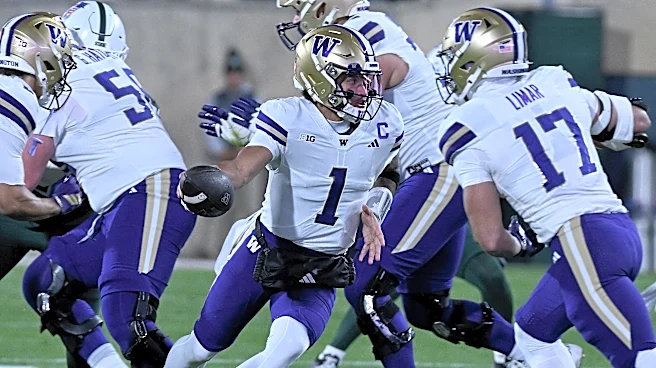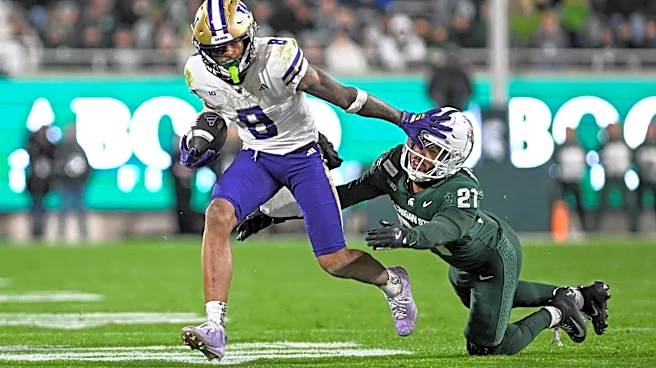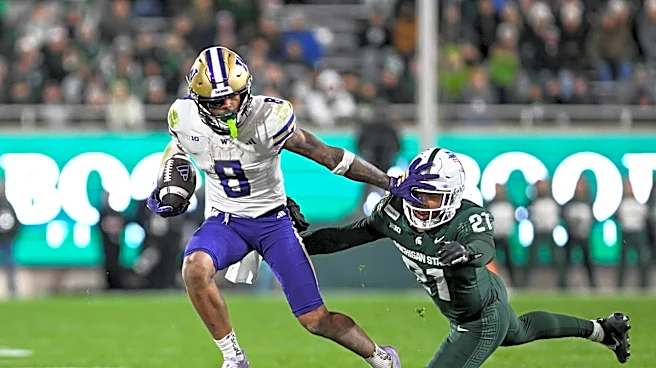


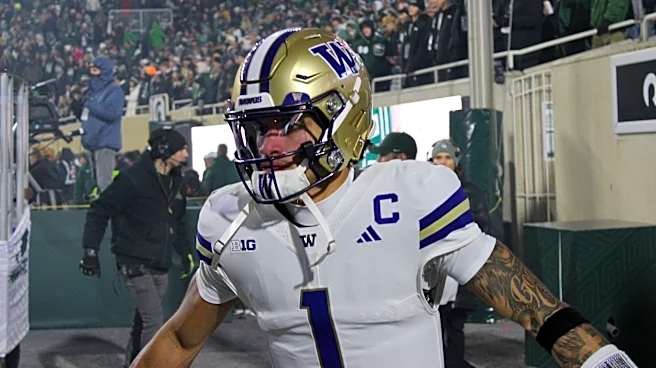

The Washington Huskies took down the Michigan State Spartans 21-14, notching their third straight road win. It was not the prettiest game (which is on par for the season), as it was 14-14 for most of the second half, despite the Spartans going down to their 2nd and 3rd string QBs. Nonetheless UW was able to come up on top, lead by Chris Lawson who continued his breakout season, notching 124 yards and 2 touchdowns.
The Dawgs become bowl eligible as they head into their toughest 2 weeks of the season,
hosting #8 Indiana then heading down to Eugene to play #13 0regon, hoping to playing upset and crush CFP dreams for their B1G counterparts.
To the film.
Offense: Going Deep

Against Michigan State, we saw a version of the offense that looked much more like the pre/early-Demond 2024 scheme than the 2025 or 2026 scheme, and while the offense was still anemic for long stretches of the game, there was proof that the skill talent and the scheme can be explosive when properly executed. What does that mean? Well, instead of the screen and drop back-heavy passing offense that’s been stagnant all season, Fisch called more of the over-the-middle shot concepts that he leaned on heavily back in 2024. Concepts like Mills and Yankee came back into the fold, and so did some of the half-roll and sprint out backfield/protection concepts. The offense couldn’t connect on very many of these shot plays, but they ended up being the difference in the game.
Hypothetically, this added vertical dimension that’s largely been missing this season could be something that opens up more opportunities underneath. To a certain extent, it’s a little too late in the season for the offense to be finding a formula that works and it make a huge difference, but I guess we wanted to feature these plays here to point out that the talent and the scheme are sufficient to give us a viable and dynamic passing game.
1st Quarter – 1:38 – 1st & 10

First up we have a Yankee concept paired with a half roll backfield action/protection. I apologize for only having the replay angle, but this was the only one available on the game recording that was half decent.
As some of the long-time readers might remember, the Yankee concept is a vertical concept that attacks the safeties with a Post-Dig route combination. Normally a concept that’s called against 1-high safety coverages, the Post-Dig combination creates a high-low stretch on the deep safety. If the safety comes up to help on the Dig, the Post route can run into open grass behind the defense. Alternatively, if the deep safety stays back to help with the Post, then the Dig route has space behind the linebackers to get open. Typically, Yankee is paired with play action and heavy protection to buy the QB time to allow the routes to develop, as well as to suck the LBs up to the line to further open the space behind the second level for the Dig to work into.
Those are the basics of the Yankee concept, but there are many variations of the core concept that offer answers to 2-high coverages, like we’re facing on this play. On this play, we have Roebuck (WR, #2) and Rashid Williams (WR, #3) running double Posts to the right side of the formation and Chris Lawson (WR, #8) running the Dig from the left. On a conventional Yankee play design facing 2-high safeties, one safety would be able to assist with the Dig and the other could help with the Post. However, with the double Posts, we’re able to attack the deep defender on the right side of the formation with multiple routes. Even if the defense is in Cover 4, we’d still have the double Posts in 1v1 coverage. That Post from Williams is what gave this play a shot.
At the snap, you can see MSU’s #24 bail deep as if he has deep half field coverage with eyes to the inside. If Rashid didn’t have a vertical route, #24 could’ve honed in on Roebuck and provided over the top support on a solo Post. Williams does a good job of selling the vertical outside release, drawing the CB’s eyes towards the sideline, forced him to flip his hips to protect the sideline, and kept Roebuck open deep downfield.
To be honest, I’m not sure what Michigan State has called here in coverage. It’s either some form of inverted coverage or a totally blown assignment because there’s no way that they wanted a LB matched up deep against Roebuck. It ended up as a missed opportunity, but the play was there to be made for a nearly 60-yard TD.
1st Quarter – 0:40 – 3rd & 11

Next up we have a Mills concept for the first UW TD. Much like the Yankee concept, this is a vertical shot play concept that features a Post-Dig route combo. Mills, popularized by Fisch’s coaching idol Steve Spurrier, was a staple of the offense over the last couple of seasons. Really, the only big picture difference between the Yankee and Mills concepts is that on Yankee the Post and Dig are run from opposite sides of the formation, whereas on Mills the Post and Dig are run from the same side. Mills is also primarily a 1-high coverage beater that attacks the deep safety, but variations of the concept can be effective against 2-high coverages as well.

On this play, we’re getting a pre-snap 1-high coverage look from MSU, but post-snap they are dropping into a version of Cover 2. This version of Mills, like the Yankee concept in the last play, has an answer for 2-high. Prior to the snap, we’re motioning Rashid across the formation to set up a Double Dig Mills concept. Lawson is running the Post here that goes for the TD, but it’s the other two routes from the right side that set his route up. Mason James (WR, #6) starts on the right and runs the first of the two Dig routes (the second coming from Rashid). His Dig route draws the initial attention from the deep safety to the left side of the formation. Rashid’s Dig draws the attention of the rotated shallow safety. By keeping the shallow safety low with the second Dig route, he isn’t able to drop and provide any over the middle help to the CB #24 who’s trying to keep up with Lawson who has inside leverage.
Shout out to the OL for providing ample time for Demond to scan the field and let the routes develop.
2nd Quarter – 8:15 – 1st & 10

Last up for offense we have a half roll concept for a big gain. Early in Demond’s career we used this half roll backfield action a lot, but for some reason we haven’t seen it as much this year. This season we’ve seen a lot of naked bootleg concepts from under center, and I think it’s because of Fisch’s preference to emulate the Shanahan/McVay offenses from his NFL days. On naked bootlegs, the QB is entirely reliant on the play action fake to preoccupy the roll out side edge defender. As we all know, our run game hasn’t been good enough to really preoccupy the edge defenders, so they often times are just fixated on Demond running around with no protection help. The difference with these half roll backfield looks and those naked bootlegs is that we’re actually designing the protection scheme to account for the play side edge defender, thus allowing Demond to actually look downfield instead of running for his life.

As you can see here on the replay, with this half roll action, we still have play action going to the right with Demond looking to move out of the pocket to his left. However, between being able to start in shotgun, thus allowing him to keep his eyes on the defense the whole time, and Rashid staying in as a personal protector against the edge defender, Demond actually has enough time to scan the field and get to his second read. That second read, Decker DeGraaf (TE, #86), is coming wide open on a crossing route behind the LBs.
The beauty of this type of half roll action is that we’re able to unlock the best traits of Demond while simultaneously mitigating his, and the offense’s, weaknesses. Like the naked bootlegs, we’re able to get Demond out of the pocket, which forces the defense to react and make decisions about sticking with their coverage assignments or playing contain. This leverages Demond’s mobility as a threat that the defense has to account for despite it being a pass play. We’re also able to get him a better view of the defense and better passing lanes outside of the pocket. Finally, it takes the edge off of the opponent’s pass rush.
Defense: Mismatch Trends

For defense this week, instead of focusing on a game-specific trend or wrinkle, we wanted to take a look at a trend that we’ve noticed over the course of conference play. The Spartans aren’t a great offense this season, but they were able to get some big plays on us using heavier personnel packages and play action. This was the same formula that Minnesota, Iowa, and Penn State all used in some form to beat us. In each instance, multiple TE personnel groupings allowed them to attack our base nickel personnel using the run game, get our defense to press, and then play off of our aggressive run fits using play action. It wasn’t always the TEs themselves who were getting big plays on us in the air. Instead it’s the oft-forgotten blocking matchups with TEs on EDGEs or LBs that set everything up.
MSU didn’t rack up a huge day on the ground, but it was effective enough when using these heavier personnel packages that the play action threat was effective. Let us show you what we mean.
1st Quarter – 13:32 – 1st & 10

First up, we have MSU in a 12 personnel (1 RB, 2 TE) condensed formation running a play action bootleg concept. This should look familiar to UW fans since this is a type of play that we’ve tried time and time again this season when we’re on offense. Against this, we’re playing a 1-high coverage look with our 5×1 Penny front that’s bolstered by Alex McLaughlin playing as the box safety.
When facing these heavy condensed formations with the offense, where the TEs and WRs are lined up tight to the OL, the WRs and TEs become real blocking threats who could factor into a potential run play blocking scheme. This creates extra gaps that the defense has to account for in their run fits. Keep in mind, the TEs and WRs who are now blocking threats are being covered by DBs, who are now also factoring into the expanded run fits. Our defense likes to play base nickel personnel against 12 personnel packages. From a coverage match up perspective, we typically like to match Jacob Manu (LB, #9) on the RB, then play our safeties on the TEs. When I’m talking about safeties, I’m including Rashawn Clark (nickel/safety, #2). The problem is that our coverages don’t always work out where our most capable run support safeties (McLaughlin and RDA) are playing in the box where they can cover the TEs and factor into the run fit effectively. We try to account for this, or try to give ourselves the flexibility to play different safeties deep, by using our Penny front with ZRS picking up more run responsibilities for Clark and having McLaughlin pull double duty as a super aggressive box defender. However, this can get picked on.

As you can see here, we’ve got RDA playing deep 1-high safety with McLaughlin and Clark in the box over the two TEs. on the left side of the offensive formation. Clark, knowing that that his primary responsibility is the inside TE, either soaking up the block or sticking to him in coverage, is plastered to the TE #82. However, McLaughlin, likely feeling the responsibility of having to make a play against a potential run, plays the run aggressively and loses track of the TE #12. This leaves a wide open man for their QB to dump the ball off to down field for a chunk gain.
I’m not sure if we would’ve been better off playing base 4-3/3-4 personnel against their 12 personnel where an LB would’ve been matched up on one of the TEs. At the end of the day, McLaughlin’s guy is who got open, and I wouldn’t want to sub out McLaughlin for the LB. Maybe he wouldn’t have played the run so aggressively if there were another LB on the field, but that aggression is also what makes him such a playmaker for our defense. Again, MSU’s offense isn’t a juggernaut, and their run game wasn’t having a field day like Iowa or Penn State’s was, so that could be the reason why we stuck with base nickel personnel. Regardless, the fact that we’re seemingly splitting run/pass responsibilities to account for some of our personnel mismatches does seem to indicate a recognition that we’re struggling with the 12 personnel runs when playing nickel.
Awgs’ Bonus Play(s) of the Week
Jacob Manu takes this week’s honors with an incredible, athletic heads up INT, making an already bad play for the Spartans even worse.