
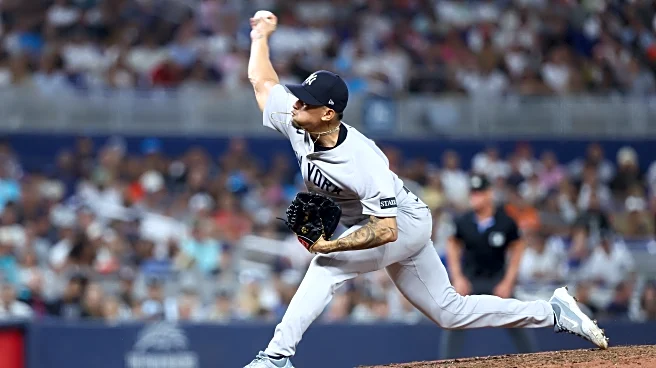
On January 21, 2026, Brandon Sproat was traded to the Milwaukee Brewers. This list, and Sproat’s place on it, was compiled back in late-November. For continuity’s sake, I decided upon including Sproat’s profile, but for all intents and purposes, every player on our list below Sproat can be considered to have moved up a spot on it.
Always more focused on hitting than pitching while playing little league and travel ball in the Pensacola area, Brandon Sproat left coaches stunned when he finally tried
out for the Pace High School varsity baseball team in his junior year there. With a fastball that sat in the high-80s-to-low-90s and a full arsenal of secondary pitches, the right-hander instantly became the best player on the team. He dominated hitters not just across Santa Rosa County, but all over Florida, a baseball hotbed. In his junior year, he posted a 1.78 ERA in 59 innings, helping lead Pace to Florida’s Class 7A State Championship Game, and in his senior season, he posted a 1.53 ERA in 32 innings. Over the two seasons that he pitched for the Patriots, he made 27 starts and 5 relief appearances, posting a cumulative 1.83 ERA. The Texas Rangers selected Sproat in the 7th round of the 2019 MLB Draft and offered him an over-slot deal, but the right-hander elected to honor his commitment to the University of Florida instead, looking to really develop as a pitcher with the Gators and hear his name called earlier in the 2022 MLB Draft.
Overview
Name: Brandon Sproat
Position: RHP
Born: 09/17/2000 (Age 25 season in 2026)
Height: 6’3”
Weight: 215 lbs.
Bats/Throws: R/R
Acquired: 2023 MLB Draft, 2nd Round (University of Florida)
2025 Season: 26 G (25 GS), 121.0 IP, 97 H, 62 R, 57 ER (4.24 ERA), 53 BB, 113 K, .271BABIP (Triple-A) / 4 G (4 GS), 20.2 IP, 18 H, 11 R, 11 ER (4.79 ERA), 7 BB, 17 K, .310 BABIP (MLB)
Initially, it looked like turning down the Rangers and their money might have been a miscalculation, as the right-hander missed most of his freshman season thanks to the COVID-19 pandemic. He appeared in 4 games out of the bullpen at the beginning of the season prior to the suspension and eventual outright cancellation of the season, and allowed 1 earned run over 6.0 innings, giving up 2 hits, walking 3, and striking out 8. That summer, as many players did, he supplemented his time on the mound by pitching in an independent collegiate league, the Texas Collegiate League. Pitching for the Tulsa Drillers, the right-hander allowed 4 earned runs over 10.1 innings, allowing 6 hits, walking 11, and striking out 7.
In 2021, he returned to Florida and appeared in 16 total games, starting 2 midweek games and making 14 appearances out of the bullpen. All in all, he posted a 6.65 ERA in 21.2 innings, allowing 29 hits, walking 15, and striking out 18. Over the summer, he made a brief appearance with the Chatham Anglers of the Cape Cod Collegiate Baseball League, allowing 3 earned runs in 2 innings with 3 hits allowed, 4 walks, and 2 strikeouts.
In 2022, his junior season, Sproat finally established himself, serving as the team’s Saturday starter following an injury to Hunter Barco. Making a team-high 16 starts, the right-hander posted a 3.41 ERA in 89.2 innings, allowing 84 hits, walking 33, and striking out 82. Analysists believed that based on his stuff and performance, Sproat would be selected early on the second day of the 2022 MLB Draft, and sure enough, he was. With their third round pick, the 90th selection overall, the Mets selected the right-hander. The two sides were unable to agree to terms, and Sproat ended up returning to Florida for a senior season, fulfilling a promise to graduate from college and potentially fulfilling a promise to teammates, classmates and Florida fans to bring a championship to Gainesville.
Sproat gave it all he could, but he and the Gators ended up falling just short of winning that championship in 2023. The right-hander appeared in 19 games as the staff ace and posted a 4.66 ERA in 102.1 innings with 81 hits allowed, 43 walks, and 134 strikeouts. Florida made the College World Series, defeating the University of Virginia in the first round, Oral Roberts University in the second round, and TCU in the semifinals, but lost to Louisiana State University in the finals two games to one. Sproat took the mound in game one, matching up against Tigers ace Ty Floyd, and pitched four innings in Florida’s one and only win in the series, allowing two runs on six hits, with five walks and seven strikeouts and not factoring into the decision. With the Gators’ eventual loss, Spoat’s career at the school came to an end. In total, he appeared in 56 games for them, starting 37, and tossed 223.2 innings. He posted a cumulative 4.27 ERA over the course of his four seasons at Florida, with 202 hits allowed, 99 walks issued, and 242 strikeouts.
Having given the Mets permission to potentially select him a second time around prior to the start of the 2023 MLB Draft, the Mets did just that, selecting him a second time, this time in the second round, the 56th player selected overall. The two sides agreed to a $1,474,500 signing bonus, exactly the MLB-recommended slot value, and Sproat finally became a professional baseball player. He did not suit up for the Mets for the remainder of the season.
Over the off-season, Amazin’ Avenue ranked Sproat the Mets 14th top prospect on the Mets Top 25 Prospects list for 2024. He was assigned to start the season with the High-A Brooklyn Cyclones, but it quickly became apparent that he was not being challenged at the level. He appeared in 6 games for the Cyclones, starting 5 of them, and posted a 1.07 ERA in 25.1 innings, allowing 12 hits, walking 16, and striking out 33. He was promoted to Double-A Binghamton in mid-May and was just as good against Double-A hitters, posting a 2.45 ERA in 62.1 innings over 11 starts with 39 hits allowed, 15 walks, and 77 strikeouts. He was promoted to Triple-A Syracuse in early August and the wheels finally fell off of his excellent season. The right-hander wrapped up his first professional season there, making 7 starts and posting a bloated 7.85 ERA in 28.2 innings, allowing 36 hits, walking 11, and striking out 21. Despite its poor ending, the right-hander had a successful season and catapulted his name into the discussion not only for Mets top prospect, but among the best nationally as well.
Amazin’ Avenue ranked the right-hander the Mets’ top prospect coming into the season, but he stumbled out of the gate, once again struggling at the Triple-A level. In March/April, he posted a 5.48 ERA in 23.0 innings over 6 starts, allowing 21 hits, walking 12, and striking out 17. In May, he posted a 6.56 ERA in 23.1 innings over 5 starts, allowing 25 hits, walking 10, and striking out 17, and in June, he posted a 4.15 ERA in 21.2 innings over 5 starts, allowing 19 hits, walking 13, and striking out 15. In late June, a lightbulb finally went on. It wasn’t one thing specifically, but suddenly everything started clicking for Sproat. Thanks to a combination of throwing his fastball harder and using a more effective pitch mix, the right-hander went on a terrific run in the month of July. In 27.0 innings over 5 starts, the right-hander posted a 0.67 ERA, allowing 14 hits, walking 8, and striking out 33. His streak of success ended in August, but by that point, the organization was looking at internal options to bolster the starting rotation and the Mets’ dwindling playoff aspirations, and Sproat was in consideration for a call-up. Sure enough, in mid-September, the Mets selected his contract from the Syracuse Mets, joining fellow recently-promoted right-handers Nolan McLean and Jonah Tong.
In his first big league start on September 9th, Sproat allowed 3 runs on 3 hits over 6.0 innings against the Cincinnati Reds, walking 4 and striking out 7. In his next start, against the Texas Rangers on September 13th, the right-hander threw six scoreless innings, scattering 6 hits and not walking a single batter while striking out 3. His next start, which came on September 19th against the Washington Nationals, was his first real clunker, allowing 4 runs over 4.0 innings. His next and final start of the year, September 26 against the Miami Marlins, was a similar clunker that saw him allow 4 runs over 4.2 innings. All in all, Sproat posted a 4.49 ERA in Queens, allowing 18 hits, walking 7, and striking out 17 in 20.2 innings of work and a 4.24 ERA in 121.0 innings with the Syracuse Mets, allowing 97 hits, walking 53, and striking out 113.
The 6’3”, 210-pound Sproat has a solid pitching frame. The right-hander throws from a three-quarters arm slot with a long, whippy arm action through the back. His delivery is fairly simple with few moving parts, and he repeats it well. He struggled with his control earlier in his career while playing at Florida, but has improved in that regard since turning pro, as the Mets worked with him to raise his arm slot a bit and remove some of the crossfire from his delivery, as they identified his lagging arm being the root cause of his control issues.
Sproat has a wide assortment of pitches that he is comfortable using, incorporating multiple fastballs, breaking balls, and off-speed pitches. His pitch mix changed slightly in Queens as compared to his mix while in Syracuse. In Triple-A, he threw his four-seam fastball 26% of the time, his sinker 21.3% of the time, his sweeping slider 16% of the time, his gyro slider 15% of the time, his changeup 15% of the time, and his curveball 7% of the time. In Queens, Jeremy Hefner had Sproat throw his sinker 34% of the time, his sweeping slider 19% of the time, his curveball 15% of the time, his changeup 15% of the time, his four-seam fastball 14% of the time, and his gyro slider 3% of the time.
Sproat’s four-seam fastball averaged 96.2 MPH while playing in Syracuse and 96.7 MPH in his cup of coffee with the Mets, topping out at 100 MPH. While it has plenty of velocity- the pitch was in the 94 percentile in Syracuse and in the 78 percentile in the majors in terms of average velocity- it features a well-below average spin rate. With an average spin rate hovering around 2,000 RPM, the pitch has minimal life and movement. Batters hit .258/.390/.423 against it in Triple-A with a 24.3% Whiff% and in a much smaller sample size, .143/.282/.143 with a 6.3% Whiff% in Queens. The pitch is almost a brute pitch offering, with Sproat having success with the pitch when he is throwing it as hard as he can and sniffing triple-digits but missing considerably fewer bats when the pitch’s velocity backs up.
His sinker sits in a similar velocity band, averaging 95.7 MPH in Syracuse and Queens, topping out at 100 MPH. Triple-A batters hit .268/.366/.366 against it with a 13.7% Whiff% while MLB batters hit .333/.262/.519 against it with a 6.7 Whiff%. Jeremy Hefner had Sproat throw the pitch more than his four-seam fastball, and while its metrics aren’t that great either, the bit more vertical and horizontal movement that it has helped with its damage suppression, resulting in more ground balls and weaker exit velocities in batted ball events.
Sproat’s sweeping slider averaged 85 MPH, while his harder gyro slider averaged 89 MPH. Like his fastball, both pitches recorded spin rates well below average for their respective pitch types, with his sweeping slider averaging 2,400 RPM and his gyro slider averaging 2,090 RPM at Triple-A and the MLB combined. While his sweeping slider has less movement than the MLB average in 2025, the pitch was effective against Triple-A and MLB hitters alike, resulting in a .104./211/.269 BAA in Syracuse with a 33.8% Whiff% and a .077/.268/.077 BAA with a 34.6 Whiff% in the small sample size of his MLB call-up. His gyro slider, used more in Syracuse than in Queens, did not achieve such results, resulting in a .291/.381/.382 BAA with a 29.3 Whiff%.
His changeup, which was an effective offering and arguably his most effective offering while a collegiate player, has remained an effective pitch against professionals. Triple-A batters hit .194/.243/.284 against it with a 29.7% Whiff%, while MLB batters hit .182/.234/.273 against it with a 8.3% Whiff%. The pitch hovers around 90 MPH with a spin rate of 1650 RPM, giving it roughly 30 inches of vertical drop and 16 inches of horizontal movement. Ironically, despite its arm-side fade, the pitch was more successful against right-handers than the left-handers change-ups usually neutralize.
Rounding out his arsenal, Sproat also throws a high-70s-to-low-80s curveball with big 11-5 shape. Much like his change-up, while conceptually his bender should have been more effective against left-handed hitters, it was actually better against right-handers.
Trouble against left-handers has plagued Sproat for his young professional career. In Triple-A, right-handers hit .180/.276/.272 against him with a 28.1% Whiff%, as opposed to the .260/.353/.390 left-handers hit against him with a 23.6% Whiff%. Left-handers also hit the ball harder and further, with more advantageous launch angles.
2026 Mets Top 25 Prospect List
6) A.J. Ewing
7) Jacob Reimer
8) Ryan Clifford
9) Will Watson
10) Jack Wenninger
11) Mitch Voit
12) Jonathan Santucci
13) Elian Peña
14) Zach Thornton
15) Nick Morabito
16) R.J. Gordon
17) Chris Suero
18) Dylan Ross
19) Ryan Lambert
20) Antonio Jimenez
21) Edward Lantigua
22) Eli Serrano III
23) Randy Guzman
24) Daiverson Gutierrez
25) Boston Baro