



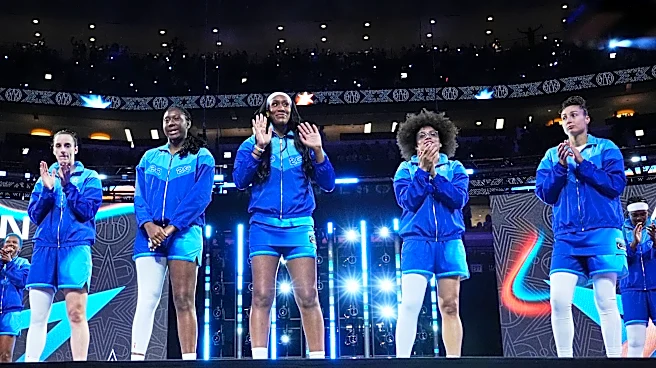


The Toronto Tempo can easily be construed as a team of twos. Two “T’s” tip off the team’s city and nickname. Toronto is one of two expansion teams to join the WNBA in 2026. Two guards, Marina Mabrey and Brittney Sykes, are the team’s flagship players, by scoring and by salary alike. Now, with the All-Star break concluded, starting the second of two halves to the WNBA season, Toronto has higher hopes for the second half than the first.
Toronto entered the All-Star break 10-16, tied for 10th place in
a league where the top eight teams—regardless of conference—make the playoffs. The Tempo sit four games out of a playoff spot, though just half a game back of the ninth-place team, albeit rueing three tight losses to the eighth-seeded Washington Mystics.
Let’s take a look back at the season that has been and then look forward to the second half of Toronto’s first-ever WNBA season.
The First Half
Here’s a look at the net rating in each Tempo game so far (compare with every team here).

Toronto finished its long, cross-Canada homestand just 2-7, which shows up in the net rating evolution: the team’s best performance of the season in Mabrey’s record 53-point game against the Sparks, and a tight win over the New York Liberty—to date, Toronto’s only win against a team above .500. Another, un-graphed highlight: Mabrey was named an All-Star and scored 23 points in the Chicago All-Star game.
Another story of the first half for Toronto has been injuries. Sykes, Temi Fágbénlé, Nyara Sabally, Julie Allemand, Kiki Rice… the list of players who have missed time to injury goes on.

While Toronto isn’t the most injured team in the league by total games lost, I think it’s fair to say that the team’s injuries have had the most impact. They’re missing out on an average of $676,714 in salary for each game lost to injury, the third-highest mark in the league. Toronto has lost more games to higher-paid players (e.g. Sykes, Fágbénlé) and has been more affected by the loss of such quality players than the rest of the league.
Those losses show up in the statistical overview of the Tempo. While Toronto sports the league’s seventh-ranked offence, 108.4 points per 100 possessions, the defence rating of 113.9 points allowed per 100 possessions ranks dead last in the WNBA (-5.5 net rating, 11th). Injuries have robbed the Tempo not only of key point-of-attack defenders Sykes (11 games missed) and Rice (16 games) but also key backend defenders and rim protectors Fágbénlé (16), Isabelle Harrison (10 games) and Nyara Sabally (eight games). The defence has had to deal with players going in and out of the lineup, and good offences have taken Toronto to task.
A guard-heavy team to begin with, the loss of the three bigs has taken an especially heavy toll. Rookies Teonni Key, Laura Juškaitė, and not-really-international-rookie Maria Conde have been forced to step up to play big minutes. That leaves the Tempo under-experienced and undersized, and—a desire on offence to shoot more threes notwithstanding—the team has given up a lot of ground in the paint as a result. Toronto scores the second-fewest points per game in the paint (42.9 per 100 possessions) but concedes the most (53.9 per 100). The Tempo allow the most restricted-area field goal attempts in the league, allowing teams to get to that highest-value zone 27.3 times per game (their 65.4 per cent FG% allowed is third-worst).
The same issues affect the glass, too, where Toronto consequently ranks last in total rebounding (47 per cent total REB%), 12th in offensive rebounding (28.5 per cent OREB%), and 14th in defensive rebounding (65.3 per cent). That turns into 17.8 opponent second-chance points per game, second-most in the league (with fellow expansion team Portland), and limits Toronto’s ability to get out and run in transition, where the league’s fifth-fastest offence is at its most deadly.
The Second Half
Toronto has 18 games remaining in its quest to make the playoffs in year one. It won’t be easy: nothing is, in the WNBA, and Toronto also figures to have the second-hardest remaining strength of schedule, per Tankathon. There are seven games still to come against the four best teams in the league, all in the Western Conference, and also two games left against the Indiana Fever and one against the Atlanta Dream. The Tempo will spend a lot of time on the road, with 12 of the remaining 18 games being played outside of Canada, and two of the “home” six to be played in Vancouver as part of the Cross Canada Series.
It’s all the more difficult, too, because not many of the injured players have recovered during the All-Star break, to quote head coach Sandy Brondello via Richard Deitsch.
Injury return timelines are pretty important. The trio of Sykes (with whom Toronto is 7-8), Mabrey, and Rice (with whom Toronto is 5-5) has posted a tremendous 116.2 offensive rating when sharing the floor (the defensive rating allowed is, uh, also high), per Databallr. With all three off the court, the team’s net rating is -18.4; with just Mabrey, soldiering on for 359 minutes by herself, the team’s net rating is -10.1. There’s work to be done either way.
But it’s work worth doing, because the first season has been a success. The Tempo hit on free agent signings, draft picks, and international acquisitions, building a brand in Toronto and across Canada. If Toronto is truly a team of twos, the second half of the season might adopt that success directly to the court.