


Once upon a time, back in the old Yankee Stadium, fans were permitted to go down to the field level behind and near the dugout during batting practice even if they did not have tickets for seats in that section, much like you can do these days along the foul lines in right and left field. Back in 2002, a pair of young fans, no more than six years old, did just that. As excited young children do, they called to the players, and while very few reacted, as their voices were drowned out in the din of the pregame
stadium noise, one outfielder noticed them. When he knew that these two kids were looking in his direction, he gave a sly wave, his hand half-hidden by the bat in his hand as he waited to take his turn in the cage.
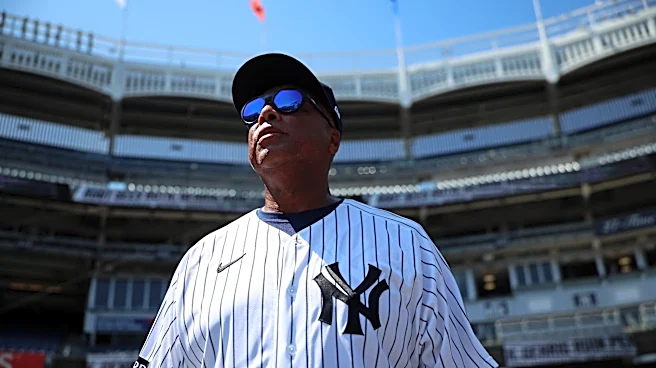
Of course, waving to two six-year-olds during batting practice isn’t exactly something that a professional baseball needs to hide. But by pretending that it was, this outfielder made those fans feel seen, giving them a much more unique memory than a simple wave normally would be — one that can be remembered just as vividly almost a quarter of a century later. That outfielder? Today’s birthday boy, Bernie Williams.
Bernabé “Bernie” Williams Figueroa Jr.
Born: September 13, 1968 (San Juan, Puerto Rico)
Yankees Tenure: 1991-2006
The son of a merchant marine and a college professor, Bernie Williams excelled in all sorts of athletic and non-athletic pursuits throughout his childhood, becoming an accomplished sprinter (winning four gold and one silver medal at the 1984 Central American and Caribbean Junior Championships), classical guitarist, and pre-medical student at the University of Puerto Rico. But it was baseball that was his first love, and so, when the Yankees signed him as an international amateur free agent, he put his other interests on hold to pursue baseball full-time.
Over the next few years, Williams established himself as one of the game’s premier prospects. It was not a smooth journey by any stretch of the imagination — he struggled so much in Triple-A in 1989 that he was dropped down a level, for example — but in the end, by the time he made his Major League debut on July 7th, 1991, he had been named Baseball America’s second overall prospect. He spent the next two seasons shuttled between the Bronx and Triple-A Columbus, before ultimately starting the 1993 season as the Yankees’ center fielder and leadoff hitter.
Because his former top prospect had not yet broken out as a veritable star by the end of ‘93, George Steinbrenner encouraged his front office to trade Williams that winter, with a rumored deal for Larry Walker possibly on the table. In the end, though, Bernie remained in the Bronx, and, obviously, everything worked out perfectly: from 1995 to 2002, Williams became one of the league’s top players, slashing .321/.406/.531 (a 142 OPS+) and averaging 5.2 rWAR per year while earning five All-Star nods, four Gold Gloves, and one batting title across that span. This performance earned him a seven-year, $85 million contract, as the team fought off strong pushes by the Boston Red Sox and the brand-new Arizona Diamondbacks to keep their superstar center fielder in New York.
More important than any regular-season and monetary accolades, however, was that fact that he came up big in October again, and again, and again, helping the Yankees to three straight World Series titles and four in five years, plus another two appearances in the three seasons following the threepeat. His 118 wRC+ ranks 341st among the 1335 players with at least 30 career postseason plate appearances, and his 22 playoff home runs remains the Yankees franchise record (and is bested only by Manny Ramirez, Jose Altuve, Kyle Schwarber, and George Springer).
After his seven-year peak came to an end following the 2002 season, Williams played for four more years. In an era before modern defensive metrics, Bernie remained the Yankees’ center fielder through the 2005 campaign, long after he was an asset with the glove in center field; as our very own Esteban Rivera wrote in his profile of Williams as the 13th greatest player in Yankee history, this “was the difference between remembering him as a Hall of Famer, and Hall of Very Gooder.” After the 2006 season, the team opted not to give him a guaranteed contract; rather than compete for a job, Williams declined the invitation to spring training, and that would be the end of his playing career — even if he did not officially retire until April 24, 2015.
Following his baseball career, Williams turned full-time to music. He had released a studio album while still a player, back in 2003, but it wasn’t until his second album, Moving Forward, released in 2009 that he established himself as a true musician, and not simply as a former athlete moonlighting as a musician. Throughout his career, he has collaborated with the likes of Bruce Springsteen, earned a Grammy nomination, went on tour, wrote a book about his baseball and music career, received a bachelor’s degree from the Manhattan School of Music, and, earlier this year, played at Carnegie Hall. Not a bad second career.
See more of the “Yankees Birthday of the Day” series here.