
Note: Apologies for this both being late and shorter than usual. I had a pretty bad cold to start the week, and the Texas power grid has been on and off the last 48 hours due to weather. So I couldn’t
put in play reviews like normal. The full season review will be a robust read with plenty of goodies in it, so that hopefully it will make up for things!
What a season it was.
Much like the script had played out for the majority of the season, it all came down to the last possession for the Bears Sunday night when they squared off with the visiting Los Angeles Rams.
After once again making the throw of the season, a 14-yard touchdown pass on 4th and 4 to Cole Kmet with 27 seconds remaining to tie the game and send it into overtime, the Bears once again had a chance to walk off as winners, after the Bears defense did their part in overtime, forcing a Rams punt on their opening possession.
But fate can be a cruel mistress.
After a 10 play 36-yard drive that saw the Bears offense reach the Rams 48 yard line, on 2nd and 8 Caleb Williams dropped back into a clean pocket and fired deep, hoping to get the Bears into prime field goal range, but the pass was intercepted by Rams safety Kam Curl.
It’s a play that’s been hotly debated since the game ended with the Rams kicking a 42-yard field goal on the ensuing drive to advance past the Bears to the NFC Championship. Overall my personal opinion aligns with former Bears quarterback and current film analysis Chase Daniel:
However I would like to expand some thoughts on it.
- On the decision to throw deep: I have no qualms with it, this is, and has been, a team that has lived off explosive plays and pushing the ball downfield. If the throw ended up completed we’re suddenly looking at a very makeable 37 to 38 yard field goal if the Bears don’t pick up a single yard after the throw.
- On the actual throw: I spend more time than I would care to admit on trying to grade the throw, to deduce whether or not it was accurate if DJ Moore had either anticipated his QB calling his number, and/or give full effort on the play. I’ve settled somewhere in the middle. I believe that if DJ is running his route full effort, and flattens it out into the zone underneath the breaking safety, that at the very worst this ball would just end up incomplete. So for my grading of the play I tacked Caleb with a turnover worthy throw, but not an additional negative mark as I believe DJ shoulders some blame for the turnover as well.
- On DJ Moore: I think it goes without saying that DJ Moore lacked effort on this play in particular. That’s not to say he CHOSE to do so, it could have been a miscommunication on responsibility of the play design, it could have been fatigue, it could have been lingering injury, as DJ missed a series earlier in the game due to it. But it’s clear on the tape that DJ was not going 100% on his route, whatever that reason may be.
When all said and done I charted 6 big plays (plays graded Great or Elite) against the Rams on Sunday, giving Williams a total of 13 in the 2025 playoffs. This translates to a 12.9% BPR, a rate nearly double his solid regular season mark of 7.6%, while his poor play rate in the playoffs did see an increase, it was by just 1.9%. So while his explosive took a huge just, his propensity for negative plays did not drastically increase.
All that said, I’m very excited about the direction of things, and I’m more than willing to say at this point that we have a franchise quarterback, and the right head coach to get the most out of him.
Benchmarks
(Totals and averages are all before the Wildcard round, Season totals are underlined, Season averages in Italics)
C/A: 330/568 (58.1%) | 19.4/33.4 (58.1%) | 23/42 (54.8%)
Yards: 3942 | 233.9 | 257
Touchdowns: 31 | 1.8 | 2
Turnovers: 8 | 0.5 | 3
QB at Fault Sacks: 14 | 0.8 | 0
ADOT: 9.0 | 9.4
Passer Rating: 90.4 | 59.3
True Passer Rating: 125.8 | 87.5
Time to Throw: 3.00s |2.96s
Time to Pressure: 2.67s | 2.67s
Pressure Rate: 30.84% | 31.11%
On-Target Rate: 67.6% | 73.2%
Poor Play Rate / Big Play Rate: 9.0% PPR / 7.6% BPR | 10.6% PPR / 12.8% BRP
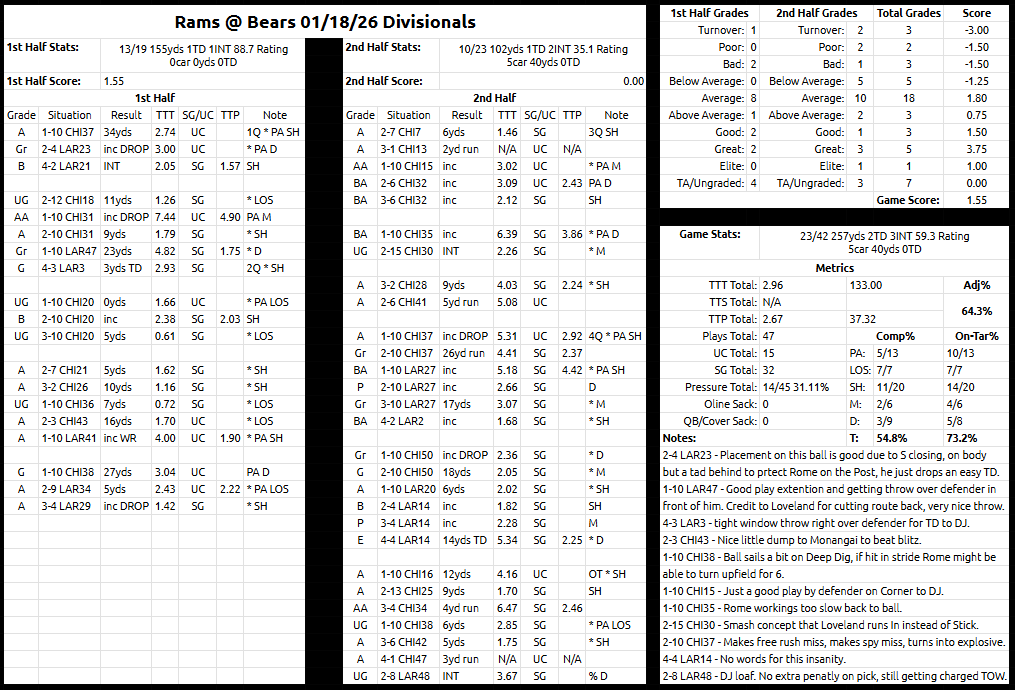
Game Scorecard

The full grading sheet for each play can be found here.
Game Notes
- NFL Passer Rating / True Passer Rating / PFF Grade: 59.3 / 87.5 / 65.8
- The average passer rating in the 2025 season sits at 91.4 for the 2025 NFL regular season. His 59.3 NFL Passer Rating would be considered a poor game.
- I’ve gone on ad nauseam about my dislike of the NFL passer rating, a 59.3 rating would lead you to believe Caleb was not effective at all in Sunday’s game, but he quarterbacked an offense that outgained, out possessed, and gained more 1st downs than the Rams. It had zero sacks and went nearly 50% on 3rd down.
- For comparison Matthew Stafford put up a 67.4 rating, which would tell you he had a better game, but in head-to-head comparison using grading metrics like ESPN’s QBR (31.6 for Stafford, 72.2 for Williams) and PFF grading system (42.2 for Stafford, 65.8 for Williams) it pains a MUCH better picture of these quarterbacks impact on the game, and the film backs that up.
- A 87.5 TPR is a Below Average game, with 100 serving as the baseline for “Average.”
- We also see a bit of a flaw in my personal metric as well, an 87.5 TPR would be backup level performance. When I created TPR I really wanted to stick to using at-fault turnovers alongside at-fault sacks, the main issue with that is if I’m going to be using TPR as a league wide metric, accurately, I would need to time to assess ALL interceptions thrown to deduce at fault turnovers. (Which is a can of worms in itself as that is subjective in itself, football will forever be a game impossible to quantify by a formula alone.)
- On the PFF scale, a score of 60 or higher is considered an Average game. With a 65.8 PFF Score, Caleb Williams’ performance was graded as solidly average.
- This aligns almost exactly with my grading, with a 1.55 being a solidly average game as well. Sometimes PFF can be a decent resource when it comes to their grading.
- The average passer rating in the 2025 season sits at 91.4 for the 2025 NFL regular season. His 59.3 NFL Passer Rating would be considered a poor game.
- On-Target Throws: Regular Season Average: 67.6% | Divisional vs. Rams: 73.2%
- Reminder: Completion % ≠ On-Target %. On-target throws are only counted on aimed passes, so throw aways, spikes, and deflections at the line aren’t counted. And drops are counted as on-target.
- Short-Level Passing (Behind LOS – 9 yards): 21/27 | 77.8% On-Target
- Deep-Level Passing (10–20+ yards): 9/14 | 64.3% On-Target
- A 77.8% On-Target rate would put him in the top 10 of the NFL it that were his season long number, as Williams continued to steadily improve his accuracy to end the year. Dating back to week 12 he had just two games sub 70% On-Target (67.9% in Philadelphia and 69.0% against the Packers in the Wildcard round.) Caleb talked about improving accuracy and footwork this offseason, but it’s comforting to know his accuracy has already taken a huge leap in the second half of the year.
- PPR/BPR: 10.6% Poor Play Rate (poor + turnover worthy graded plays) against a 12.8% Big Play Rate (great + elite graded plays)
- As mentioned earlier, his 12.9% BPR in the post-season nearly doubled his 7.6% mark in the regular season, fueled by 11 Great plays graded, and 2 Elite. He accounted for 339 yards of offense a game in his first trip to the post-season.
- And while his turnover worthy % did jump (1.97% -> 2.97%), I’m not too concerned over it due to sample size, and historical data backing Caleb’s ability to avoid turnovers. He’s only going to get better there in future playoff games.
- Time to Throw: 2.96s against the Rams this week.
- 6 of Caleb’s last 9 starts have seen a time to throw sub 3 seconds, which is essentially the mirror opposite of his first 10 starts in 2025, which saw 6 of those 10 being North of 3 seconds time to throw.
- To me this speaks to a few things, comfort within the offense, and decisiveness and willingness to throw within structure more often.
- 6 of Caleb’s last 9 starts have seen a time to throw sub 3 seconds, which is essentially the mirror opposite of his first 10 starts in 2025, which saw 6 of those 10 being North of 3 seconds time to throw.
- Turnovers: 5 total interceptions in 2 playoff games seems like an insane amount as we saw Caleb legitimately set records for his ability to protect the ball in the air in the last 2 seasons. But I think the craziest thing of that is 4 of those interceptions you could make legitimate claims that Caleb had either no blame in or partial blame can be placed on his receivers.
- 4th down interception on a pass intended for Luther Burden: on an Deep In requiring anticipation, Burden goes rogue, throwing up the mailbox, Caleb doesn’t see it, throws to where Burden should be if he were running the Deep In.
- 4th down interception on a pass intended for Cole Kmet: The play’s designed receiver DJ Moore, slipped on the goal line, on what would have been an layup touchdown. Caleb is forced to extend the play and with pressure baring down, throws up a prayer that gets intercepted.
- 2nd interception against the Rams: The Bears were running a Smash concept, which requires the underneath receiver to run a Stick route while the primary receiver runs as Corner. In situations where the underneath receiver reads man coverage, he can option that to a shallow In, to drag that underneath defender with him, making the throw to the Corner a lot cleaner. The Rams, unfortunately were in Zone, Loveland ended up freeing up his defender, which allowed the defender to drift back into the Corner route Luther Burden was running, causing the interception.
- The throw I outlined above that included a breakdown by Chase Daniel.
- The only throw I place full blame on Caleb is his 1st interception against the Rams, a throw that was too high on a open Colston Loveland. In any case, they all resulted in missed opportunities, something I’m sure the Bears will focus on moving into the 2026 season.
Summary
His final scores of the Divisional round of 1st Half (1.55) / 2nd Half (0.00) / Game (1.55) make this a solid Average game.
When you zoom out from the box score and even the heartbreak of the final interception, it is hard not to come away encouraged by what Williams put on tape in his first playoff run. The offense consistently moved the ball against a good Rams defense, created explosive plays, avoided sacks entirely, and sustained drives late into the fourth quarter and overtime. His accuracy continues to trend upward, his internal clock is speeding up in the best way possible, and his willingness to operate within structure while still hunting big throws is exactly what you want to see from a young quarterback making his postseason debut. The interceptions sting, especially when four of the five across two games involved either miscommunication, route breakdowns, or receivers losing leverage, but the larger profile still reflects a passer who elevated the offense and gave his team multiple chances to win on the biggest stage.
That is ultimately why I remain bullish on the Bears’ trajectory and on Williams himself heading into 2026. The advanced metrics, the situational tape, and the underlying efficiency trends all point toward a quarterback whose highs already tilt games and whose lows remain largely manageable, especially as chemistry improves and the margin for error tightens in future playoff runs. There are clear areas for refinement, and there always will be, but nothing in this performance suggests the moment was too big or the foundation unstable. When all the grading is tallied, the data and the film converge on the same conclusion.
As always, Bear Down, and sadly this brings us to the end of our weekly grades for the 2025 season. As mentioned we will be doing a large scale wrap up in the coming weeks with the data I’ve uncovered, as well as PLENTY of off-season things in store for us here at WCG. So stay tuned, and we will see you then!
Gary Baugher Jr. is a rookie contributor to WCG, bringing football insight backed by over 16 years of experience in organized football and more than 30 years as a passionate fan of the game. You can follow him on Twitter at @iamcogs.