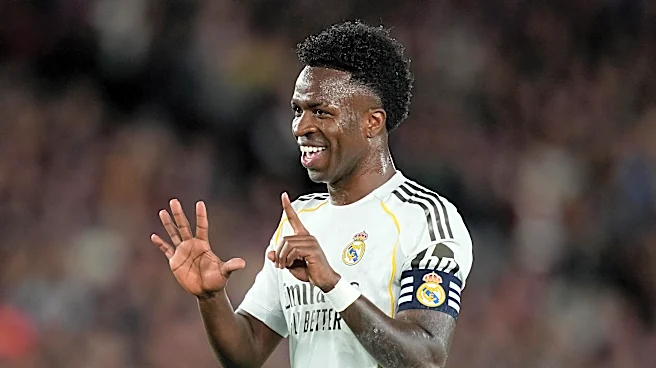




When Vinicius Junior arrived at Real Madrid at the age of 18, most expected him to be a future star who slowly gets developed over the course of several years.
But the timing of his arrival changed everything, and the footballing gods had other plans. The 2018-19 season—one of Real Madrid’s worst campaigns in the 25 years—the club collapsed in all competitions in the winter. The summer prior, Cristiano Ronaldo had departed the club, and when he left all of Real Madrid’s offense dried up. The team’s
build-up was labored and the team looked directionless.
Then interim head coach Santiago Solari, desperate to find a spark, decided to promote Vinicius from Castilla and throw the Brazilian into the fire ahead of schedule.
What happened was monumental: A very raw Vinicius tortured defensive lines for half-a-season with his dribbling, and, though his finishing needed a lot of work, he worked himself into the ground defensively. Despite Real Madrid enduring a forgettable season, they had a revelation: Vinicius is someone they can build the offense around in the post-Cristiano era.
The rise of football’s ultimate chaos creator
Vinicius created chaos, but it was with purpose. When Ancelotti returned to Real Madrid in 2021, he unleashed a version of Vinicius that laid waste to Europe.
With Ancelotti, Vinicius morphed into a better finisher, and, with that improved skill, he became one of the most decisive attackers in world football.
Vinicius was no longer merely a winger with upside; Real Madrid built the entire attack around his line-breaking ability. The team was unstoppable in transition, and Vinicius formed an incredible connection with Karim Benzema as the two conquered Europe together in 2022.
In Ancelotti’s first season, Vinicius led both La Liga and the Champions League in goal-creating actions, completed dribbles and carries into the final third. He also had the most key passes and defensive pressures in the Champions League. Above all, he became an unstoppable player in Champions League knockouts, and through a year stretch which culminated in two Champions League titles, he racked up the most goals and assists in Champions League knockouts in Europe.
Oh, and one minor detail: He also scored goals in two separate Champions League finals.
Vinicius’s rise changed how Real Madrid played, built their team, and in turn, how the rest of the continent had to cope. Opposing defensive lines sent multiple players at him to stop his cut-ins, and that freed up space for the likes of Benzema, Jude Bellingham and Rodrygo Goes.
From 2021 to 2024, no player in Europe was more inevitable in knockout football.
Brazil’s biggest question at the 2026 World Cup
Vinicius has conquered Europe, but internationally, the story is more complicated.
For all his brilliance with Real Madrid, he has not yet replicated that dominance consistently with Brazil. The chemistry, structure, and rhythm that allow him to thrive in Madrid have often felt absent with the national team. Some of that is because Brazil is not as talented as it once was, but some of that is also on Vinicius, who just hasn’t played as well for the national team.
Still, Vinicius is only 25 years old, and he has time to turn his international legacy around, and no manager understands how to maximize Vinicius better than Ancelotti does.
Brazil, however, remain outside the very top tier of favorites. Their qualification campaign exposed tactical flaws, and the overall collective level has not matched the elite international sides entering the tournament.
If Brazil are going to win the World Cup, it will almost certainly be because Vinicius elevates his game. They won’t be able to go far without him at his best.