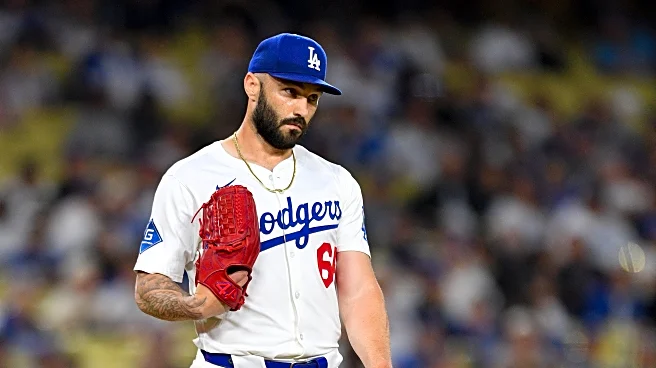




In hindsight, if one squints hard enough, the acquisition of Tanner Scott made sense.
The 2024 Dodgers had a bullpen that overachieved, but was getting a bit long in the tooth with Blake Treinen as the de facto closer. When the Dodgers acquired Scott in January, he was the best relief arm on the market.
In 2024, with two clubs overall, opposing batters had a slash line of .179/.285/.243, which is comparable to 2024-Billy McKinney. He routinely made Shohei Ohtani look silly in the 2024 NLDS, and by
acquiring Scott, the Padres are diminished in theory.
Scott was supposed to lead the new version of the bullpen dawgs, with Treinen, Kirby Yates, Michael Kopech, and Evan Phillips.
The plan did not work.
Frankly, Scott was a primary culprit. If Scott’s season could be distilled into a single word, that word would be “bad.“ The bullpen core as a whole blew 26 saves throughout the year. Scott led the way with 10 blown saves, a career high. If the 2025 Dodgers bullpen was just average, heaven forbid good, the team likely would have ended up with the top seed by mid-September at the latest.
The season started promisingly enough with Scott saving the first game of the year in Tokyo wth almost-boring efficiency.
Things went sideways almost immediately upon returning to the United States. No one could have envisioned what was about to happen next.
In 2024, Scott blew two saves all year in 72 games and 72 innings of work.
In 2025, Scott blew two saves by the end of April.
Granted, Scott had eight saves at this point, but they were more of the “hold on to your butts” variety (multiple batters and baserunners) than the “Game Over” variety. No one knew it yet, but it would get much worse.
To save time and sanity, let us instead review Scott’s year by month to see the bullpen carnage or why Dodgers fans needed so much antacid throughout the summer.
- March/April: 15 games, 8 saves (out of 10 chances), 15 IP, 2 HR, 14 K, 2.40 ERA, 3.00 FIP
- May: 12 games, 2 saves (out of 5 chances), 10 2/3 IP, 2 HR, 3 BB, 14 K, 7.59 ERA, 3.79 FIP
- June: 13 games, 8 saves (out of 8 chances), 13 1/3 IP, 1 HR, 14 K, 1.35 ERA, 2.69 FIP
- July: 7 games, 1 save (out of 3 chances), 6 2/3 IP, 3 HR, 5 BB, 8 K, 8.10 ERA, 9.70 FIP
- August/September: 14 games, 4 saves (out of 7 chances), 11 1/3 IP, 3 HR, 7 BB, 10 K, 7.15 ERA, 5.52 FIP
It is hard to pick a nadir of Scott’s season because it was generally bad. In June, the Dodgers got the reliever they paid for. Unfortunately, in 2025, as a Dodger, Scott had not pitched this poorly as a professional since leaving the Baltimore Orioles organization. Dave Roberts stuck with Scott throughout.
Scott is a two-pitch reliever: a 4-seam fastball and a slider.
Comparing the path of his pitches, Scott’s problem was fairly obvious: he threw way too many strikes, especially when compared to last year. One might wonder how this situation is a problem (see: Treinen, Blake), but if one’s slider is catching too much of the strike zone when it usually would not, then unscheduled batting practice in live games tends to break out.
In July, Scott left a game early with what turned out to be a forearm strain. Per Dave Roberts that night:
“Emotionally [Scott’s] not well. He felt something in his forearm, as far as a sting. We’ll get an MRI tomorrow, and we’ll know more after that,” manager Dave Roberts told reporters Monday night at Dodger Stadium, as shown on SportsNet LA. “Obviously if the pitcher has to come out of the game, it’s concerning.”
Scott was sidelined for about a month, and whatever effectiveness he had in June was a distant memory in some of the ugliest games to be “closed out” this year.
In a series in Baltimore that will likely pass into local legend, on September 5, Scott was walked off by the Orioles equivalent of Alex Freeland, Emmanuel Rivera (a prospect with no demonstrable bat at the major league level). Scott took responsibility for being terrible and lamented that baseball hated him.
Unsurprisingly, Scott could not read the room, as every other fanbase but the Dodgers loved him at this point, for he was hope incarnate for a Dodgers bullpen meltdown whenever he came into a game. Scott was reminding older fans of Brandon League in a non-complimentary way.
While the Dodgers did not lose every game in which Scott blew a save, he did blow enough saves in games that the Dodgers lost to cover the gap in the standings between the Dodgers and the eventual one-seed Milwaukee Brewers.
It had gotten so bad that fans would preemptively meltdown whenever Scott was summoned into a game. I speak from personal experience on that front. Because the following night, on September 6, Scott was tasked to get one measly out to save a game where Yoshinobu Yamamoto had gotten 26 outs in a failed no-hitter bid. Blake Treinen put Scott into an impossible position to get one out. He failed in three pitches.
The comedic timing of what happened next could not be scripted because it was too perfect, including the worst throw home from center field by Justin Dean I have ever seen.
One would think that September 6 was the nadir of Scott’s season, but another meltdown in San Francisco less than a week later arguably transformed Scott’s appearances from problematic to malpractice in an active pennant race.
On September 23 in Phoenix, Shohei Ohtani, in his final pitching tune-up of the season, threw six dominant shutout innings. The Dodgers’ bullpen, enabled by Jack Dreyer and Scott, managed to sour yet another gem of an outing.
Scott made just two more appearances in 2025 and earned a save against the Seattle Mariners in the final series of the year, but the reputational damage was done.
He posted career-worsts in just about every statistical measure. For the year, hitters had a slash line of .254/.321/.460, equivalent to slightly worse than 2025-Manny Machado. He had the third-lowest WAR on the staff (tied with Blake Treinen) and trailed only Matt Sauer and Noah Davis.
The question of who would be the closer during the postseason was answered quickly as Roki Sasaki was summoned to do what Scott was signed to do, which is a topic for a different day.
Scott made the Wild Card and Division Series rosters, but he did not make a single pitch in October. Justin Wrobleski replaced Scott on the Division Series roster due to Scott suffering a lower-body injury. Scott was thus ineligible to pitch until the World Series, which became moot considering Sasaki’s success. Per Dave Roberts:
“As I understand it, it was an abscess excision, some kind of lower-body minor procedure,” manager Dave Roberts said Thursday. “I do know [Scott’s] recovering well.”
After the Dodgers prevailed over the Blue Jays, Scott took to Instagram to celebrate:
Postseason 2025….put everything BEHIND me, got a new 🍑 and a WS 💍….can’t take it away from me! 2026 I promise I’ll be better for you!
Scott has not addressed his injury yet apart from the emoji, but I am sure the question will be answered before the start of the 2026 season. Scott’s promises to be better aside, with three years left on his contract, which is likely immovable at this point, the Dodgers need to upgrade their bullpen. Whether Scott’s 2025 means the arrival of Ryan Helsley (nope), Pete Fairbanks, Devin Williams (dang it), Edwin Diaz (seriously?!?), or any combination thereof of relievers unknown in 2026 is an open question.
The fact that the Dodgers even have to ask this question after making such a splash in the last offseason demonstrates the categorical failure of Tanner Scott in 2025. For what it’s worth, Dave Roberts still believes in Tanner Scott:
“I still feel that last year was an outlier year for Tanner Scott,” Roberts said. “Not to say that he needs to be a dedicated closer. But I feel that he’s going to be much improved next year. There are some things physically that he was dealing with — some that were talked about, some that weren’t.
“There were just some things he kept under wraps about his body, and I think the transition to LA — anything that could go wrong went wrong. He works his tail off. He’s too talented. And his track record was nothing like last year.”
2025 particulars
Age: 31
Stats: 1-4, 23 Sv (out of 33 chances), 57 IP, 60 K, 18 BB, 4.74 ERA, 4.36 FIP, 4.20 xERA, 1.263 WHIP, -.6 rWAR, 0 fWAR
Salary: $11 million ($5.25 million deferred)
Game of the year
On April 5th in Philadelphia, Scott became the fifth pitcher since 1988, the year that pitch counts started being tracked, to record a save on three pitches.
Roster status
Scott has three seasons left on his contract and will make $11 million ($5.25 million deferred) in 2026.