


INDIANAPOLIS—The largest arena in the NBA in terms of capacity is the United Center in Chicago, which can hold 20,917 fans. The biggest in college is Louisville’s KFC Yum! Center, which has a capacity of 22,090.
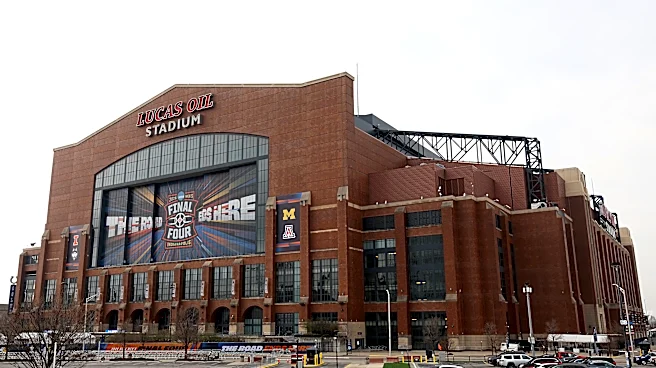
When the 2026 Final Four gets underway on Saturday, with Illinois and UConn meeting in the first semifinal, more than 70,000 people could be in attendance inside Lucas Oil Stadium. So it goes when college basketball is played inside a football stadium.
Friday’s open practice was the second
opportunity for players from all four teams to get used to the layout of the venue, with a court raised two feet above the team benches. Beyond the playing surface, there were the sightlines for shooting to acclimate to.
“It’s definitely weird being up, and the stands and all that stuff farther out, but we’re going to adjust and play our game,” Arizona guard Jaden Bradley said. “At the end of the day we’re all playing on the same court. I’m just a hooper, all I need is a ball and a rim and I’m going to get used to the environment.”
The NCAA has exclusively used football domes for the Final Four since 2000, and though each venue’s layout is slightly different what has stayed the same is the tendency for some bad performances from 3-point range. In the the 75 Final Four games more teams have shot below 30 percent (53) than above 40 percent (47).
That could bode well for the UA, which has become notorious for not relying on the perimeter shot. It has only attempted 53 triples in the NCAA tourney, making 23, while Michigan is 45 of 101.
Since 2000, teams attempting 15 or fewer 3s in a Final Four game are 21-16 compared to 15-12 for those taking 25 or more from deep. In the four games Gonzaga played in 2017 and 2021, with Lloyd on staff, it went 29 of 76 (38.2 percent) from 3.

From Yuma with love
The top-ranked player in the Final Four, according to NCAA.com’s Andy Katz, is a few months away from potentially being a lottery pick. Not bad for someone who was forced to spend three years in Yuma.
Yaxel Lendeborg, Michigan’s 6-foot-9 senior forward, began his college career at Arizona Western College in the same conference as Pima. He went there from New Jersey, where because of academic issues he only played 11 high school games and did not get through the NCAA clearinghouse.
“It was a culture shock, I was very depressed,” said Lendeborg, who said his mother made him to play junior college basketball rather than continue with a warehouse job after finishing high school. “As soon as I landed in Yuma, it was awful. There was no green anywhere. I didn’t see any trees. It was all desert. I see movies where they have tumbleweeds going across the street. I actually saw one, I was like damn, this is crazy.”
Lendeborg was a JUCO All-American his final two years at Arizona Western, and from there he was set to play at St. John’s before a coaching change landed him at UAB. Following two seasons there he joined Michigan, where he’s the leading scorer and a consensus All-American, and he credits his time in Arizona for getting him to this point in his career.
“Just being alone without my mom helped me trust people around me more,” he said. “I was a super shy kid back then. They broke me out of my shell. I had no confidence in myself when I went to JUCO, I didn’t want to go anywhere. But that journey has really felt like a dream, every step of the way.”
Born-again Boswell
The first premier recruit that Lloyd signed at Arizona was Kylan Boswell, a 4-star point guard from Compass Prep in Phoenix who reclassified in order to join the Wildcats as part of the 2022 class. That meant Boswell was only 17 throughout his freshman season in 2022-23, a fact that was ad nauseam on broadcasts.
Boswell spent two seasons at the UA, coming off the first year and then starting 35 of 36 games in 2023-24 when he averaged 9.6 points, 3.6 assists and 1.4 steals per game. His play was uneven, scoring at least 15 points eight times but five or fewer 10 times, and off the court there were issues as well.
A change of scenery was needed.
“I left Arizona to put myself in a more disciplined environment,” Boswell said Friday. “I knew who I wanted to be as a person off the court and who I wanted to be as a basketball player, and how I was perceived and all that. And I think I needed to surround myself back home, my roots, how I grew up.”
Originally from Champaign, Ill., Boswell lived there until eighth grade and still has plenty of family in the area, which made transferring to Illinois a no-brainer.
“I think going home has helped,” Illinois coach Brad Underwood said. “I think that a place that Kylan was so beloved, I think so many friends and family, and everybody says, well, sometimes that can be a distraction. I think it’s just been a source of comfort for him. Mom, dad, grandparents, everybody is right there. I think that our fans have great appreciation for one of their own. And then the way he’s handled himself has been—he’s just been elite. He’s been a joy to coach. He’s been unselfish. He’s been a guy that is all about winning. When I think of Kylan, I think of those things. He’s been a great teammate to everybody. He’s as much a part of this success, and it’s pretty unusual to do it from your hometown.”
Boswell has started 63 games with the Fighting Illini, including 29 this season, and is averaging 12.5 points, 3.9 rebounds and 3.1 assists. He missed seven games in January and February with a fractured right hand, and since returning has averaged 9.5 points and 2.6 assists.