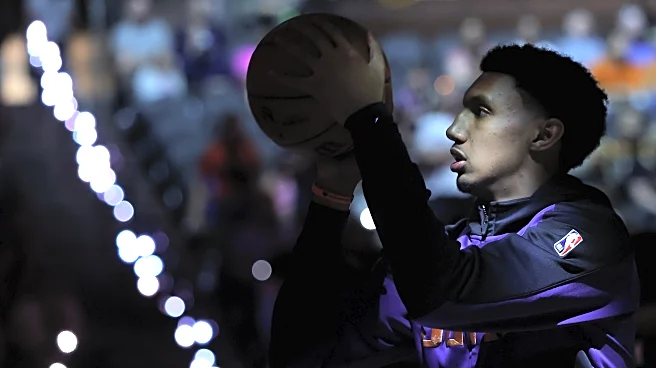



Ryan Dunn doesn’t enter the NBA as a classic “3&D.” He’s more of a “D&??,” an old-school pure defender with an offensive ecosystem still under construction. This asymmetry makes his study fascinating: you immediately see what he can become, but also what needs to be sculpted.
Early-season strengths
What stands out right from his first minutes is his reading speed. He anticipates drives like a veteran, cuts angles without overplaying, and allows the Suns to be more aggressive on-ball because he cleans up mistakes behind
them. His ability to track two actions at once, both the ball and the weakside, is atypical for his age.
His transition defense is already highly developed. He sprints back faster than the ball, cuts passing lanes, and turns dead possessions into neutral ones. Phoenix hasn’t had a player of this type since Mikal Bridges: long, mobile, disciplined, unfazed by screens. Both belong to the rare club of +1% BLK% and +2.5% STL% this season. Statistically, Ryan Dunn sits in the same category as OG Anunoby, Jalen Suggs, or Keon Ellis.
On the boards, he stabilizes the lineup despite being a wing, with 5 rebounds per game (just behind Mark Williams and Royce O’Neale). Defensive rebounding isn’t his primary focus, as he often is one of the first to leak out in transition. Where he truly stands out is on the offensive glass: 1.9 offensive rebounds per game and an incredible 8% OREB% for his position. It’s a discreet factor (though anyone watching sees how hard he fights nightly), but a major one.
Early-season weaknesses
Where Dunn still drags the team into a shadow zone is offense. His shooting mechanics aren’t disastrous, but they’re not yet adaptable. Too many slightly forced catch-and-shoot attempts; nearly 70% of his threes are open looks, yet only 32% accuracy on catch and shoot. That’s very weak for a player aiming at a starting role, especially since he doesn’t shine in other offensive areas either: 15th and 10th percentile this season in “Paint shooting & Midrange Talent” and “Movement Scoring Impact.”
He lacks variety in angles, offers little threat off-ball or with the ball, which explains his low offensive efficiency: ≈105 PSA, 53 TS%. That limits the lineup combinations the coach can use and, therefore, his overall playing time.
His handle is functional, not creative. In straight-line attacks, it works. But when he needs to manipulate a defender, slow down, change direction…you see the upper body and hips aren’t yet synchronized. He’s a young player who needs volume, repetitions, and above all, a framework where his mistakes are accepted.
Dunn can also over-help at times. His defensive instinct, if miscalibrated, pushes him to over-anticipate and leave corners open. A quality that turns into a flaw when discipline is still fresh.
Ryan Dunn embodies the archetype of the modern defender: instinctive, versatile, and already making an impact. His profile highlights a defense that can reach very high levels, but his offensive arsenal is still embryonic. The Suns’ challenge will be to give him the time and structure to turn his limits into weapons, without restraining his defensive energy. If he manages to stabilize his shot and enrich his off-ball game, he can become an indispensable starter. He is at the crossroads of the legacies of Mikal Bridges and Dillon Brooks.