






What a wild season Noah Cameron had. He went from fifth starter to team ace to nearly demoted and back to team ace. While last year saw him be incredibly consistent, this year was a year of very high highs and very low lows. The end result was a significantly higher ERA than his rookie campaign, but significant improvements in several other major statistical categories.
One thing I think can be very interesting when discussing baseball is figuring out what an “ace” is. Is it simply the best pitcher
on each team, or is there some sort of statistical cutoff? If there is a cutoff, where does it lie? The top 50 starters in baseball? The top 10? Or maybe it’s the top 30 so that, theoretically, each team could have an ace, even if some teams often have more than one of them, leaving the others out to dry. This is an important question when discussing Noah Cameron because there has been and will continue to be heavy debate about exactly what kind of pitcher he is.
I think we can easily agree that he is a major-league quality starter. I think we can also agree he’s something more than a back-of-the-rotation starter, despite the seven-game stretch from mid-June to mid-July that saw him put up a 7.94 ERA. But that still leaves us wondering: Is he a very good three starter? A regular two starter? Or is he a borderline ace?
If we go by that 30 best starting pitchers cutoff point, then he might be an ace. He finished the season tied for the 28th-best fWAR in MLB (2.8) and had the 30th-best K-BB% (13.4%) among qualified starters. He does come in at 80th by bWAR (2.0), but I’ve never liked the way it measures pitchers in particular, which is why I only bring it out for special occasions. He was certainly the “ace” of the Royals staff, leading the team quite comfortably in the first two categories, though bWAR has Michael Wacha ahead of him, all the way in 15th place (4.3).
So, yeah, I think you could argue that he’s actually been a borderline ace this season. But, because I know this is what we all want to do, what if we just looked at his numbers since that game in Detroit when he started calling his own pitches? Then he’s tied for 19th in fWAR, he falls to 34th in K-BB%, and he’s up to 11th in ERA (I can’t get bWAR over spans in the same way, unfortunately). So the quick takeaway from all that is, if you think that stretch was good, his overall season was in a similar place.
It’s easy to remember the awful stretch he was having before he started calling his own pitches, but if you followed all the landmarks I laid above, there was a stretch before that that was pretty darn good, too. In fact, it was even better than the stretch that won him Pitcher of the Month for August, but somehow it flew under the radar. From May 10 through June 7, he had 6 starts with a 2.38 ERA, a 22.1 K-BB%, and a total of 35 strikeouts in 34 innings pitched. That ERA ranks 13th, and the K-BB% ranks 16th over that span. He was a bit overshadowed at the time because Jacob Misiorowski and Cristopher Sánchez appeared to be redefining what being a starting pitcher could look like at the same time; they both had sub-0.50 ERAs over that span.
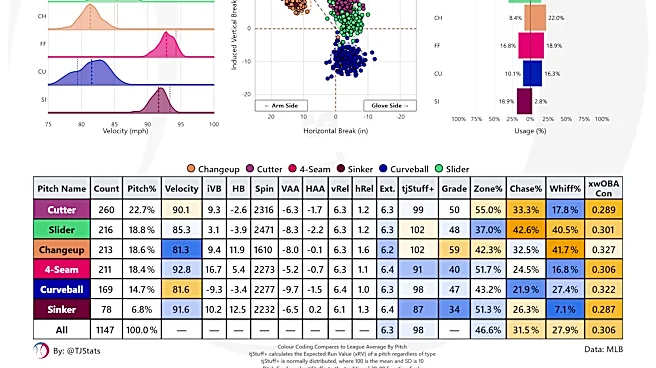
I love the pitching infographics we can get from TJ Stats, so let’s put up Cameron’s for the full season here, just so we can visualize some things:

There is a scary amount of blue on this page, so I can understand if you’re still a bit leery of what Cameron could be next year. I do feel it necessary to highlight that the blue xwOBACons are all at the bottom with pitches he threw less often, so at least he generally knew which pitches he should be throwing more. Let’s take a look at the graphic from the change:

That’s a lot more orange. Smartly, he drastically decreased the four-seam usage, a change I was calling for even as he was struggling. The cutter became his primary fastball without gaining much usage, which is good, because even now while it does get soft contact, he can’t get guys to swing and miss at it. Fascinatingly, the slider usage got increased almost to the same degree the fastball usage dropped, and it started really performing for him instead of being one of his worst pitches. You can see he started throwing it perhaps a bit differently, getting more horizontal break and less vertical break. That makes it act a bit more like a sweeper than it had before.
His changeup still came in at third in usage, but he modified it to make it go more straight down, and that led to significantly more chase and whiffs. The curveball looks impressive when he throws it, but it’s clearly his steal-a-strike pitch, so keeping its usage low makes a lot of sense.
So what are the takeaways here? For the second year in a row, Noah pitched better than his stuff. But this time he did it with improved three-true-outcomes results over last year in the form of a better K-BB% and fewer home runs allowed. And that’s if we just take in the full season numbers!
He also showed us over two different stretches that he can be a truly dominant pitcher. At the end of last year, we could tell he was definitely a back-of-the-rotation guy, maybe more. At the end of this year, we can tell he’s definitely a mid-rotation guy, maybe more. Hopefully by this time next year, we’ll know he’s a bona fide workhorse ace – did I forget to mention he’s the only Royals starting pitcher to miss no more than a single game with an injury over the past two seasons?
He is never going to be a Justin Verlander or a Max Scherzer. But could I interest you in a left-handed Sandy Alcantara? I know you could interest me in that. Noah Cameron gets an A from me. What say you?