

Big Ten play is finally here. The Gophers took care of business against Eastern Illinois and Akron, but in between they got run off their own field by Mississippi State. Which version shows up in Husky Stadium? To the (offense) preview.
The Numbers
- Points per game: 37.7
- Total yards per game: 394.0
- Rushing yards per game: 117.0
- Passing yards per game: 277.0
- Turnovers per game: 0.7 (2 giveaways in 3 games)
- 3rd down conversion: 45.2% (19-of-42)
- 4th down conversion: 80.0%
- Time of possession: 33:23
- Sacks allowed per game: 1.0
One thing to note: three of Minnesota’s touchdowns weren’t scored by the offense, with two punt return scores against Eastern Illinois and a fumble return TD against Mississippi State. Mississippi State held the Gophers without an offensive touchdown in that 38-13
game.
Key Players
This offense runs through junior QB Drake Lindsey, a 6-5, 230-pound NFL style pocket passer who takes care of the football. Through three games he’s 67-of-103 (65%) for 747 yards with four touchdowns and one interception. That one pick came against Akron and ended a school record streak of 232 attempts without an interception. Last season he threw for 2,382 yards with 18 touchdowns and six picks. In the Week 2 Mississippi State game, he went 31-of-48 for 279 yards, and he mixed some impressive throws with some flat-out misses. He’s not much of a runner, so this is a player you want to make uncomfortable in the pocket rather than one you have to spy.
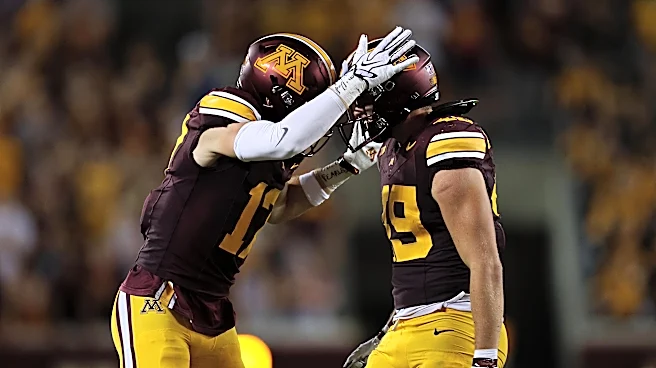
The big question is at running back. Senior Darius Taylor is the headliner, when healthy. He sits 10th in program history with 2,526 career rushing yards and has 103 career catches, the second-most ever by a Gopher running back. He ran for three first-half touchdowns in the opener against Eastern Illinois, but he played only 16 snaps against Mississippi State before leaving with an injury, and he’s missed time to injury in each of his four seasons for the Gophers. He sat out last weeks 41-7 victory over Akron and his availability is up in the air. If healthy, he’s a very talented running back at 6-0 and 215 pounds. His size gives him impressive contact balance, while also possessing very good agility. He’s a one-cut-and-go type of runner with the power to punish defenders when he finishes a run.
Without Taylor, the offense looks like a different team. Against Mississippi State, Minnesota managed just 13 rushing yards on 15 carries and 292 total yards. Elon transfer TJ Thomas has been the best of the backups and leads the team with 173 rushing yards on 23 carries (7.5 per carry), including a 71-yard touchdown against Akron. But, 154 of Minnesota’s 191 rushing yards in that game came in the fourth quarter when it was already 27-0.

The receiver room has three primary targets. Javon Tracy leads the team with 17 catches for 240 yards, and he also shows explosion/playmaking in the return game. Noah Jennings is Lindsey’s favorite target out of the slot. He leads the team with 26 targets and has 15 catches for 217 yards and a score. Jalen Smith was last year’s big-play guy. This year he has 10 catches for 104 yards and a touchdown after averaging 15.0 yards per catch last season with two catches of 60-plus yards. His touchdown against Akron came on a nicely placed fade in the corner of the end zone. The tight ends aren’t much of a factor in the passing game.
The offensive line is the strength of this offense, at least on paper. Left tackle Nathan Roy, left guard Greg Johnson and center Ashton Beers started all 13 games last season. Roy has a 85.1 PFF offensive grade that ranks sixth nationally among offensive linemen. Johnson was a preseason second-team All-American by the AP and Beers is on the Rimington Trophy watch list. But, for a line this well regarded, the Gophers are only averaging 4.08 yards per carry, which ranks 102nd nationally.
The Scheme
Minnesota used to be the textbook P.J. Fleck team: run the ball, shorten the game, and win ugly. That began to change in 2024 when QB Max Brosmer arrived, and the offense has revolved more and more around the quarterback since. After last season in which the run game ranked last in the Big Ten, the staff made it a priority to re-establish Darius Taylor on the ground and also get him more involved as a receiver. But with his injury this year they are only running the ball 24 times per game, third from the bottom in FBS. They run it less than 40% of the time overall.
The results so far have been…mixed. When this offense needs something, it turns to Lindsey dropping back and throwing. In the second half against Mississippi State, down 28-6, the Gophers ran 31 plays and 29 were passes. Even against Akron, they ran it just nine times in the first half compared to 23 Lindsey passes.
The good news for them is they don’t give the ball away. Minnesota committed only nine turnovers all of last season, and it has gone seven straight years without a negative turnover margin. Other than 12 penalties for 115 yards against Mississippi State, the most in Fleck’s tenure, they have played clean in their other two games.
Final Thoughts
The X-factor is Darius Taylor’s availability. With him, Minnesota has a balanced offense built around a quality line, a smart quarterback, and a halfback who can hurt teams as a runner and receiver. Without him, the run game dies, the offense becomes one-dimensional, and Lindsey has to throw 45-plus times to keep them in it.
If that happens, it’s a matchup Washington should love. The Huskies are allowing under 3 yards per carry and averaging 2.67 sacks per game. If the front wins on early downs and puts Minnesota in obvious passing situations, Walters can get aggressive. The flip side is that Lindsey rarely turns it over, so the defense will have to earn stops.
This is the most talented offense Washington has seen so far, and it’s a Big Ten opener, so don’t expect a blowout. But if Taylor is out or limited, and the Huskies stop the run early, a late kickoff in a loud Husky Stadium is a tough spot for a quarterback being asked to do everything himself.