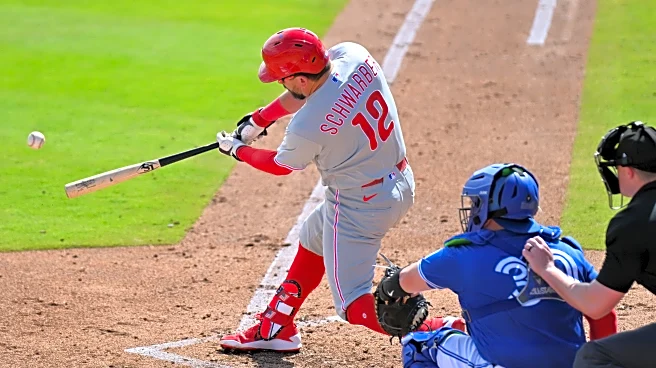



Bryson Stott had himself a productive spring this year. The Phillies second baseman hit .366 with a 1.072 OPS across 16 Grapefruit League appearances. Spring training stats are not a surefire precursor to a successful season, but in this particular case, Stott’s success continues a trend of improved hitting dating back to last season.
Stott hit .294 with an .855 OPS in 60 games after the All-Star break in 2025, and that’s including a brutal month of July where he hit just .194 in 20 games. If you
look from August through the end of the season, Stott was hitting .310 with an .880 OPS.
There are more reasons to believe the improvement is real in addition to those traditional back of the baseball card numbers too. Stott’s weighted on-base average (wOBA) improved on both fastballs and breaking balls from August on, and in the case of fastballs it was a significant increase.

Stott’s expected batting average on both pitch types also hit their season highs in August and September, offering dramatic increases from the early season months.

What this means is that Stott began impacting the ball more and at a higher rate of occurrence, leading to more well hit balls and base hits in general. He credits lowering his hands and understanding his limitations to the opposite field as major reasons for his success as he described to the Athletic’s Charlotte Varnes.
That ability to impact the ball has carried over so far into 2026, as Stott’s average exit velocity in spring training was 92.5 MPH, which if it happened over the course of a full season, would be the first time he had an average exit velocity that started with a 9. Stott has routinely been among the bottom of the league when it comes to hitting the ball hard with a career average exit velocity of 87.7.
Now of course, this is spring training and we’re only talking about 16 games and 48 plate appearances. It’s hardly reasonable to conclude anything for certain from such a small sample size. Even with Stott’s second half improvements last season, he still only had average exit velocities under 90 in his two months of greatest improvement. But Stott doesn’t need to be someone who rips the ball all the time either, as his skill set leads to being more of a contact hitter who sprays the ball over the field rather than swinging for the fences. That said however, he still needs to be better at impacting the ball, something he’s been able to accomplish since the end of last season.
Time will tell whether Stott is truly a new hitter or not. Once again, this spring isn’t a confirmation, but rather a continuation of a trend that started in August. It will be interesting to see if Stott’s improvements hold up as the league will no doubt adjust back at him as the regular season gets under way.
So, do you buy into Bryson Stott’s improvement? Has he finally found the secret to unlocking more of his offensive potential? Or will all of this prove to be a mirage once pitchers find a new weakness to exploit?