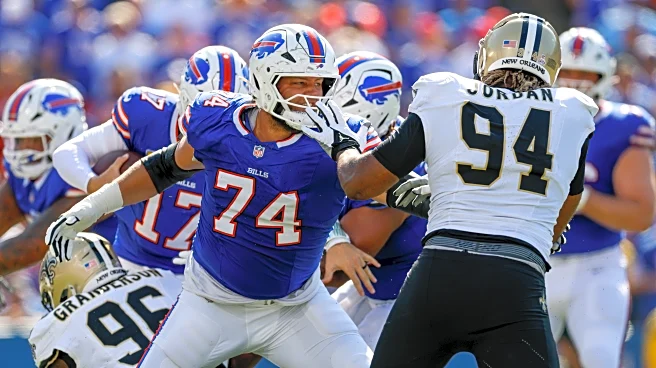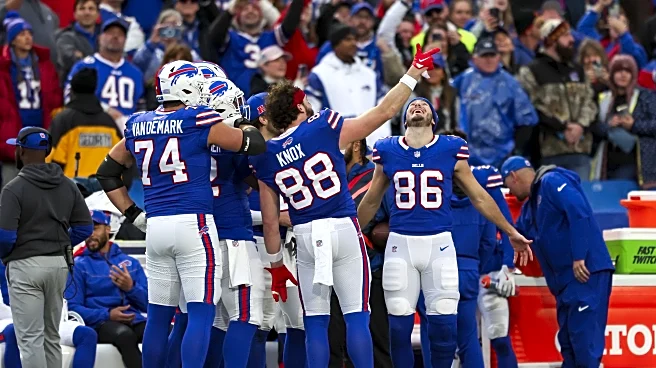

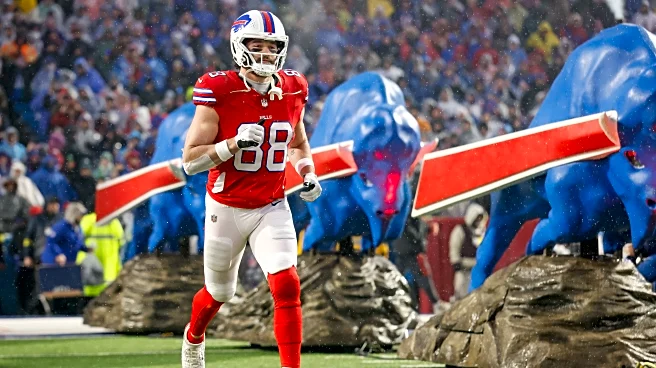

The Buffalo Bills relied heavily on their tight ends last season. Their top two tight ends both exceeded 40% of the team’s total snaps, and all three of their top players at the position played at least 25% of Buffalo’s overall snaps. While some of that snap share might have been due to injury, it’s clear that offensive coordinator Joe Brady loved using 12 and 13 personnel. Now, head coach Joe Brady will likely carry a similar philosophy into next season.
While we’re discussing the injury share, it’s
also worth noting that Buffalo’s best tight end was the player of their top three who played the least last season. That’s an unfortunate trend that has plagued that particular player throughout his young career. Can the Bills coax a healthier year out of their TE1 in 2026, or will it be more of the same?
In our latest look at the state of the Bills’ roster, we discuss the tight end group.
_____________________________________________________________________________
Dalton Kincaid
Contract Status for 2026: Signed; third year of four-year rookie contract w/fifth-year option ($3,670,425 cap hit; $7,942,659 dead-cap number)
Age: 26 (27 on 10/18/2026)
Playing Time: 12 games (4 starts), 302 offensive snaps (26.68% of team total), 1 special teams snap (.23% of team total)
Key Statistics: 49 targets, 39 receptions, 571 receiving yards, 5 receiving TD, 1 fumble
Whereas Buffalo’s top wideout last year was Khalil Shakir, who was always available, arguably their top pass-catcher is Kincaid, but his career has been plagued by injury. A lingering PCL issue has gone unrepaired via surgery, and while I have no medical degree, it seems odd that the issue has hampered him since midway through the 2024 season and he has continued the manage/rehab path rather than a full repair of the issue.
When Kincaid’s on the field, Buffalo’s offense is significantly more dangerous than it is when he’s off of it. With Kincaid attacking the intermediate levels of the defense, it opens up so much more for other players. Quarterback Josh Allen trusts Kincaid fully, and when the young tight end is on the field, he’s given his quarterback every reason for that trust.
If one’s best ability is their availability, however, Kincaid has been shoddy in that regard. He and the team need to find a management plan that allows Kincaid to maximize his time on the field moving forward.
Dawson Knox
Contract Status for 2026: Signed new three-year contract; terms have yet to be disclosed
Age: 29 (30 on 11/14/2026)
Playing Time: 17 games (12 starts), 653 offensive snaps (57.69% of team total), 1 special teams snap (.23% of team total)
Key Statistics: 49 targets, 36 receptions, 417 receiving yards, 4 receiving TD
Knox is a longtime Bill and a close friend of Josh Allen, but at a $17 million cap hit, which was what his old deal was set to pay him, there were really only two choices: Knox needed to be flat-out released or accept a pay cut. I assume that the Bills were able to recoup some cap space by signing him to a new deal; otherwise, a release would have been more prudent.
It’s clear that his rapport with Allen extends onto the playing field, as he has remained a trusted, solid target throughout his career. Knox was the de facto TE1 last season, and given Kincaid’s inability to stay healthy mixed with the Bills’ love of 12 and 13 personnel, having a strong tight end room is essential moving forward.
Knox wanted to remain in Buffalo, and he’s a big part of what the team does on offense. The Bills found a way to match their business needs with their players’ wants. Now, we wait to see what the actual numbers for the contract are.
Jackson Hawes
Contract Status for 2026: Signed; second year of four-year rookie contract ($1,085,504 cap hit; $240,162 dead-cap number)
Age: 25 (26 on 12/6/2026)
Playing Time: 17 games (8 starts), 487 offensive snaps (43.02% of team total), 79 special teams snaps (18.02% of team total)
Key Statistics: 19 targets, 16 receptions, 187 receiving yards, 3 receiving TD
Hawes emerged as a legitimate force on offense as a rookie, serving as a de facto sixth offensive lineman in the run game while providing a greater threat than Alec Anderson, the usual choice for an extra blocker, as a receiver.
Hawes graded out as one of the league’s best rookies regardless of position, and he was also among the league’s top tight ends. Pro Football Focus graded him at an 85.2 for the season.
His emergence could have made losing a player like Knox hurt a bit less, and even with Knox back in the fold, Buffalo likely wants him to take a step forward as a receiver if he is going to see an even larger role next season.
Keleki Latu
Contract Status for 2026: Unsigned; ERFA
Age: 23 (24 on 8/13/2026)
Playing Time: 5 games, 52 special teams snaps (11.98% of team total), 85 offensive snaps (7.51% of team total)
Key Statistics: 4 targets, 4 receptions, 35 receiving yards
As far as undrafted rookies go, Latu’s performance wasn’t something to ignore this season. He appeared in five games, which is likely five more games than Buffalo wanted him to play, and he looked like he belonged on the field in each of them. His role was quite limited, to be fair, but he is a solid receiver and athlete overall.
_____________________________________________________________________________
Final Thoughts
Buffalo will need to add someone here for camp fodder, but really I don’t see much of a need to change things. The Bills have an outstanding receiver at the position in Kincaid, an outstanding blocker at the position in Hawes, and a promising young player at the position in Latu. In Knox, they have an incredibly reliable, consistent player who just wasn’t worth his massive cap hit.
Knox is quarterback Josh Allen’s longest-tenured pass-catcher, and it’s clear that they have a rapport that runs deeper than just the football field. And, while Knox is nominally the TE2, thanks to Kincaid’s constant dings, he ends up serving the TE1 role more often than the Bills would like. That’s ultimately what I imagine led to Buffalo working to retain their 2019 third-round draft choice.
With Knox under contract for the foreseeable future, the Bills don’t have any need to invest resources at the tight end position. Perhaps they’ll add an undrafted free agent to compete during training camp and take snaps during the preseason, but they’re returning all four players from what was a strong unit last season.
There’s no need to reinvent the wheel here, and adding any other big-ticket players would be a total waste of resources. Buffalo’s tight end room is all set.