


Basketball turnovers are nothing if not lost opportunities.
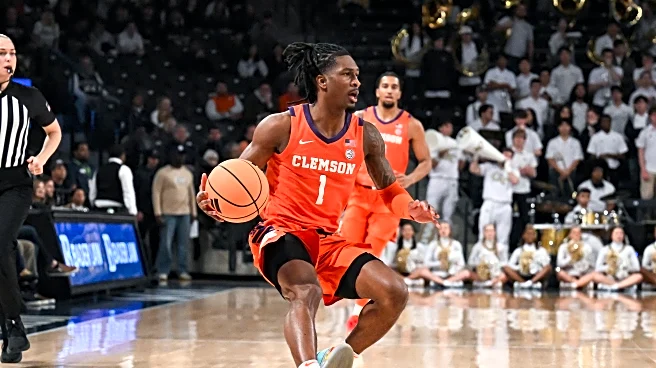
This season, there’s only one ACC team that’s making the most of its possessions in that regard, and that’s Clemson. Playing with toughness and tight discipline, Brad Brownell’s Tigers lead the league in a single official statistical category and that’s defensive rebounding percentage. But they’re also among the leaders in rebounding defense, defense on threes, field goal percentage defense, and scoring defense.
If you consider conference-only
defense, according to KenPom no one surpasses Clemson. (And everyone surpasses UNC.)
Playing to Brownell’s specifications, through the end of January the Tigers stood second in the ACC standings. This was no surprise, except for those not paying attention to the tenure of the league’s longest-serving current coach (16 years).
Clamping down on opposing attacks and limiting their own mistakes, the Tigers are the sole ACC squad without a single player committing more turnovers than assists. This team-wide strength is camouflaged when consulting routine statistical measures.
The ACC doesn’t report team turnover totals as a separate stat category. Clemson is eighth in the league in turnover margin and 10 in assists to turnovers, but plays at a tempo that lends itself to maintaining control without stifling its own initiatives.
A number of other ACC teams aren’t so solid with the ball. Four starters at both Boston College and Miami have more turnovers than assists. Another four league teams — Pitt, Stanford, Syracuse, and Wake — each have three starters committing more turnovers than assists, an obvious detriment in running an offense smoothly or precluding opponents’ breakout baskets.
Sure, turnovers can also be the result of aggressive offensive play. Some of the ACC’s greatest players, like Maryland’s Len Bias, ACC Player Of The Year in 1985 and 1986, had more turnovers than assists. But making too many miscues, or failing to understand when best to throttle back, can undercut the gains a strong attack might allow.
Of ACC teams with a majority of turnover-afflicted starters, after 21 or more games only fading Miami seemed to have viable NCAA tournament aspirations judging by NET ratings.
Still, things are looking up for the ACC overall. Forty league regulars had more turnovers than assists through January, including 34 starters. That compares to 51 in 2025, a season the league is still trying to live down.
Much-improved Cal, which had 38 more turnovers than assists as a unit in 2025, and Louisville are the only ACC teams with a single starter whose ballhandling miscues outweigh his assists this season. For the Bears it’s 6-7 Chris Bell (15 assists v. 28 turnovers), a Syracuse transfer, and for the Cards it’s musically-named Sananda Fru (29 to 36), a 6-11 junior with four years under his belt as a pro in Germany.
Duke has a pair of key perimeter performers with significant room for growth as ballhandlers. Dame Sarr, a sometime-starter notable for his defensive prowess, has more turnovers than assists (18-24). Sharpshooter Isaiah Evans, one of two Devils who’ve started every game this season (along with Cameron Boozer), had as many assists as turnovers (24 of each) over Duke’s first 21 games.
And here’s a stunning stat from a Jan. 31 game at Atlanta, which should thrill the Tar Heels and embarrass Georgia Tech. UNC had 20 assists and just 2 turnovers compared to 14 assists and 11 turnovers by the Yellow Jackets.
Every winner in intra-league competition on Jan. 31 had fewer turnovers than its opponent, except Cal, which matched Miami with 7 turnovers each in a one-point victory.
Note, too, that two of the highest-rated ACC teams, UVa and UNC, are among the worst in outshining opponents in avoiding turnovers.
| MANAGING OPPORTUNITY Listed By TO Margin (Through Games Of 1/31) |
||
| Team | Edge In TO/YrOpp. |
Avg. TO v. TO/G |
| NS | 213-305 | +4.23/22 |
| WF | 256-320 | +2.91/22 |
| VT | 236-301 | +2.83/23 |
| GT | 298-239 | +2.68/22 |
| FS | 265-322 | +2.59/22 |
| D | 236-284 | +2.29/21 |
| ND | 252-206 | +2.09/22 |
| Stan | 246-291 | +2.05/22 |
| UM | 253-298 | +2.05/22 |
| C | 217-261 | +2.00/22 |
| SU | 249-290 | +1.86/22 |
| Cal | 216-253 | +1.68/22 |
| UL | 242-268 | +1.30/21 |
| SMU | 248-276 | +1.29/21 |
| NC | 199-204 | +0.24/21 |
| V | 224-226 | +0.10/21 |
| UP | 242-242 | +0.00/22 |
| BC | 220-217 | -0.14/21 |