



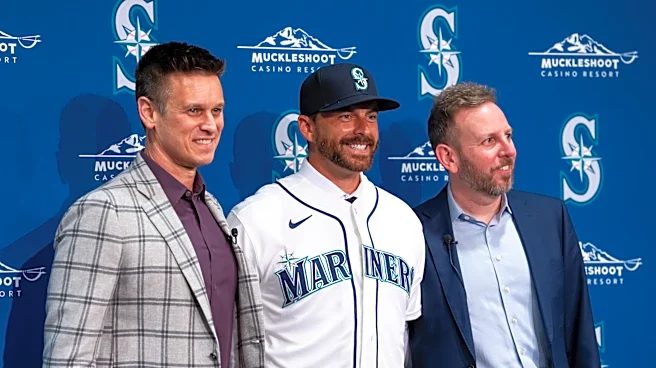
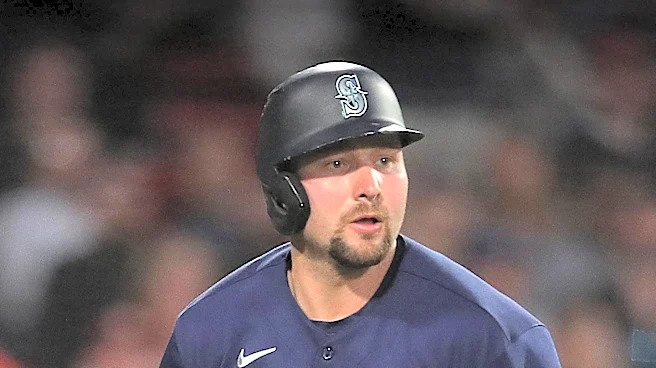

Jason Kanzler’s young son dozed off during the 45-minute press conference introducing Kanzler as the new Mariners manager, but he was the only one. The rest of the room was abuzz with questions, for Kanzler as well as Mariners execs Jerry Dipoto and Justin Hollander, who surprised the rest of the baseball world when it was announced the 36-year-old Kanzler would be accepting his first managerial job with the Mariners. That seemed to stand in contrast to a reported desire from the front office to find
a candidate with experience in a big-league managing role, and has drawn some early criticism around baseball when the hire was announced. But for Dipoto, the experience question wasn’t such a question.
“Experience is good,” said Dipoto. “In this case, we didn’t think it was good enough to dissuade us from all the traits that Jason brings to the table.”
Those traits were on display in today’s introductory press conference. Kanzler gave thoughtful, concise answers that expressed his viewpoint, sprinkled in with a couple more quotable aphoristic slogans that it’s not hard to see catching on in the clubhouse (or in the marketing department; at one point Kanzler said, regarding the atmosphere at T-Mobile Park, he wanted to “ride the lightning” and Kevin Martinez, sitting behind me, made a noise that made me think we’ll be seeing that on t-shirts by the weekend). He even cracked some jokes, referring to the Astros, his former employers, as “the team who shall not be named.” For a team that had well-publicized communication breakdowns last year, with that quality being at the top of my personal wishlist for a manager, it was an encouraging introduction.
“The way he communicates is very clear,” said Dipoto. “You won’t be confused as to what the directive is when you leave the station, and I think our players will pick up on that.”
Hollander noted the Mariners had actually interviewed Kanzler before, back in 2021 for a potential additional hitting coach job, but ultimately couldn’t pry him away from the Astros. But Hollander said Kanzler’s interview was so impressive that his name continued to be brought up on and off over the years, until finally landing in the Mariners’ managerial search this year.
“I think he left us no choice throughout the process,” said Hollander. “It was just round after round, conversation after conversation. He dominated the process to the degree that I think we would have been foolish to take all the hard work and throw it out the window and not choose him.”
Kanzler said he actually realized he wanted to manage during the interview process, when he had an epiphany moment that directing a farm and managing a team aren’t all that different – both are concerned with developing players on the micro and macro levels and figuring out how to help people be the best version of themselves.
“This came about quickly, and I realized equally quickly throughout it that managing a major league club is just the pinnacle of what I was already doing as a farm director, where I had to manage an entire minor league system. This is just a way higher magnitude, with brighter lights and a third deck, but in the end, it’s the same. I want to win. I want to develop people. I want to develop players. And I want to achieve something with a collective and a great group of people around me.”
Kanzler said that what he’s focused on right now is getting to know the players he’ll be managing and building relationships with them, a process he said he’s started and he describes as being of “the utmost importance” to him. For Kanzler, everything starts with those relationships before anything else can be accomplished.
“It’s important to have connection with the players. It’s most important to have connection throughout the entire thing. The entire organization needs to be connected towards the common goal of winning the World Series…I like to think that the sign of things going well is when people start using the word ‘we’ more than ‘me’ or ‘I.’ When the group starts talking in ‘we’, then I know that things are going well.”
The 2026 Mariners lost their way, something that was largely attributed to a lack of solid clubhouse culture or identity: too much passivity, players not moving in a unified direction. While Kanzler says he wants the identity of the Mariners team to surface organically (the most specific vision of culture he’d give was “step on their throats”), Kanzler’s view of what the 2027 Mariners could be surprisingly starts with what the 2027 Mariners will not be.
“Culture is, in my opinion, all the things that you don’t allow. All the things that don’t happen. It’s the things that you hold the line against. It’s doing, obviously, the big things right, it’s doing all of the little things right all of the time, but most importantly, it is not doing the wrong thing as much as humanly possible. What we allow is what we stand for, and that’s what culture means to me.”
For a team that played some of the worst defense in MLB, made embarrassing baserunning gaffes, and overall didn’t play disciplined, consistent baseball, that vision has appeal: firm guardrails to keep things from going off the rails as they did last season.
“Accountability” was a popular buzzword after the disappointing 2026 season, but Kanzler is quick to clarify that accountability first and foremost requires communication and a clear definition.
“My view [of accountability] is that it requires clarity,” he said. “People need to understand what they’re accountable for before you can hold them accountable. So it starts with clarity, simplicity. Even when the things we’re talking about might be complex, they need to be understood. When people understand what the goal is and they have a clear path to get there and they understand how to get there, then all the stuff in between takes care of itself, and it makes those conversations much eaiser.”
Those hard conversations are ones Kanzler has been having with players for years, at multiple levels, and like his approach to building culture – not imposing it but allowing it to develop organically – he doesn’t force things on players, but rather sees himself as someone who can facilitate the player to coming to better decisions.
“It doesn’t necessarily land well with anyone when they’re told, like, you need to do this, you need to think this. So the way I challenge players and people is I ask questions. I listen a lot. I hear them. I propose alternate ways of thinking or looking at a problem. With players in this game, they are going to be faced with an unending slew of problems, small ones and big ones. They’re going to have to make adjustments. They’re going to have to get better at certain parts of their game. They’re going to have to maintain other parts of their game. They’re going to have to deal with so many things. And I think the ability to help them come to the more correct behavioral outcomes and decisions to make themselves better, and to work themselves through those situations, the better.”
But even if his method is more hands-off – the old “praise publicly, criticize privately” – Kanzler indicates he’s not afraid to get in there and tear things up when the time calls for it.
“There are times where, you know, we have to rip ass with the whole team, and that’s fine. You just have to pick your spots. I’ve been in a major league dugout, I’ve been around major league players, I’ve been around major league clubhouses. I understand when that’s appropriate and when it’s not. But overall, we want to celebrate the things that we care about publicly to reinforce them, and I’d rather address things that need to be addressed privately, to start.”
For Kanzler, that desire comes from what he wanted during his brief minor-league career. His coaching career, culminating in becoming the Mariners’ manager, is a full-circle moment that allows him to pour into players what he craved from coaches as a player.
“I wanted to be coached extremely hard, I wanted things to be intentional, and those are things that have stood with me. I bring intensity to the things that I do, and I really want that delivered to the players. Each of these players is a human being, and they deserve individual, deep attention, especially at this scale, at this stage. We owe it to the fans, we owe it to the organization, and we owe it to the players themselves to give them what they need individually to help the collective win….These are people’s lives, and there’s a lot of people that care about what happens and how these players grow and how they perform.”
“I’m the right man because I believe that every player and every person can be better, and I believe these players so deeply want to be better, and to grow and to win as a unit, and I’m excited to get that out of them.”