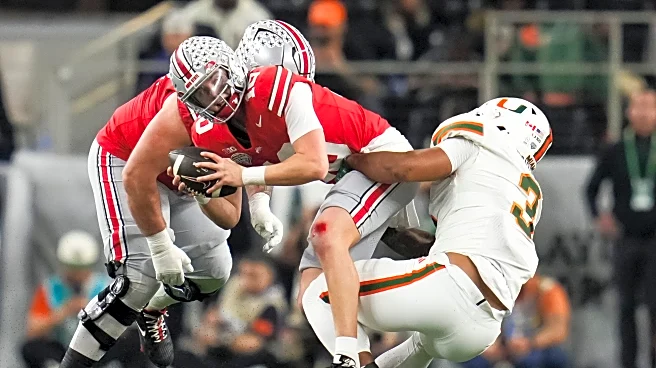


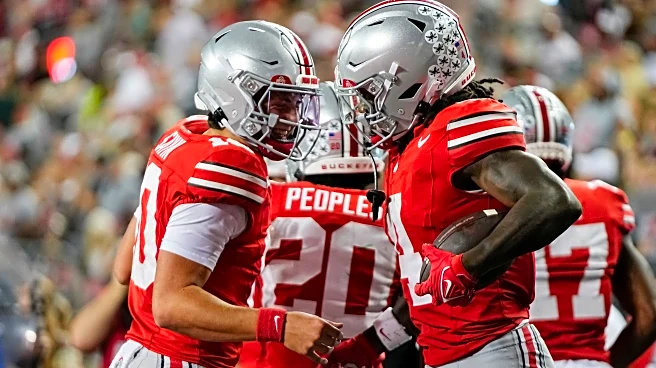
Ohio State’s season has once again come to an end on New Year’s Eve, this time in a 24-14 loss to Miami in the Cotton Bowl.
The Buckeyes came out of the gates slow on both sides of the ball, and a second quarter pick-six by the Hurricanes to make it a 14-0 game ultimately proved too big a hole to dig out of for an offense that was simply unable to find another gear.
Back in early November, Ryan Day said that Ohio State’s main goal this season on offense was chasing efficiency. The Buckeyes were perfectly
fine accepting only a handful of possessions each game as long as they resulted in points. That slower pace, in the long run, would, in theory, limit snaps for your starters over the course of the year, keeping them fresh for a College Football Playoff run.
Day insisted, however, that,“When it’s time to turn up the gas, we will.”
That was decidedly not the case.
Trailing 14-0 to begin the second half with its season on the line, Ohio State refused to up the tempo. The Buckeyes had only FOUR possessions over the final two quarters of the game, with one of those coming in the final minute of the game down by two scores.
Ohio State scored on its opening possession of the third quarter, a drive that spanned 11 plays and 82 yards while eating up 6:44 of the clock. Miami responded with a field goal drive, taking up another 5:04 of game time, but the Buckeyes answered with yet another long touchdown drive — 10 plays, 75 yards over 4:33 — to cut the deficit to 17-14 with now 13:28 left in the game.
It seemed as though Day’s squad had flipped momentum, forcing a Hurricanes punt and getting the ball back with over 10 minutes to go. However, even with the game hanging in the balance and time dwindling down, Ohio State’s offense was not equipped to speed things up and meet the moment.
Ohio State picked up 12 yards on its first play of the drive and later converted a third-and-15, all while continuing to let the play clock wind down with each snap. Following a questionable holding penalty and an incompletion, all the sudden the Buckeyes were forced to punt, and as a result of their own lack of urgency, there was now less than six minutes left in the game.
Put another way: Ohio State willingly ate up over four minutes in the fourth quarter of a three-point game against a gassed defense for a drive that netted six yards and resulted in a punt.
Miami would score on its ensuing possession to ice the game, as Matt Patricia’s defense, which had been so dependable all season long, seemed to run out of gas at the end after being let down by the offense for two-straight games to end their 2025 campaign.
Ryan Day and Ohio State played right into Miami’s hands by limiting its own number of possessions with a maddeningly slow approach offensively, regardless of the situation they found themselves in. It turns out that when you play one style of football for an entire season and never change it up, you cannot just magically flip a switch to ‘turn up the gas’ when your back is against the wall.
When push came to shove, the Buckeyes’ pursuit of efficiency over tempo netted them 10 points against Indiana and 14 points over Miami. In both games, each ending in a loss, Ohio State only got the football four times in the second half, with one of the four coming with under a minute to go.
Ohio State got out-coached both in the Big Ten title game and in the Cotton Bowl. The coaching staff let this incredibly talented group of players down, with a game plan that benefitted the opponent far more than it would’ve ever benefitted the Buckeyes.
There were obviously other reasons why Ohio State lost this game. This Buckeyes’ team, while dominant at times, had some clear shortcomings in a few key areas, and nearly all of those came home to roost against Miami.
Ohio State never got its run game going. While Bo Jackson had some great moments this year and was solid enough in this game, as a group it was an extreme drop-off from the TreVeyon Henderson/Quinshon Judkins combo of a year ago. The Buckeyes mustered only 45 rushing yards against Miami, and it kept the offense behind schedule all night.
The offensive line seemingly got worse and worse as the year went along. Earlier in the season the run blocking was a massive issue, but it was the pass blocking that really got exposed once Ohio State came up against talented defensive lines like Indiana’s and Miami’s. Between the two contests, Julian Sayin was sacked 10 times.
Then, of course, came the special teams woes, where yet another Jayden Fielding missed field goal potentially changed the final outcome of a game. The Buckeyes added a previously reliable kicker in the transfer portal, but instead elected to roll with the guy who has never made an important kick in his life.
The special teams unit also cost Ohio State on Miami’s eventual game-sealing touchdown drive, with a penalty giving the Canes the ball at the 30-yard line rather than from their own 11-yard line. Day refuses to take special teams seriously as the Buckeyes’ head coach, and it has actively cost them on the field in some of the team’s biggest games.
Even the play of Julian Sayin saw a pretty significant downtick towards the end of the season. UCLA seemed to figure something out defensively against Sayin, finding different ways to pressure him and confusing him with different looks, pre and post-snap rotations.
Having been completing more than 80% of his passes with four picks in nine games prior to that contest against the Bruins, Sayin completed under 70% of his passes with four picks over his final five. His average yards per game also took a hit, dropping from 276.8 to 223.8.
Sayin looked totally confused at times against both Indiana and Miami. He did not do a good job of stepping up and avoiding pressure as he had earlier in the year, he was completely unwilling as a runner to take off and pick up yardage when it was given to him, and he missed some wide open guys for potential game-changing plays, including what would’ve been a wide open touchdown to Max Klare one play before the pick-six.
All of these shortcomings were areas we had seen before this year. We knew a lack of an efficient run game, shaky offensive line play and a miserable special teams unit could eventually come back to bite them, and with the slow-play offense looming over it all with a young quarterback that defensive coordinators had seemingly figured out, it became a recipe for disaster.
Despite finally getting back on the right side of the ledger with a win against Michigan, its tough to feel like this season is anything short of a failure.
While its obviously hard to repeat as National Champions, Ohio State once again failed to win the Big Ten, and proceeded to lose to a less talented team in its first game of the College Football Playoff with a roster full of future superstar NFL talent on both sides of the ball.
A long offseason now awaits this program, with improvements needed from the coaching staff and player personnel alike.