
For more than 20 years, John Cena preached hustle, loyalty, and respect. Above all, he carried a message that resonated across generations: Never give up.
Perhaps for that reason, fans inside Washington’s
Capital One Arena were furious after Saturday Night’s Main Event.
In his final professional wrestling match, Cena lost to Gunther. Losing, however, wasn’t what pushed fans over the edge. Rather, it was how he lost.
With Gunther cinching in a sleeper hold, the crowd erupted: “Don’t give up! Don’t give up!” But despite decades of telling fans the opposite, Cena did the unthinkable — he gave up.
After the match, Cena saluted the crowd. As he said goodbye, WWE Chief Content Officer Paul “Triple H” Levesque joined him at ringside, alongside Stephanie McMahon, Cody Rhodes, longtime executive Bruce Prichard, and other company figures.
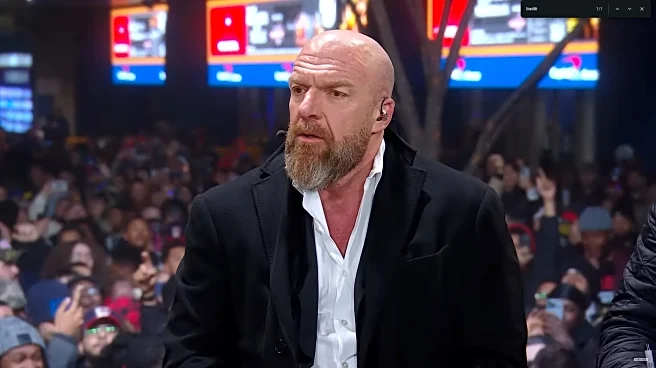
The mood shifted immediately. Fans showered WWE’s corporate leadership with boos, chanting, “You f***ed up!” Those chants carried into the post-show, where a defiant Levesque dismissed their emotions.
“C’mon,” Levesque said, urging the crowd to let it out. Then he brushed off the reaction entirely. “I’m actually mildly disappointed. I thought it would be so much louder.”
Whether John Cena should have lost his final match will be debated for years, but the manner of the loss — and Levesque’s response afterward — was absolutely the wrong call.
Tone-Deaf Company
Before Cena’s final match, WWE aired a video montage of fans offering farewell messages to the 17-time world champion. One fan from New York summed up what Cena meant to him.
“You’re like a father figure to me, honestly,” the man said. “Growing up without a father, watching you do your thing in the ring — never give up — it meant the world to me.”
He wasn’t alone. Similar testimonials highlighted how Cena transcended wrestling. He wasn’t just an entertainer; he was a source of motivation — and for some, the father figure they never had.
If Cena had to lose in wrestling’s time-honored tradition of elevating the next star, WWE had countless options. The deafening chants of “Don’t give up” made one thing clear: of all the ways for Cena to go out, this was the one fans didn’t want.
One could argue Gunther became a made man by forcing Cena to do the one thing he swore he never would. But in doing so, WWE — and perhaps Cena himself — betrayed the character.
Wrestling has seen this before. In 2001, “Stone Cold” Steve Austin shocked fans by turning heel and aligning with his longtime rival, Vince McMahon. For many, it marked the end of WWE’s Attitude Era. Though the company remained successful, a sizable portion of the audience checked out because Austin’s actions violated the character they believed in.
In Cena’s case, the right finish for his character was for his body, not his spirit, to break. By tapping out, Cena didn’t just lose a match — he abandoned the very foundation that defined him.
Time-Honored Tradition
In the post-show, Levesque defended the finish afterward, invoking wrestling’s “time-honored tradition” — putting over the next star on the way out.
“You do what is right for the business, you do what is right for this industry,” said Levesque. “John has done that his entire career, and I’m going to do that my entire career. I will do what I believe is right for this business. It just is what it is. And I understand that’s tough for people to understand, but it’s part of what we do.”
Most of the time, that logic holds. But tradition, it turns out, has always been flexible.
Bruno Sammartino, WWE’s original icon and a hero to fans much like Cena, went out on top in 1981, defeating George “The Animal” Steele in what was considered his final full-time match.
At WrestleMania III in 1987, “Rowdy” Roddy Piper left with his hand raised, beating Adrian Adonis in what he called his last match.
Five years later, Hulk Hogan — the man who replaced Sammartino as WWE’s face and became the blueprint Cena followed — also exited victorious. At WrestleMania VIII, Hogan defeated Sid Justice by disqualification in what was billed as possibly being Hogan’s last match.
In 2006, at Unforgiven, Trish Stratus retired in her hometown of Toronto by defeating Lita to win the Women’s Championship, leaving as champion.
Nearly a decade and a half later, The Undertaker ended a nearly 30-year WWE career by defeating AJ Styles in a cinematic match at WrestleMania 36.
Under different circumstances and with a different opponent, Cena could have walked away a winner, too, giving fans the feel-good moment they believed their surrogate father deserved.
Triple H’s Response
Regardless of how fans feel about the finish, Paul Levesque’s explanation for wrestling tradition was reasonable. His delivery, however, was not.
After mocking the crowd’s boos, he closed with, “I know people will criticize this. People will talk about this moment right here. I’ve got big shoulders, I’m good with it.”
It wasn’t an isolated moment. Earlier this year, ahead of WrestleMania 41, Levesque dismissed critical fans outright, saying, “I wish I could tell people ‘f*** off’ being a critic. Be a fan. Go watch this and be a fan.”
On Saturday night, fans did exactly that. They reacted emotionally to the downfall of a hero they believed in. In response, Levesque waved them off and boasted about his shoulders.
The Final Bell
Commercially, Saturday Night’s Main Event was a success. Capital One Arena was sold out, with more than 19,000 fans in attendance.
Whether WWE — and Cena — made the right call regarding the finish will be determined over time, measured in ticket sales, ratings, and goodwill. Wrestling moves on. It always does.
But when stepping back, understanding what Cena represented, and knowing that wrestling’s rules have always been flexible, it’s hard not to agree with the fans in Washington.
While WWE may have chosen the right winner, how they got there was wrong — obliterating the very principle that made John Cena who he was.