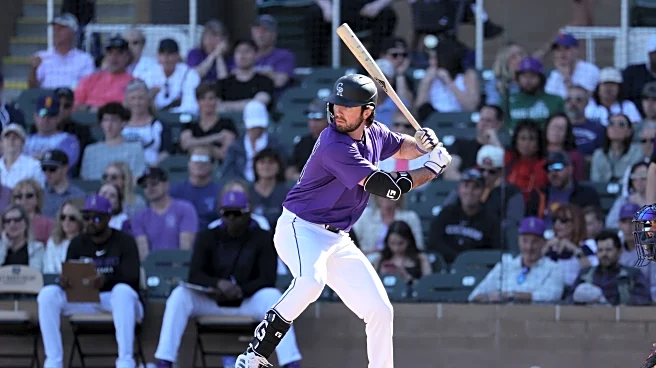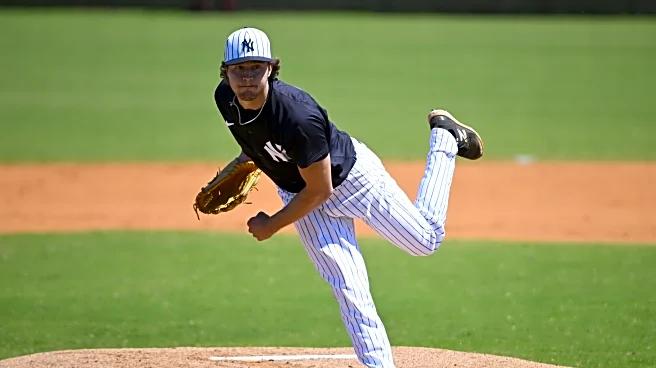

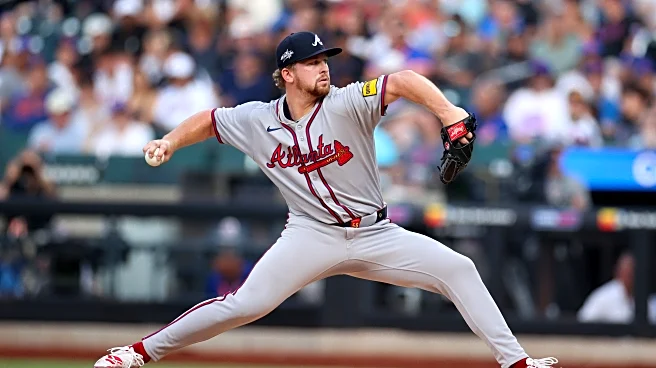
10. Griffin Herring (368 points, 19 ballots)
Herring was the headline prospect coming to the Rockies from the Yankees in exchange for Ryan McMahon near last year’s trade deadline. The 6’2”, 22-year-old lefty pitcher was the Yankees’ sixth-round pick in 2024 out of LSU as a draft-eligible sophomore. Herring signed for a $798k bonus that was over double the pick’s $340k slot value, more akin to a late third-round pick’s slot value. Herring was a key contributor as a freshman to the 2023 National Championship squad as an ace multi-inning reliever
despite velocity topping out in the low 90s, then was even more impressive in that role as a sophomore (1.79 ERA, 1.03 WHIP, 12.0 K/9 rate, 2.3 BB/9 rate) in 50 1/3 innings (which was third on the team) across 21 games.
Mid-season 2025 Rank: 14
High Ballot: 6
Mode Ballot: 10
Future Value: 40+, back-end starter
Contract Status: 2025 Trade, New York Yankees, Rule 5 Eligible After 2027, three options remaining
MLB ETA: 2027
As a professional, the Yankees not only gave Herring the opportunity to start, they remade his delivery and his pitch mix — emphasizing the slider. The result was a breakout debut professional season. Herring made eight starts in Low-A to begin the year and was dominant, posting a miniscule 1.21 ERA with a 0.9 WHIP and 11.7 K/9 rate in 44 2/3 innings as a league average pitcher. A late-May promotion to High-A (where he was 1.2 years younger than league average) didn’t faze Herring much. He threw eight more strong starts with another 44 2/3 innings, a 2.22 ERA, 1.16 WHIP, 8.9 K/9 rate, and 4.0 BB/9 rate — though his 3.71 xFIP indicated some good fortune.
After the trade in late July, Herring made seven shorter starts for High-A Spokane as the Rockies no doubt metered his usage considering his lower innings total in 2023 and 2024. In 30 innings with Spokane, Herring allowed eleven earned runs (2.40 ERA) on 14 hits and 13 walks ( 0.90 WHIP) while striking out an impressive 47 hitters (14.1 K/9 rate). In fact, Herring struck out over a batter per inning in every single start with Spokane, going a max of 84 pitches and five innings in those outings, and was named the August Pitcher of the Month in the Northwest League.
Across the full 2025 season, Herring threw 119 1/3 innings across two levels and three teams with a 1.89 ERA, 1.00 WHIP, 11.2 K/9 rate, and 3.7 BB/9 rate while allowing only a .530 OPS. That’s 149 strikeouts against 49 walks and 70 hits. Impressively, the lefty was even stingier when batters had the platoon advantage (.485 OPS for righties, .639 OPS for lefties), though Herring cut down the mightiest hitters in the league regardless of handedness.
Here’s some video of Herring in High-A in a mid June start:
Additionally, here’s an interview with Herring from August where he describes his adjustment to a new team and a new coast.
Keith Law of the Athletic recently ranked Herring 10th in the system:
Herring struck out 31.4 percent of batters he faced last year, the seventh-best strikeout rate among all qualifying starters in the minors. He sits 90-92 from a very high slot that gives him a ton of deception, working with a short slider that generates a ton of whiffs and an average changeup. He’s almost certainly a reliever between the slot and the below-average fastball, but could get there quickly and be valuable in any kind of once-through-the-order role. I wish he’d been traded to the Reds; I’m worried in Denver, he’ll get smoked.
Baseball America ranked Herring 12th in the system last month:
Herring has been developed as a starter, which might seem strange for a player with a fastball that averaged a tick under 90 mph in 2025, but his nearly seven feet of extension and slight pause in his delivery create an impressive angle of attack, plenty of deception and a whippy finish. He has found the most success so far with a mid-80s slider that generates plenty of whiffs within the strike zone. … If Herring wants to remain a starter, he’ll need to add more zip to his fastball, perhaps by packing on some muscle over the offseason. His profile and wipeout slider could fit better in a bullpen.
Shaun Kernahan of Three Quarter Slot wrote up Herring earlier this month:
Herring operates with a deceptive, athletic delivery from the extreme third-base side of the rubber, using extension, timing disruption, and angle to make a below-average fastball play above its raw velocity. The heater lacks pure velo, but the ride/run shape allows it to miss bats at the top of the zone when located, even if it can flatten out and get exposed when it leaks arm-side or into the middle. Your look showed a mechanical operation with a slow windup and quick finish, hiding the ball well but occasionally losing consistency through release, which ties directly to the fastball’s volatility. A modest velocity bump would materially change the profile, especially given how well the rest of the arsenal fits a starter look.
The slider is the clear carrying pitch, working in the mid-80s with tight gyro action and strong spin, consistently landing glove-side and missing bats against both lefties and righties. The changeup is better than most give credit for, showing real vertical separation and late tumble when executed, particularly effective against right-handed hitters. Strike throwing is generally solid, though command can waver within outings, leading to stretches where hitters are off balance followed by lapses where he misses his spots. His background as a high-leverage reliever at LSU shows up in the competitiveness and ability to execute secondary pitches, but the long-term path hinges on fastball improvement. If the heater takes even a small step forward, there’s a workable starter track; if not, the slider/changeup combination still fits an innings-eating role or leverage usage where the deception and bat-miss traits can play up.
MLB Pipeline is high on Herring, ranking him 9th in the system as a 45 FV player with a 60 grade on the slider:
Herring’s best pitch is a sweeping mid-80s slider with horizontal and vertical action that confounds both lefties and righties. He can’t overpower hitters with his fastball, which operates in the low 90s and tops out at 94 with some armside run, and he’ll need to find more velocity or life against better competition. He threw only 11 changeups at LSU but emphasized the pitch more during three Cape Cod League starts last summer, showing some decent if firm mid-80s cambios with depth.
Herring has a long arm action and a less-than-smooth delivery, though it throws batters’ timing off and didn’t stop him from pounding the strike zone as a sophomore. To succeed as a pro starter, he’ll need to add more strength to his 6-foot-2 frame and improve his fastball and changeup. If he can’t, he still could become a high-leverage reliever thanks to his slider and mound presence.
Eric Longenhagen at FanGraphs ranks Herring 20th in the system as a 40 FV pitcher with a 55 future grade on the slider and command:
The Yankees made several changes to Herring after drafting him (more sliders, better extension, higher arm slot) and the result looks like a stable backend starter despite 30-grade fastball velocity.
Herring spent two years as LSU’s most consistent long reliever (working as many as five innings) and was a draft-eligible sophomore in 2024. The Yankees made multiple changes to his delivery and pitch usage, which helped him dominate Low-A and earn a promotion after just eight starts. He had a 1.71 ERA combined at both levels at the time of the trade, though his K% dipped quite a bit after he was moved up to Hudson Valley. Herring’s fastball only averages about 90 mph, but lives off deception and riding life. Since turning pro, his arm slot has been raised, but Herring’s stride down the mound has gotten bigger and longer, and his extension was just shy of seven feet at the time of the trade. His loose, whippy arm action prevents hitters from seeing the baseball until release, and despite lacking anything close to average big league fastball velocity, Herring’s heater has generated above-average miss and chase so far this year.
With the Yankees, Herring also emphasized use of his slider, which has become his most-deployed pitch. It ranged from 80-85 mph in his final outing prior to the deal, and has tight late movement but lacks huge depth. It’s playing like an above-average pitch in pro ball. Herring didn’t really have a changeup in college, but he’s added one as a pro and is throwing it about 14% of the time. His feel for it isn’t bad considering he’s just begun using it, but it often cuts on him or finishes too high. A smooth on-mound operator, Herring looks the part of a starter even though he isn’t especially physical because of his mechanical grace. It’s impressive that he’s maintained his excellent college strike-throwing even though his delivery has been changed, and he projects as a high-floored backend starter.
Herring joins fellow PuRPs Carson Palmquist (No. 19) and Sean Sullivan as left-handed Rockies pitching prospects who use deception and extension to make mediocre fastball velocity play up. Herring hasn’t yet proved his effectiveness against upper-minors hitting like the other two pitchers have, but he is my favorite of the group given his weapon of a slider and is a 40+ FV player for me, ranking tenth on my list. I expect Herring to start in Double-A this season, with a big league debut possible later in the year if he’s successful and healthy.
Please keep in mind our Purple Row Community Guidelines when you’re commenting. Thanks!