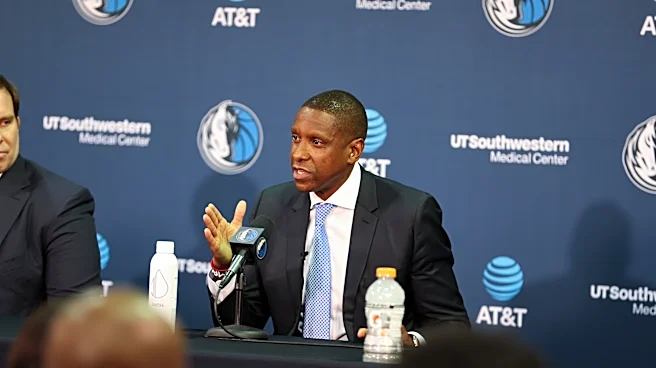





When Masai Ujiri was hired he was tasked with a difficult balancing act; build a competent winning team, and set up success in the future. The idea of a full rebuild is sadly impossible due to the lack of draft picks over the next 5 years, and Cooper Flagg’s rapid ascension could mean the desire to win sooner rather than later.
But the Mavericks can’t go all in right now.
The roster is full of odd-fits and mismatched timelines. The addition of the 9th pick further complicates this dynamic because that
player will need development.
But blowing up the roster is also not an option, so what do the Mavericks do?
Well I decided to put on my GM hat and take the Mavericks through an entire simulated offseason. This will include everything from coaching hires to mock trades, all in an attempt to correct both the present and future of the franchise.
But before we dive in, what are the specific goals the Mavericks must accomplish this offseason?
- Use aging veterans and financial flexibility to acquire future draft assets
- Build the current team to suit Cooper Flagg’s playstyle
- Begin building the foundation of the basketball culture that will define this era
So with all of that out of the way, let’s begin
The head coach
The first order of business is to hire a new head coach, and with the Mavericks being very early in their search we can only speculate on the potential hire.
But for this excersise we will hire former Portland Trailblazer head coach Tiago Splitter as the next leader of the Mavericks.
Splitter had an impressive season for the Blazers, as he stepped in when Chauncy Billups was fired in an FBI gambling investigation. Splitter led the Blazers to the playoffs, an impressive feat given the impossible circumstance he was placed into.
Splitter would bring a focus on offensive organization and a more balanced shot diet, as the Blazers attempted the majority of their shots at the rim or from three. This change is philosophy is much needed for a Mavericks team who were nearly last in both three point attempts and percentage last season.
Finally, Splitter would have a connection to current GM Mike Schmitz, with the pair overlapping in Portland for a couple of years.
The Kyrie conundrum

With all the talk of resetting the timeline it may feel obvious that Kyrie Irving would be on the trade block.
But it may be smarter to keep Irving for the time being. Irving can still provide value on the court even if his athleticism is diminished from his ACL injury. But this injury is the reason the Mavericks should keep him, with his trade value probably being diminished from where it was before he got hurt.
Now this doesn’t mean the Mavericks shouldn’t listen to offers, and if they get a package that can restock their future draft assets, they should take it. But I don’t expect teams to be lining up with packages that involve multiple first round picks, which is my minimum with any Irving trade.
It would be smart to keep Irving around for now, with any trade being revisited at the deadline. This would allow Irving to come back and show his extraordinary abilities, and possibly drive his price to the point where a trade would make sense.
The Draft
By far the single most important aspect of the Mavericks offseason will be nailing the draft.
The Mavericks do not own another outright first round pick until 2031, and won’t have another opportunity to acquire a premier young player for some time.
Not only do the Mavericks have to draft a player with high-upside, but they also have to fit next to Cooper Flagg long term. Now the draft is still two-and-a-half weeks away, and the order could be shaken up dramatically. But it feels obvious that the Mavericks need a guard, but whether that player will be a ball-handler is still unknown.
The most likely players in my opinion are either Brayden Burries or Kingston Flemings, 2 players with wildly different skillsets. It remains to be seen if the Mavericks want the more pro-ready candidate in Burries, or the higher upside bet in Flemings, either way, a guard being drafted feels extremely likely.
For this excersise, I will default to the mock draft that we recorded on Pod Maverick last Monday, in which the Mavericks selected Flemings.
Flemings would immediately fill multiple holes within the team, serving as a primary point of attack defender, and another downhill threat. He would also help as a floor-general, as his 32.6% AST ranked in the 86th percentile. His shooting is a large concern, but his on-court play and high basketball IQ make him a tantalizing fit on this team.
But the Mavericks also posses the 30th pick, where I will again default to the previously mentioned mock draft, in which the Mavericks select Meleek Thomas.
Thomas was a Freshman last season at Arkansas, and while he was overshadowed by his teammate Darius Acuff Jr., Thomas was still very impressive. His most standout skill is his three-point shooting, as Thomas shot 41.6% from three on 5 attempts per game. Thomas’s size and defense are real concerns, but he would fill the most desperate need on the roster, and could become a very useful player.
Finally, the Mavericks have a second round pick, but this pick will be used in a trade later on.
Overall, the additions of Flemings and Thomas would help to address 3 biggest needs of the current roster. They would also be building blocks of the future, as both were just freshman in college last season.
Possible re-signings

Before the Mavericks can make any new additions to the roster, they have some decisions about players currently on the team.
The 5 players who could receive an extension this offseason include: Dereck Lively, Naji Marhsall, Max Christie, Ryan Nembhard and Moussa Cisse.
The first 2 that we’ll focus on are Nembhard and Cisse, as both will be receiving extensions in this scenario. Nembhard will be signed to a 3 year $9 million deal, and Cisse will be signed to a 2 year $6 million deal. Both of them showed potential last season, and can give you rotation minutes at the very least. Cisse especially showed tremendous upside, and he should be kept around no matter what.
Resigning Nembhard means that Brandon Williams is gone, and while I enjoyed watching Williams play, I do not believe he fits next to Cooper Flagg.
The next player to receive an extension will be Marshall, signing a 3 year $45 million extension. This was the hardest decision of this bunch, but in the end, I felt it was better to keep Marshall around rather than trade him. His new deal is also not very expensive, and if he needs to be moved in a future transaction he still can be.
Finally we get to both Christie and Lively, 2 players who fit Flagg’s timeline, but have significant issues that hinder my excitement.
First with Christie, while he is an effective 3 point shooter and decent defender, his impact is inconsistent at best, and is not worth a potentially lucrative extension. This carries risk due to his current contract because of his player-option next season. If the Mavericks choose not to extend him now, he could become a free agent next offseason, but that is a risk that Mavericks must be willing to take.
On the other hand, there is not questions about Lively’s impact when he plays, as the young big-man has consistently been one of the more impactful role-players in the league. The issue, of course, is his health, as Lively has played in fewer than 50% of the possible games in his career.
But his health issues could help with his next contract, with the Mavericks having the option of extending him now at a cheaper price, rather than waiting for restricted free-agency. The contract I have devised is 4 years 64$ million, but with the only guaranteed seasons being the first 2. This type of contract has been done before, and allows for a compromise between the 2 parties.
Now this still carries risk, especially if Lively is a shell of himself due to the injuries, but the upside is tremendous. If Lively is able to overcome his early career injuries, the 16$ million contract per year will feel like a steal.
Trades
Finally we have reached the most exciting part of any mock offseason; trades.
P.J. Washington
Dallas receives: Keldon Johnson, 2027 Atlanta Hawks first round pick
San Antonio receives: P.J. Washington
This trade has been brewing in my mind while watching the NBA finals, specifically with how much the Spurs have struggled to contain Karl-Anthony Towns. Washington has proved to be a great defender in his time with the Mavericks, and fills a roster hole the Spurs have. The Spurs do not have a player of Washington’s build on roster, and should be in the market to upgrade if they end up losing in the finals.
For the Mavericks this trade is simple; a 2027 first round pick alleviates pressure for next year’s team. If the Mavericks had the security of this pick they would not feel forced to win games, and could put a greater focus on development. This pick is also not a meaningless first, as it would not be surprisng if the Hawks pick could end up in the lottery.
The real hold up for this trade could be the inclusion of Keldon Johnson, with the Spurs possibly being hesitant to move off of the reigning 6th man of the year. But if they feel the need to make major improvements next year, Johnson’s $17 million contract will have to be moved.
Daniel Gafford

Dallas receives: Jarred Vanderbilt, 2032 Lakers first round pick
Los Angeles receives: Daniel Gafford, pick 48
This next trade could trigger some Mavericks fans, with the prospect of helping the Lakers being the last thing many fans want.
But feelings cannot get in the way of a good deal, and this deal makes perfect sense for both teams.
The Lakers are in desperate need of more athleticism and size across their team, with Gafford bringing both in spades. There is also the connection that Gafford and Luka Doncic share, with the ladder being able to advocate for the big men’s services. If the Lakers want to keep Doncic happy they need to continue to add more talent, and who makes more sense then a starter on Luka’s only finals appearance.
The purpose of this trade for the Mavericks is simple; adding another unprotected first round pick. Obviously 2o32 is 6 years away, but all first round picks are incredibly valuable. Whether the Mavericks ever use this pick isn’t the point, rather, gaining more assets and flexibility gives the Mavericks more avenues to build around Cooper Flagg.
So why did I choose these 2 players to trade?
Simply put, their skillsets are redundant on the current roster, and both will be on the decline when the Mavericks are actually ready to contend. The Mavericks already have a plethora of center options, with Gafford being the oldest and most worn down of them all.
Washington’s issue is his fit next to Flagg; simply put, it doesn’t really work. Both players occupy similar roles defensively, and have similar size and athletic profiles. Washington also pigeon-holes Flagg at the 3, rather than his more natural position at the 4.
Finally, Washington does not provide the requisite shooting the thrive off of Flagg’s gravity, and unlike Marshall, he cannot be a primary ball-handler.
Traded player exception
Dallas receives: Isaiah Joe, 2028 UTA, 2029 BOS, 2030 HOU second round picks
OKC receives: Cash considerations
The final trade of this offseason is using an underrated tool that the Mavericks posses; a traded player exception. This exception allows for the Mavericks to absorb any player who has a salary of $20.2 million or under, which is incredibly useful for absorbing a bad contract. The Thunder have to make a move like this due to their proximity to the second apron, and while Joe is a useful player, his minutes had decreased heavily in this year’s playoffs.
The Mavericks would receive Joe, who would add much needed three point shooting, along with 3 second round picks to help the Thunder out.
Free Agency

For the last several years free agency has become much less important, with few teams having any cap space, and exceptions being the only way contenders add players.
This fact is especially apparent in this year’s free agent class, with there being few high-level contributors available, and even fewer who would want to join the Mavericks.
Due to this, I will have the Mavericks split their full non-taxpayer mid-level exception ($15,000,000) on two players: Marvin Bagley III, 3 years $25 million, and Simone Fontecchio, 2 years $7 million.
Bringing back Bagley is obvious for me, he was a spark for the Mavericks after the Anthony Davis trade, and brought a different skillset to the center position. Bagley averaged 10 point and 6 rebounds after the trade, but the most interesting development was him shooting 48% from three. If this development can continue over a full season it would allow for the Mavericks to have true versatility at the center position, rather than the simple rim-running big men that have populated the position.
Fontecchio is a lesser known name, as the Italian wing has only spent 3 seasons in the NBA after leaving the Euro league. But his skillset is very intriguing, with his primary value coming from his three-point shooting. Fontecchio has shot 37% from three over the course of his career with an elite .70 3PR. Fontecchio can also compete on the defensive end thanks to his size, measuring at 6’7 and 220 LBS.
While this class may feel lackluster, the Mavericks would be adding 2 solid contributors on cheap contracts, which is exactly what they should be doing.
Final roster
So after all this maneuvering and changes, what does the final roster look like?
- PG: Kyrie Irving, Kingston Flemings, Ryan Nembhard
- SG: Max Christie, Isaiah Joe, Meleek Thomas,
- SF: Naji Marshall, Simone Fontecchio, Caleb Martin
- PF: Cooper Flagg, Keldon Johnson, Caleb martin
- C: Dereck Lively, Marvin Bagley III, Moussa Cisse, Jarred Vanderbilt
Overall the roster has been changed heavily from what is was before this exercise, with the majority of the focus being on restructuring the depth of the roster. While the starting lineup is similar to last season, the bench has been completely slanted towards three point shooting and offensive creation.
This choice would certainly hurt the defensive upside of the roster, but would completely change the way they play on the offensive end of the court. Joe, Fontecchio and Bagley all bring real three-point shooting, with Flagg, Marshall and Flemings relentlessly attacking the rim.
Klay Thompson is also absent from this roster with the Mavericks buying out his contract. While I searched for a trade, nothing felt very likely, and it would be fair to let the veteran try and win one last ring on a contender.
But the X-factor would be Kyrie Irving. If Irving is able to return to the level of play that he was showcasing pre-injury, then this could be an offense that causes serious problems. But even if he isn’t at his peak anymore, he still brings elite shooting and a clutch-gene that was sorely missing last year.
Combine these upgrades to the roster with 2 more first-round picks, and I would say that this offseason accomplished the goals that were laid out at the beginning: more three-point shooting and creation for the current roster, all while gathering future draft assets.