
One of the cruelest stories sports has to offer is that of the player who seemed to have all the tools, seemed to be destined for superstardom—but their body or mind simply wouldn’t allow them. Ill-timed injuries and troubles with mental health have swallowed up the career of many a superstar over the years, and Travis Lee is a prime example. A former second-overall draft pick, Lee was a can’t-miss prospect who never rose to the superstar heights expected out of a player taken at that draft position.
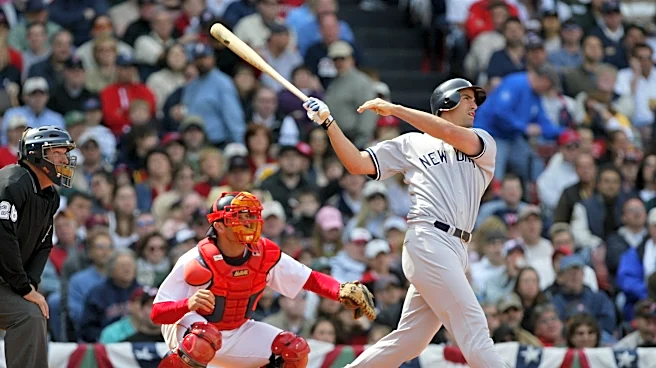
Injuries also overshadowed his tenure with the Yankees, which lasted just seven games at the outset of 2004.
Lee was not a bust—far from it. While he missed a lot of time throughout his career, that career still lasted over 1,000 games and nearly ten seasons between Arizona, Philadelphia, New York, and Tampa Bay. But, as he later disclosed in a 2020 interview, the battle to stay physically healthy was waged in tandem with a career-long battle with anxiety.
Travis Reynolds Lee
Born: May 26, 1975 (San Diego, CA)
Yankees Tenure: 2004
Travis Lee was a college superstar. At San Diego State in the mid-1990s, Lee was a two-time All-American who won the Golden Spikes Award with the Aztecs before winning an Olympic gold medal with Team USA: a 1996 season straight out of a movie. That incredible year continued when the Minnesota Twins made Lee their first-round draftee, selecting him second overall. But then, along came a plot twist.
The Olympics came at an awkward time for Lee and the Twins. They wanted to negotiate the terms of his contract, but also did not want to make the negotiations a distraction for Lee as he competed in Atlanta. While the Olympics were happening, the Twins neglected to extend a formal contract offer to Lee within 15 days of selecting him, which would make him a free agent per the collective bargaining agreement. Normally, this is the sort of rule that isn’t always followed and is almost never enforced. But when ascendant super-agent Scott Boras made Lee and his agent Jeff Moorad aware of this, the Twins had no choice but to admit they had messed up, and surrender the draft pick.
By the letter of the law, Lee was a free agent. In another bizarre twist to this saga, he would ultimately be signed by a team that didn’t even fully exist yet: the expansion Arizona Diamondbacks. They signed him to a four-year deal which would kick off when the D-backs finally had a full team to field in 1998. (This whole ordeal kicked off some heated debates about the draft’s place in baseball’s labor ecosystem, which are fascinating to revisit now.)
The Diamondbacks only had A-ball teams in 1997, so once Lee quickly surpassed the High-A level, he was loaned to the Brewers, who played him at their Triple-A team in Tucson. The next year, he made his long-awaited MLB debut, and collected the first hit—and later, the first home run—in the hist]ory of the franchise.
Lee finished third place in NL Rookie of the Year voting, behind two greats in Cubs phenom Kerry Wood and future Rockies Hall of Famer Todd Helton. Lee hit 22 home runs and finished with a .775 OPS (103 OPS+) while also proving to be an excellent defensive first baseman.
The following offseason, the Diamondbacks established themselves as a contender by signing Randy Johnson, Luis Gonzalez, and Steve Finley. They won 100 games in 1999, but Lee did not take the big step forward that the rest of the team did. He managed just a 77 OPS+ before a lingering ankle injury sidelined him for their NLDS loss to the Mets. (Lee never did play in the postseason.)
Lee spent the first half of the following season shuttling between Triple-A and the majors, but his days in the desert were numbered. The Diamondbacks were thirsty to make another big move, and were eyeing Phillies star pitcher Curt Schilling. In late July, they pulled the trigger, acquiring Schilling for a package of Lee and pitchers Vicente Padilla, Omar Daal, and Nelson Figueroa.
In Philadelphia, Lee’s role stabilized, and he appeared in over 150 games in both of his full seasons there (2001 and 2002). He was a roughly average hitter in that span, hitting 20 homers in 2001. After finishing out his time in the City of Brotherly Love, Lee signed a one-year deal with the other 1998 expansion franchise, the Rays.
Lee’s 2003 campaign was the best of his MLB career. The lefty cut back on his strikeouts, worked more walks, and boosted his slugging percentage by over 50 points, finishing with an .807 OPS (116 OPS+), earning him a raise with a contender: the New York Yankees.

As we mentioned at the top, Lee would only wind up playing seven games with the Bombers because of a shoulder injury that required surgery. It was a shame, since the Yanks got subpar production out of first basemen that season, with Jason Giambi off his game and also missing a bunch of time due to benign tumor in his pituitary gland. Replacement/future MLBPA leader Tony Clark was fine, but ran hot and cold, all but necessitating an August trade for veteran John Olerud.
Lee’s career only lasted a few more seasons. He returned to Tampa Bay in 2005 and pieced together another decent season as a strong-side platoon bat, catching fire in the second half, before taking a step back in ‘06. The following season, he retired after a brief spring training stint with the Nationals.
Lee has enjoyed a quiet life away from baseball in the intervening years. In 2020, The Athletic’s Zach Buchanan reached out to Lee to ask him about his life since the end of his career. That was when Lee revealed to Buchanan that he had struggled his entire career with anxiety. That anxiety largely revolved around his supposed inability to play catch with teammates, a rather minor issue—but to hear him tell it, this fear of having the yips consumed a lot of his mental energy. It was also difficult to convince others that he was struggling since he remained a pristine defensive infielder.
Had Lee played in the current era of professional sports, an era in which athletes’ mental health is taken as seriously as their physical health, he may have had a longer and better career. But Lee isn’t interested in dwelling on the past. He’s enjoying his retirement as a stay-at-home dad and coach to his kids.
The more I looked into the story of Travis Lee, the more engrossed I became. His career began with an incredible draft gaffe, and an unprecedented signing with a team that didn’t even fully exist. He then pieced together a solid Major League career despite dealing with all kinds of physical and mental adversity. It’s easy to play the what-if game with a guy who may have been talented enough to become a perennial All-Star, but future perennial All-Stars become average nine-year big-leaguers all the time. And ultimately, he picked the right time to call it quits and move on. Make no mistake: this is a story of success.
See more of the “Yankees Birthday of the Day” series here.