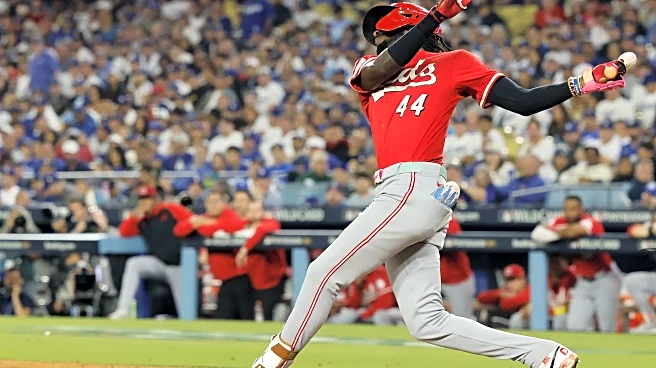


The eye-test through the 2025 season revealed to anyone who paid attention that the Cincinnati Reds simply weren’t the slugging Reds of yore. The roster assembled by the front office had been deliberately put together to hit ‘line drives,’ a club designed to, in theory, produce more contact gap to gap even at the very purposeful expense of over-the-fence power, and the results were predictable.
Only two clubs had a team-leader in dingers with fewer than that of the Reds. Elly De La Cruz, said team leader on
the Reds with 22 last year, hit just one (1) homer during a particularly odd 74 (!) game stretch during the middle of said season, and he slugged just .373 from June 24th through the end of the regular season – a stretch of some 83 games. That’s right, the team’s preeminent power hitter went over half a season with an almost complete power outage, yet still managed to hit more homers over the course of the regular season than anyone else.
Elly struggled through a leg injury during most of that span, something we were let in on only after the season ended. This is also not meant to rag on Elly – he’s one of the few bats on the club who, when healthy, actually has a chance to repeatedly knock the snot out of the ball. Rather, this is an article to highlight a corner of a leaderboard not everyone stumbles across, and to point out just how many Cincinnati Reds occupy it.
A quick trip over to the Statcast tab on FanGraphs is an excellent place to begin to understand just how light-hitting the 2025 Reds were. It’s also a place you shouldn’t view as a Reds fan until you’ve found a way to sit down.
Let’s start with Expected Slugging Percentage (xSLG), a metric ‘formulated using exit velocity, launch angle and, on certain types of batted balls, Sprint Speed’ according to MLB.com’s glossary. It effectively tracks what kind of slugger you should be expected to be based off how hard you hit balls and whether you hit them in a fashion that produces grounders, line drives, or fly balls. Well-hit fly balls go for homers, after all.
Among the 277 MLB players who logged at least 300 PA last year, you’ll find old friend Santiago Espinal ranking 2nd to last with a .285 xSLG (only Atlanta’s Nick Allen, at .263, was worse). You may recall Espinal hit in the #2 spot in the batting order more than in any other spot last year, too. You’ll also find everyday leadoff man TJ Friedl (.315) ranked 10th worst on this list, as well as Gavin Lux – who ‘played’ DH more than any other position and also got 21 starts batting in the #2 spot – checking in at 17th worst. That’s right, the Reds rolled out guys ranked among the 17th worst expected sluggers in the game atop their order more than any other club in baseball last year, with Friedl at leadoff in 150 games last year and Espinal/Lux batting 2nd to start a combined 51 games.
To manager Terry Francona’s credit (credit?), it wasn’t as if he had a ton of inverse options. Each of Ke’Bryan Hayes (30th worst), Jose Trevino (38th), and Matt McLain (39th) all ranked among the bottom 40, and McLain got an additional 68 starts batting 2nd. Yikes!
Looking at the overall team metrics doesn’t exactly make you walk away feeling better. Take, for instance, the team rankings in EV90 – or 90th percentile exit velocity. Cincinnati’s team mark of 103.7 mph may make you say dang, a hundred and three miles an hour is pretty fast! And, it is…just not in the context of the rest of Major League Baseball hitters, as that mark tied with the Cleveland Guardians for dead last among all 30 clubs. The New York Yankees, unsurprisingly, ranked tops at 106.3 mph.
The Reds ranked 28th among the 30 clubs in both total number of barrels and barrel rate (7.2%), and also ranked 28th in hard-hit % (38.2%, ahead of only San Diego and Cleveland). Their .368 xSLG ranked 29th, better than only Cleveland, while their expected weighted on-base average (wOBA) of .299 was better than only the lowly Colorado Rockies (.293) and, again, Cleveland.
If we circle back to Elly to end this quick dive, well, it’s to point out just how much of a dichotomy his particular Statcast metrics show. He ranked tops on the team (and 10th in all baseball) in maxEV (maximum exit velocity) with a ball he hit 117.4 mph. He lapped the rest of the team in EV90 and average exit velocity, too, his barrel rate (10.2%) better than all other Reds with at least 300 PA save for Tyler Stephenson and Austin Hays. What stands out with Elly on the other end of the spectrum, though, is his minuscule 7.6 degree launch angle, which is by far the lowest among the 10 Reds who had 300+ PA. Gavin Lux (9.6) is the only Red even sort of close, with Spencer Steer’s 18.8 the most fly-ball of the bunch.
That’s right, the only Red who so much as hit the ball at all league-average or better in terms of contact is also the one who pounded it into the dirt more than any other on the club.
It’s an alarming set of data given the heights to which this club aspires heading into the 2026 season. It’s no surprise to see Kyle Schwarber, whom they coveted so, ranking 3rd overall in barrel rate (20.8%), 20th in launch angle (20.0), 12th in max exit velocity (117.2 mph), 8th in EV(0 (109.8 mph), and 2nd in hard-hit % (59.6%). That’s the kind of hitter who could begin to drag the team’s overall marks back to the middle of the pack, something that simply hoping everybody just gets a little better won’t do.