
It should be another offseason of upheaval around the Florida State football program.
Mike Norvell said he anticipates both coordinators returning for a second season, but there have already been a few
other staff moves, reported and/or confirmed. With player exit meetings with Norvell already underway, there should be movement on the transferring out front this month before the portal officially opens Jan. 2 for a 15-day window.
For all the bad things you could say about this year’s FSU season, it did see an impact from a number of younger, less-proven players.
Which younger players should Norvell prioritize keeping this offseason to try and save his job in 2026?
Defensive linemen Mandrell Desir and Darryll Desir
There aren’t a ton of true freshmen across the country who made a bigger impact than FSU defensive lineman Mandrell Desir.
He made an immediate impact, but really came into his own down the stretch with a half-sack or more in each of the Seminoles’ final five games. Desir finished with a team-high 6.5 sacks, three more than anyone else along with 30 tackles, an additional tackle for loss, a pass breakup and a forced fumble. He finished second in ACC Defensive Rookie of the Year voting, just two votes behind Cal’s Luke Ferrelli.
His twin brother, Darryll, didn’t have quite the same statistical impact with 23 tackles, 1.5 TFLs, one sack and four quarterback hurries. But by the end of the year, both were among the most consistent members of the Seminoles’ defensive line.
It’s taken little time for the twins to go from three-star prospects who were afterthoughts when they committed to FSU to critical pieces of the Seminoles’ defense. Retaining them is among the biggest priorities for the staff this offseason.
Running back Ousmane Kromah
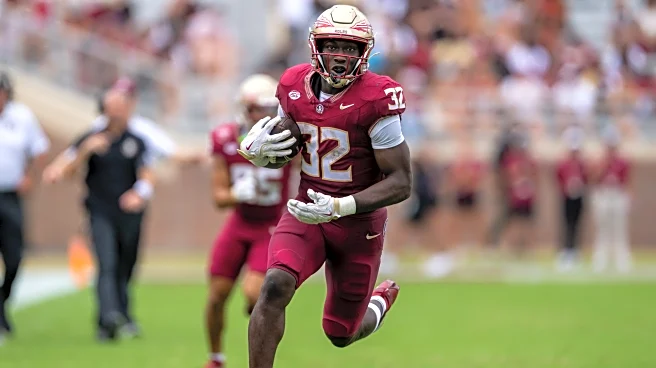
While the Desirs were not the most prominent signees last December, Ousmane Kromah very much was when the Seminoles flipped him from Georgia during the early signing period.
He played right away, getting seven carries for 31 yards in the Alabama game. Throughout the season, it seemed the first would-be tackler almost never brought the bruising running back down.
However, his usage faded some in the middle of the season. After Norvell pledged to use him more in the final stretch, he recorded 11 carries at Virginia Tech, but then a combined nine in the NC State and Florida losses.
He finished his first season with 408 rushing yards on 72 carries, with a 5.67 yards-per-carry average that was well above Gavin Sawchuk (486 yards, 4.46 ypc). He did not record a rushing touchdown, although he did have a receiving touchdown.
It may not be an easy sell considering a number of other schools would likely pay top dollar to land a back of Kromah’s caliber. But if they can get him to return, he could be a featured piece of the run game in 2026.
Defensive back Ja’Bril Rawls
Ja’Bril Rawls isn’t as young as the first few names on this list. He just wrapped up his third season as a Seminole.
But it was the type of breakout season that showed his potential as a standout starting cornerback headed into 2026.
Injuries limited Rawls to just seven games this season. His absence was felt, especially against the run, in Florida State’s final two losses after it was announced he was out for the season with an injury.
In his first extended playing time at cornerback this season, he impressed with 40 tackles, his first career interception, two tackles for loss and two pass breakups.
If he returns, he’s a piece to build around entering 2026. The extra wild card here is his feelings about the firing of defensive backs coach Pat Surtain Jr. That could make it harder to retain him if he was a big fan of his position coach.
Wide receivers Micahi Danzy and Lawayne McCoy
I could shout out Duce Robinson here as a wide receiver FSU should prioritize trying to retain.
And for what it’s worth, I’m sure FSU will attempt to convince Robinson to run it back. But considering he’s a 6-foot-6 receiver who just led the ACC in receiving yards (1,081 yards), it’s easy to envision him being ready to test the ACC waters.
That brings us to Micahi Danzy and Lawayne McCoy, a pair of second-year players who were FSU’s second and third leading receivers this season.
Danzy, who was largely thought to be a track star entering the season, showed his football acumen with that remarkable speed translating to big-play ability. He had three 100-yard games, finished with 571 receiving yards and led the ACC and ranked fourth nationally in yards per catch (21.15).
But Danzy faded a bit down the stretch with 68 yards over the team’s final four games. That’s where McCoy picked up the slack a bit. McCoy was a constant minor presence in the passing game, but surpassed 45 yards just once in FSU’s first eight games before doing so in three of the final four games. That included a career-high 110 yards and his third TD of the season vs. Florida to finish with 396 yards.