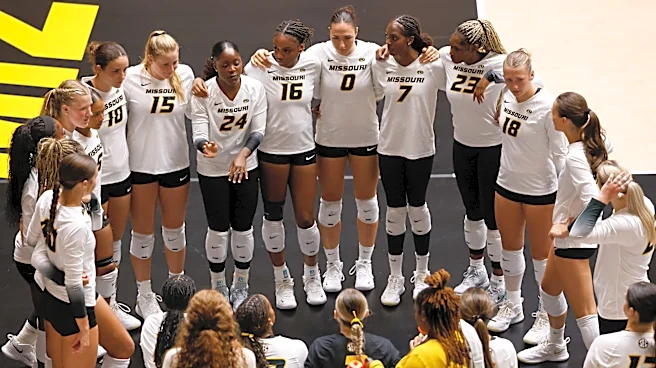





Missouri volleyball’s Black and Gold Scrimmage on Saturday will provide the first public glimpse of a program entering one of the most intriguing seasons of the Dawn Sullivan era.
The Tigers have become one of the SEC’s most consistent programs under Sullivan, but this roster enters the fall looking different than any of her previous three teams. Veteran leaders have moved on, a new coaching staff has arrived and several newcomers are expected to play significant roles immediately.
With the season
approaching, three storylines stand above the rest: the biggest concern, the greatest reason for optimism and the one question that could determine Missouri’s ceiling.
The biggest concern is team chemistry.
Every team has to build chemistry during the preseason, but this year’s challenge feels different. Missouri isn’t simply replacing production. It’s replacing the identity that helped establish the program under Sullivan.
For the first time since Sullivan arrived in Columbia, the Tigers will take the floor without familiar faces such as Maya Sands and Janet deMarrais. Both were foundational pieces throughout Missouri’s rise, providing leadership, consistency and experience in pressure moments.
Those departures come alongside changes on the coaching staff, creating a level of transition the program simply has not experienced during Sullivan’s tenure.
Building chemistry goes beyond learning rotations or offensive timing. It means establishing trust during long rallies, developing communication in serve receive and finding leaders capable of settling the team when momentum swings.
The talent is certainly there. Missouri added experienced transfers while returning several players who have waited for larger opportunities. But talent alone doesn’t guarantee cohesion.
Saturday’s scrimmage won’t answer every question, but it should offer an early indication of how quickly this new group is coming together. If Missouri develops chemistry early, many preseason concerns could disappear by conference play. If that process takes longer, the Tigers could endure growing pains.
The biggest reason for excitement has nothing to do with the roster.
It’s the schedule.
Simply put, Missouri has never faced a nonconference slate like this under Sullivan.
The Tigers will travel to Wrigley Field to face perennial national power Nebraska in one of college volleyball’s premier showcase events. They’ll also play Oregon and Louisville, giving Missouri repeated opportunities against programs that consistently compete deep into the NCAA Tournament.
Those are exactly the kinds of matches that prepare teams for postseason volleyball.
Instead of building confidence against underwhelming opponents, Missouri will spend September learning where it stands against some of the nation’s elite. The experience gained from those matches could prove instrumental once SEC play begins.
And conference play won’t offer many opportunities to catch a breath.
The SEC continues to improve every season, with multiple programs capable of making deep NCAA Tournament runs. Missouri’s league schedule provides another collection of high-level tests that should prepare the Tigers for the postseason come November.
If this team develops the chemistry many expect, the schedule presents a chance to build one of the strongest tournament resumes in program history. Even losses against elite opponents can strengthen postseason positioning when they come against nationally respected teams.
Perhaps most importantly, the schedule will reveal exactly how far Missouri has progressed before the postseason arrives.
The biggest toss-up remains Missouri’s size.
This has been a recurring conversation throughout Sullivan’s tenure.
Her teams have consistently prioritized speed, defensive versatility and athleticism over overwhelming size at the net. That philosophy has produced success, but it has also created difficult matchups against the nation’s biggest and most physical teams.
When Missouri faces the upper tier of the SEC or reaches the NCAA Tournament, the Tigers often encounter opponents that possess both exceptional athleticism and significant height advantages.
Those teams force Missouri to choose between speed and size because they have both.
Sullivan put a band-aid on that concern during the offseason by adding more length to the roster, including 6-foot-2 transfer Lauren Larkin, 6-foot-4 freshman Eva Smith and 6-foot-3 freshman Ceylin Kuyan. Their additions should provide more size at the net and greater flexibility throughout the rotation, but still aren’t as tall as the top teams middles.
The question is whether those additions are enough.
Missouri doesn’t need to become the tallest team in the SEC. It simply needs enough size to avoid being overmatched against the conference’s elite blocking units and powerful outside hitters.
The Tigers’ speed and defensive systems have proven they can compete with anyone. Whether they can consistently match the physicality of the nation’s best remains the unanswered question.
Saturday’s scrimmage is only the beginning, but it marks the first opportunity to see whether Missouri is taking meaningful steps toward answering all three questions.
If chemistry develops quickly, the demanding schedule could become a launching point instead of an obstacle. And if the added size translates into more success at the net, Missouri may finally possess the balance needed to challenge the SEC’s elite and make a deeper postseason run than any Sullivan team before it.