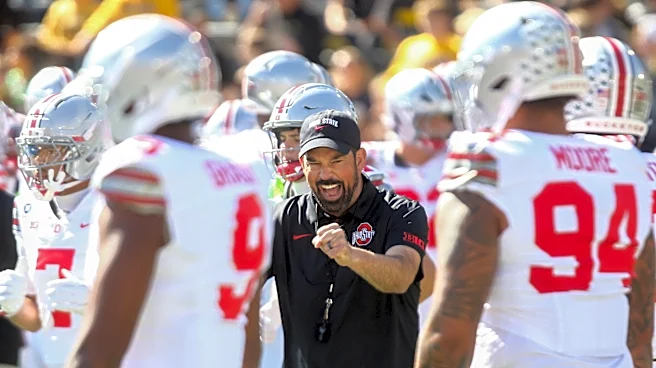

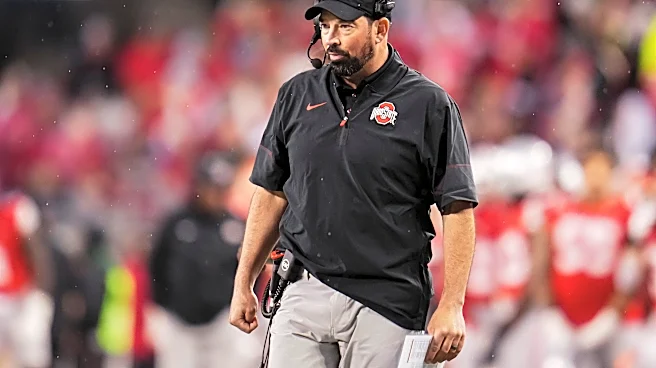

I have spent much of the past seven-plus seasons begging, pleading, and occasionally screaming into the void for Ryan Day to stop coaching like he is afraid of what might happen if Ohio State makes a mistake, and perhaps even more afraid of what might happen if they don’t. Now, I fully recognize that this is a fairly reductive characterization of a coach who has won a national championship, consistently recruited at an elite level, and currently boasts one of the highest winning percentages in college
football history. However, I also believe Day’s natural inclination toward caution has, on too many occasions, kept his teams from fully exploiting the considerable talent advantages they possess. And, not for nothing, I just think a more aggressive offense would be vastly more fun for us fans to watch.
But friends, if there was ever a time for the head coach to abandon his inherent timidity, I would suggest that the time is now.
With Julian Sayin out indefinitely — possibly for the entire season — after injuring his throwing arm in Saturday’s 19-15 victory over Indiana, Ohio State finds itself in a situation that is both incredibly unfortunate and potentially liberating. The Buckeyes have lost their Heisman Trophy-finalist quarterback, but they have not lost the extraordinary collection of talent that surrounded him. And while the former is certainly going to make accomplishing the team’s championship goals more difficult, the latter should provide Day and offensive coordinator Arthur Smith with more than enough reasons to throw caution to the wind.
To be abundantly clear, I am not suggesting that Luke Fahey or Tavien St. Clair is incapable of leading the Buckeyes to a Big Ten championship or a College Football Playoff berth by running something approaching the Buckeyes’ traditional offense; I obviously hope at least one of them is, since that is almost certainly what we will get for the rest of the season. But we simply haven’t seen enough of either young quarterback in meaningful game situations to believe that either can step in and immediately recreate — or even improve upon — what Sayin was doing pre-Indiana game.
Both are talented young players who earned their spots on Ohio State’s roster, but I think we can acknowledge that the path to a national championship appears considerably steeper today than it did before the Buckeyes went to Bloomington, especially with the most difficult stretch of the regular season looming.
That is precisely why I believe the Buckeyes need to stop worrying so much about minimizing their weaknesses and start doing absolutely everything possible to maximize their strengths, and I don’t think I need to tell you that Ohio State’s greatest strength, now more than ever, is the overwhelming athletic advantage that it possesses over practically every team that it will face.
The Buckeyes still have Jeremiah Smith, inarguably the most talented player in college football. They still have an embarrassment of riches at wide receiver, a stable of steady (and perhaps even improving) running backs, and a handful of surprisingly capable tight ends (as long as you don’t ask them to do much blocking). Even without Sayin and a shoddy and beat-up offensive line, OSU still has the type of athletes that will be significantly better than the vast majority of teams in college football.
So why on earth would Day and Smith voluntarily make life easier for opposing defenses by limiting what those players are allowed to do?
I understand the inclination to simplify the offense for an inexperienced quarterback, but simplifying doesn’t mean you have to make it boring and safe. I am not advocating that Ohio State abandon the fundamentals of sound offensive football in favor of randomly throwing the ball downfield and hoping that Smith catches it. Nor do I think that they should all of a sudden roll out a pure run-and-shoot. I simply don’t believe that OSU can win a B1G or CFP title by turtling the next nine games.
In fact, I would argue that the less experienced your quarterback is, the more creative your offensive coaches need to be. Sure, you don’t expect him to have as much command of the playbook as Sayin did, but that doesn’t mean that what you do give him has to just be turning and handing it off. Make the decisions easier for him, not the decisions easier for the opposing defensive coordinator. Those are two very different things, and the Buckeyes have more than enough talent to accomplish the former without resorting to the latter.
What I am advocating — much like I did when they went to Austin in Week 2 — is that Day and Smith stop allowing the fear of a negative play to dictate their offensive philosophy. Will there be more mental and physical mistakes from the QB position with Fahey or St. Clair than there were with Sayin? Probably, but you can’t let the fear of failure stop you from attempting to win.
If that means occasionally throwing deep on first down, do it. If that means going for fourth-and-manageable near midfield, go for it. If that means incorporating trick plays, unconventional formations, misdirection, or getting the ball into the hands of the team’s most explosive athletes in ways that opposing defensive coordinators haven’t seen on film, then by all means, let’s get a little weird.
Use motion to manufacture mismatches. Create opportunities for Smith to make plays without requiring the quarterback to thread a needle between three defenders. Get the ball to the running backs in space. Make opposing defenses defend every blade of grass instead of allowing them to crowd the line of scrimmage because they know you are determined to play it safe, keep the clock running, and establish the run at all costs.
Sometimes, the most aggressive thing you can do isn’t calling a particularly risky play; it’s putting your best players in positions where the defense has almost no chance of stopping them. And with the offensive line struggling to stay healthy, perhaps finding creative ways to get the ball out quickly is an even better idea than asking an inexperienced quarterback to stand in the pocket waiting for something to develop.
Part of my concern is that Day will look at the increasingly impressive performance of Matt Patricia’s defense and conclude that the safest path forward is to lean almost exclusively on that unit while asking the offense to avoid catastrophic mistakes.
After all, the Buckeyes currently rank fifth nationally in scoring defense, allowing just 13.4 points per game, and the unit has seemingly gotten better with each passing week. There is a reasonable argument that the defense is good enough to keep Ohio State competitive against anybody in the country.
But there is a monumental difference between keeping a team competitive and putting it in the best possible position to win. We’ve been talking about the difficulty of Ohio State’s November schedule since it was announced, and with Northwestern and Nebraska playing better than many anticipated, that stretch looks even more daunting than it did before the season.
If the Buckeyes think that they can run a very vanilla, risk-averse offense and still score points, they might have another thing coming, especially in November. While USC’s defense is not especially daunting (ranked 80th nationally in scoring), Oregon (42nd), Northwestern (26th), Nebraska (15th), and Michigan (20th) all could present problems if Day doesn’t lean on his playmakers.
Besides, if the defense really is as good as we believe it is, shouldn’t that make the coaching staff more willing to take calculated risks offensively? If Ohio State has one of the best defenses in the country waiting on the sideline, the occasional unsuccessful fourth-down attempt or intercepted deep ball shouldn’t automatically spell disaster.
And conversely, if the offense becomes so obsessed with avoiding mistakes that it can’t consistently sustain drives or score touchdowns, how long can we reasonably expect the defense to bail it out? Playing conservatively doesn’t eliminate risk; sometimes it just transfers that risk to the other side of the ball.
We have seen what happens when Day’s teams become tentative, when the play-calling becomes predictable, and when Ohio State seems more concerned with avoiding disaster than creating something extraordinary.
I have no idea whether Fahey or St. Clair will ultimately prove capable of leading Ohio State to another national championship, but I do know that the Buckeyes aren’t going to discover what they’re capable of by spending the rest of the season driving 55 miles per hour in the right lane, hoping that everyone else crashes before the finish line.
So, Ryan, take off the training wheels. Remove the restrictor plates. Put the pedal to the metal and let these extraordinarily talented players show us what they can do.
The road to a championship might be bumpier than it was nine days ago, but that doesn’t mean Ohio State should travel it with one foot on the brake. If anything, it’s time to find out just how fast this thing can go.