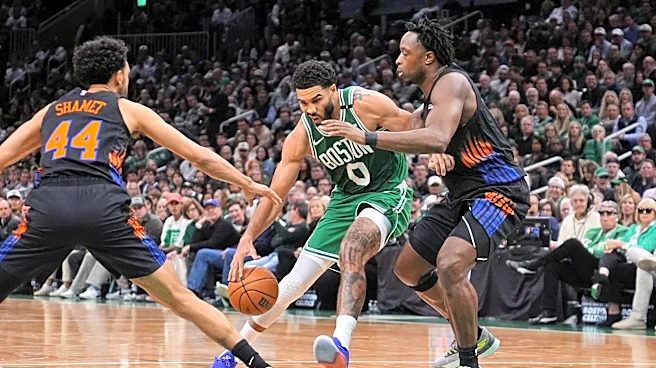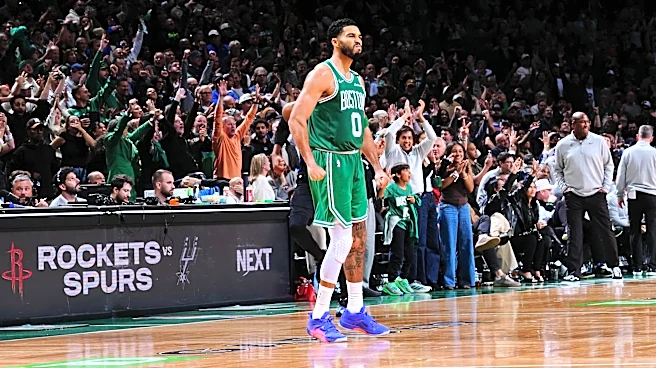


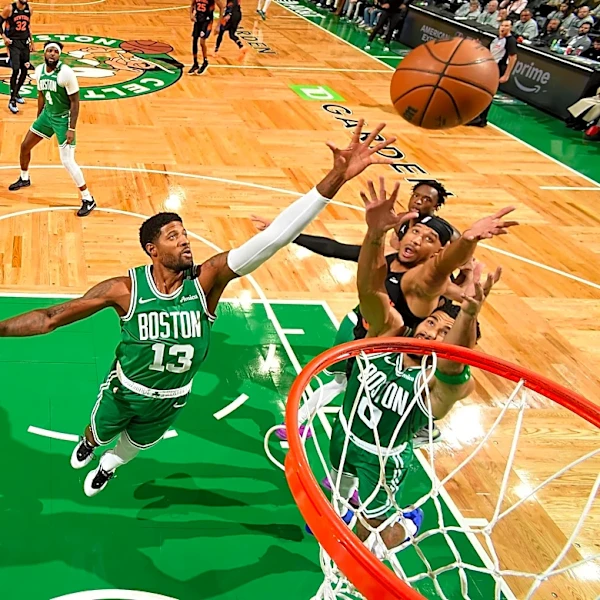
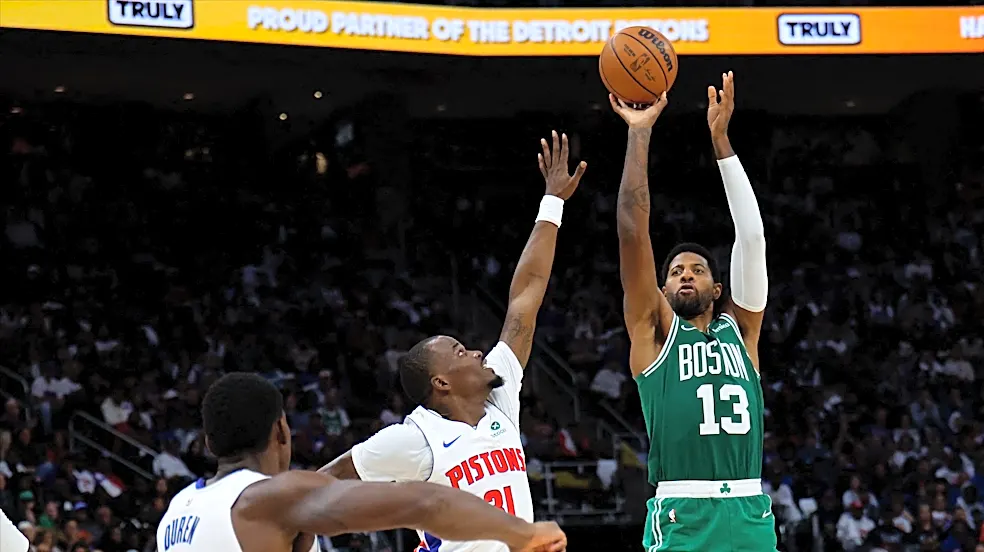

The Boston Celtics secured their first victory of the season in their home opener against the New York Knicks, fueled by a spectacular 36-point outburst from Jayson Tatum.
Although Boston finished with 107 points, the Celtics were efficient from the field, shooting 46% overall and 38% from beyond the arc. More importantly, they executed several well-designed offensive sets that could serve as reliable staples throughout the season.
Much of the Celtics’ read-and-react, timing-based offense is elevated
by the basketball IQ across the roster. Their ability to recognize defensive coverages, make quick decisions, and get/take advantage of advantages, are what continuously stands out.
On this first play, the Celtics go to “Zoom” action.
Zoom is a DHO (Dribble Handoff) where there is an off-ball screen for the handoff receiver.

Here, the ball finds Queta at the top of the key, where he serves as the handoff passer in many of Boston’s offensive actions as the “Delay” big (a concept I’ll revisit later). Zoom is particularly effective given Boston’s personnel: the Celtics have excellent screeners and, in Tatum, a ball handler with the vision and manipulation skills to exploit defenders in a split second.
The screen by Hugo Gonzalez gets Josh Hart a few steps behind Tatum going to get the handoff.

Because of this, Karl-Anthony Towns has to allocate himself to Tatum and come off the body of Queta. With Hart chasing to get back to Tatum, two are on the ball, and the two-on-one is created.

At this point, Tatum is reading Jalen Brunson who is the “tagger” in this situation with Queta rolling. The tagger on defense is responsible for impeding the path of the roller, so they can’t just get a free run to the hoop. Tatum sees Brunson is much closer to Queta than Gonzalez on this play and fires the pass to the youngster for an open three.
Although they don’t score on this play, the quality of an offensive action should be evaluated by the process rather than the outcome alone. A missed attempt does not negate the effectiveness of the action or the advantages created by its execution.
Next, the Celtics return to their Zoom action, this time utilizing a variation known as Pistol Wide Zoom. This alignment builds on the principles of the standard Zoom action while introducing a different entry and spacing structure.
“Pistol” is an offensive series commonly used to initiate quick-hitting actions in early offense. The easiest way for me to identify Pistol is by looking for a player positioned along the wing near the hash mark, closer to the baseline, with the ball handler advancing up the same side of the floor. This alignment creates an opportunity to flow seamlessly into handoffs, ball screens, and other actions before the defense has time to get fully organized.


Another way is when you see the throw ahead sideline pass.
Here we see that pass from Payton Pritchard to Hugo to start this play. Then we have the “Wide” action screen which is an off-ball screen for a player to come towards the ball.

Boston’s usual aim for this action is for the player using the screen to get the ball, but on this occasion, it’s more of a means of relocation to clear Hauser to the corner. After of course we have the Zoom.
As Boston runs the action, Brunson commits more aggressively to tagging Queta this time. However, Queta is able to slip past the tag as Pritchard drives toward the basket. Towns is too far away from the big man to disrupt the passing lane or offer a meaningful contest.
On this possession, the Celtics get some good stuff out of their early offense mixing a Ghost screen with Staggered screens.
A “Ghost” screen, which is usually set by a shooter, is when an offensive player acts like they are going to set a ball screen then sprint away to the perimeter before making contact.
Following that from Hauser, we have Staggered screens on the left side from Paul George and Mitchell Robinson. “Stagger” screens are two of the same off ball screens with space between them.

The effectiveness of this action is largely a product of its timing, as Boston initiates the sequence early in the shot clock. The Knicks are still retreating into their defensive positions as the Celtics flow into the action.
More importantly, as George and Robinson set up the staggered screens, both Towns and OG Anunoby are still backpedaling, leaving Jose Alvarado without adequate support as he navigates the screens.
George is the only screen needed, and Prichard knocks down the three.
This next play highlights one of Boston’s SLOB Double Zipper plays.
SLOB is an acronym for Sideline Out of Bounds, so anytime you see the ball being taken out on the side, that’s the call.
After that we have the “Zipper” Cut from Derrick White. This is when a player on or near the block cuts all the way up to the top of the key. The path of the cut should resemble a zipper pulling up.

This one is called Double Zipper because of the two screens of course. White can just catch the ball on the move and touch the paint, forcing the defense to rotate.
These rotations cause Anunoby to sink to Tatum and leave George open in the corner.
Boston builds on this concept by revisiting its Double Zipper entry on this SLOB play, but flows into a Spain Pick-and-Roll after.
Spain is a variation of a pick and roll where there is a back screen on the on-ball screener’s man.

What I love about this action is that it brings the center out of the paint and sometimes up above the three-point line. This forces smaller players to defend near the paint.
Tatum sets a really good back screen on Towns and actually gets Bridges stuck on it too.

While that’s happening, Robinson rolls to the rim forcing Brunson to tag him again, which brings him away from the corner.

Now all White has to do is drive a few steps more to officially draw Hart to him and get the pass to Jordan Walsh in the corner.
Next, Boston goes to something I referenced earlier in Delay action.
“Delay” action is a 5-out series that triggers actions on one or both sides of the court when the ball is passed to the center at the top of the key. This has been a part of the Celtic’s offense since Robert Williams was here.
As the ball is given to Queta, this triggers back screens on both sides. Pritchard sets a great one for George, and he gets an open dunk.

On this play Boston goes back to Spain pick and roll but start it with Ram action.
“Ram” action is an off-ball screen for someone to set a ball screen.

Boston flows directly into the Spain Pick-and-Roll, with Queta stepping up to set the initial ball screen. However, Tatum makes a particularly smart read as he approaches the screen. Recognizing the defensive positioning, Tatum notices that Hart is already shading toward the screen before Queta even makes contact, effectively conceding the right-hand driving lane.

This also leads Towns right into the filthy back screen of Scheierman, and Tatum has no contest at the rim.

On to the fourth quarter, we see Boston go to Wide Reject Peja.
As discussed earlier, the “Wide” screen is an off-ball screening action designed to bring a player toward the ball. In this sequence, Robinson initially prepares to set the Wide screen for George, but George rejects the action and relocates while Robinson gets the ball.
Boston then flows into a “Peja” action, a back screen followed by a dribble handoff (DHO). The action, named after Peja Stojaković, combines off-ball screening with a handoff to create separation for the receiver and put pressure on the defense to navigate multiple actions in quick succession.

George sets a good back screen on McBride that gets him off balance. As McBride gets up and prepares to defend the screen, George is patient in seeing which way the defense shades. Recognizing that McBride is shading toward the screen, George rejects it and creates the separation necessary to rise up and knock down the three-pointer.
This next play is one of the key reasons why Boston’s offense can be so dangerous when it’s operating at its best. They return to the exact same look while adding wrinkles at the end of the action based on how the defense responds. This adaptability makes the offense particularly difficult to anticipate, as the same initial look can lead to multiple outcomes depending on the defensive coverage.
Here they go back to Wide Reject but with Flares.
George rejects the Wide screen and comes to set the back screen just like before, but White Flares it to the wing.
A “Flare” screen is an off-ball screen for someone to go away from the ball usually in between the passer and the recipient.
After that George comes over to Queta to receive his own Flare screen and gets fouled before flowing into the pick and roll.
Lastly, we have my favorite play of the night which is crazy because it ended in a turnover.
Boston goes to Veer Wide here, but we see another high IQ play from Queta.
A “Veer” screen is when a screener fakes an on-ball screen and sprints into an off-ball screen.
Veer screens are so effective when done right because it helps Boston get their two-on-ones. Queta coming up and stopping like he is going to set the on-ball screen for White, engages Towns in that action.

At the last second, Queta sprints over to George and as you can see Towns is nowhere near him, so the two-on-one is clear as he tries to set the Wide screen on Anunoby.

Even with this being a two-on-one, Anunoby is a great defensive player with a high IQ of his own. He sniffs out this Wide action and shoots the gap correctly to possibly get a steal.

Queta and George process this, and the big man changes his screen to a Flare screen to get George open.

I’m not sure why Pritchard wasn’t in the corner here, but I would love to see them do this correctly in the future.
Ultimately, Boston’s home opener offered an encouraging glimpse of what this offense can become. The Celtics showcased a diverse system built on intelligent screening actions, precise timing, and the ability to adapt to defensive coverages. With so many layers to their offense and plenty of room for improvement, Boston has a promising foundation to build on as the season progresses.