


Batting Average on Balls in Play is a stat that’s about as objective mathematically as can be. The fine folks at FanGraphs provide this concise explanation of the metric.

The basics are this: when a batter puts a bat on the ball and it ends up in the field of play, how often does said batter not get retired? Home runs go over the fence and therefore aren’t ‘in the field of play,’ while sacrifices are pulled out the equation due to the batter giving themselves up for the good of the team. What you’re
left with at the end, mathematically, is a data set of millions of plate appearances that ended up with batters putting pitches into play, with roughly 30% of those ending up as hits.
If a player posts a season with a .351 BABIP – like, for example, Gavin Lux did in 2025 – odds are there was some good luck, or good fortune propping that up. If a player posts a season with a .255 BABIP – like one of the players I’ll mention immediately below – odds are there was some bad luck, or bad fortune at play.
There’s some obvious noise in there, though, as not all batted balls are created the same. Fly balls (that don’t go over the wall) are a lot easier to turn into outs than line drives and even grounders, so players who show extreme fly-ball heavy approaches will typically have lower BABIP numbers than those who don’t. Speedy guys that race down the 1B line can more easily leg out infield hits than lumbering sluggers, so you don’t see a lot of catchers with high BABIP numbers, for instance.
All of this, of course, is relative to pitchers, too. Extreme fly-ball pitchers might surrender more homers, but they typically have lower BABIP against them than their grounder brethren. Inducing weak contact from hitters typically leads to a lower BABIP against, too, all factors that help determine whether a pitcher’s expected BABIP based on their pitching profile should actually be closer to .290 or .310 than just .300.
Anyway, here are a handful of Cincinnati Reds who – based on BABIP and their respective approaches – should probably be due for some better fortune in 2026 than they were last season.
Will Benson, OF
2025 BABIP: .255
Career BABIP prior to 2025: .331
I have hammered this point home about Benson already this offseason, so I will try not to belabor it while highlighting some of his peers who likely will see better luck in 2026, too.
To summarize, Benson hit just .226/.273/.435 in 2025 with a .255 BABIP despite his batting percentile rankings (had he had enough PA to qualify) all landing in the top 15% of all hitters in xSLG, average exit velocity, barrel rate, hard-hit rate, and launch angle sweet-spot percentage. He’s not an extreme fly-ball hitter, either, and he refined his approach well in 2025 to swing at better pitches in-zone (and make a lot better contact when he did).
He’s fast, too – 94th percentile last year, per Statcast. Guys that fast should never end up with just a .255 BABIP.
I think Benson’s in for a big, big regression in 2026 in a good way. He just needs the playing time.
Graham Ashcraft, RHP
2025 BABIP: .342
Career BABIP prior to 2025: .305
Ashcraft leans on his 97+ mph cutter out of the bullpen, a completely filthy pitch that both limits hard contact and induces a ton of grounders. Yes, ground-ball heavy pitchers typically have higher BABIP allowed than fly-ball pitchers, but the weak contact nuance with Ashcraft should mitigate a lot of that. For instance, he allowed just a 24.6% hard-hit % (per FanGraphs) last year – tied for the 10th best among the 287 pitchers who threw at least 60 IP – while his 55.9% grounder rate was tied for 17th on that same list.
Nobody ranked higher than him in either category allowed a BABIP anywhere close to his. Eight of the pitchers who ranked ahead of him on that hard-hit list posted BABIP numbers of .275 or below.
His xERA (3.46) and FIP (2.72) think Graham got royally screwed last year, as they were both significantly better than his 3.99 ERA. I think 2026 is a year where those all begin to tell the same story, and the Reds are going to be better off because of it.
Ke’Bryan Hayes, 3B
2025 BABIP: .289 (.270 with Reds after being acquired)
Career BABIP prior to 2025: .312
Look, there’s not really going to be anything about Hayes’ offensive profile that jumps off the page. He’s just not a very good hitter, and of late has been one of the worst in the entire sport. There’s a lot of small sample noise in Hayes’ initial foray into playing for the Cincinnati Reds, but even his entire body of work between the Reds and Pittsburgh Pirates last season suggests he was a bit unluckier than he should of been.
Perhaps the biggest question right now is just how much his back issues have haunted him, and how much they’ll continue to do so. As recently as 2023, he ranked in the 85th percentile in hard-hit rate and 93rd percentile in average exit velocity, but last year those nose-dived to the 46th percentile and 39th percentile, respectively. He ranked in just the 13th percentile in barrel rate and 9th in xSLG, meaning he really, really wasn’t making very good contact at all.
Still, there’s evidence that he’s been able to hit the ball decently hard before, and last year his 49.0% grounder rate ranked 11th highest in the sport among qualified hitters. With a healthy-enough back and an average sprint speed that’s close enough to league average, I’d expect his BABIP to shoot back up above .300 again in 2026.
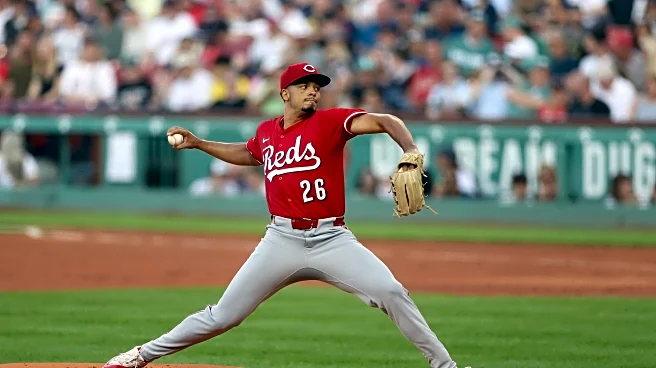
Chase Burns, RHP
2025 BABIP: .360
Burns allowed a .316 BABIP during his electric season with Wake Forest in 2024 before being the #2 overall draft pick. When he debuted as a pro in 2025, he posted a .258 BABIP in 42.0 IP with AA Chattanooga and a .244 BABIP in 66.0 IP in the minors across all stops before his call-up to the big leagues.
Without getting too numbers-heavy on a pitcher with such a small sample of results, I’ll simply point out that a) nobody with his filthy arsenal of pitches is going to post a .360 BABIP allowed again and b) that one disastrous start against Boston last year where he was tipping pitches featured a .667 BABIP against him in-game.
Chase Burns stock to the moon!