
Well, the season is over. The tank is complete, and after weeks of speculation, the Jets will be picking No. 2 overall.
At No. 2, there are still plenty of questions about what direction they take. If Dante
Moore declares, the debate will almost certainly center on whether the Jets go quarterback, trade back, or simply take the best player on the board. That discussion is fairly straightforward and will dominate much of the early draft conversation.
However, there’s another pick the Jets own that isn’t getting nearly the same level of attention.
Thanks to the Colts’ collapse down the stretch and their failure to make the playoffs, the pick they traded to the Jets now lands in the top half of the draft. For a team with holes all over the roster, that’s a massive asset.
We’ll dive much deeper into these prospects as we get closer to April, and it’s important to note that draft boards can change rapidly between January and draft night. But for now, let’s take a brief look at the four most popular players players mocked to the Jets with this pick:
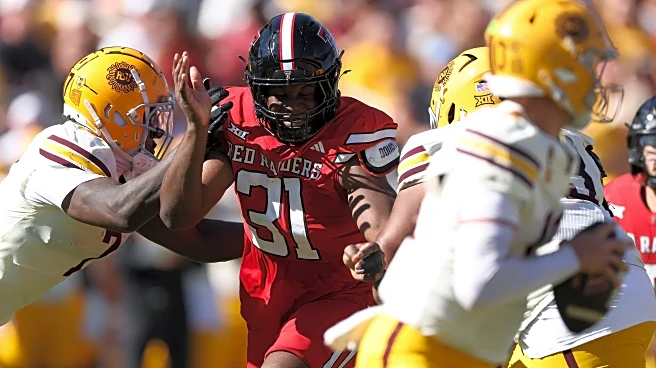
David Bailey:
Bailey immediately emerges as a popular potential target for the Jets.
A four-year senior who began his career at Stanford before transferring to Texas Tech, Bailey has been on draft radars for the better part of the last two years. However, it was his senior season that truly launched his draft stock. After entering the year viewed as more of a mid–second-round prospect, Bailey has climbed to consensus No. 11 overall on most big boards.
The book on Bailey is fairly simple: he’s an elite college pass rusher.
After two solid seasons at Stanford, Bailey took a major leap in his junior year, becoming one of the highest-graded pass rushers in the country. With a larger national stage at Texas Tech, he only continued that ascent, arguably becoming the most dominant pass rusher in college football this past season. With better coverage behind him, his sack total also exploded with 15 sacks this past year.
Bailey is the highest-graded pass rusher in the country on both true pass sets and overall snaps. He leads the nation in PRP—a PFF metric that combines sacks, hits, and hurries relative to pass-rush opportunities—and also ranks first in win rate on true pass sets, measuring how often he beats his blocker on non-penalty pass-rush snaps.
The athletic profile jumps off the page as well. Bailey is fast, explosive, and incredibly productive. He reportedly bench-pressed 405 pounds, squatted 550, and has been clocked at 22.16 mph. There’s a lot to like.
The concerns, however, are also easy to spot.
Bailey is undersized, listed at 250 pounds (a number that appears generous given he doesn’t look much different from the 240 pounds he was listed at during his Stanford days). That size raises legitimate questions about his ability to set the edge, hold up against the run, and rein in some of his more reckless tendencies.
Ultimately, there are two very different ways to view Bailey depending on the story you are going to tell yourself. On one hand, you’re getting a freaky, explosive, highly productive pass rusher, something the Jets desperately need. On the other, you may be drafting a situational edge defender who can’t consistently stay on the field for all three downs due to size limitations.
With Will McDonald already on the roster and facing similar concerns, it remains to be seen whether the Jets would be willing to take another swing on this type of profile.
Keldric Faulk:
We’ll continue the trend of examining potential pass rushers at pick No. 16, but this one couldn’t be more different from David Bailey.
Keldric Faulk is a specimen. If you were designing an NFL edge rusher in a lab, it would look a lot like Faulk. He stands 6’6”, carries long arms, and weighs in at 285 pounds a drastically different body type than the Jets’ current edge rushers in Will McDonald and Jermaine Johnson.
Faulk is also a completely different type of player than Bailey. While Bailey lined up almost exclusively outside the offensive tackle, Faulk has been used all over the front. Over the past two seasons, he’s aligned outside the tackle roughly 55–60% of the time, but Auburn has also deployed him over tackles and even inside over guards. He’s been asked to do everything.
That versatility shows up most clearly against the run. Faulk has graded extremely well in run defense, ranking in the top 25 in both stop rate and run-defense grade in each of the last two seasons. What makes that even more impressive is his age, he’s been doing this at 19 and 20 years old in the SEC.
The pass-rushing profile, however, is very much a work in progress and that’s where the concerns begin.
Most notably, Faulk took a step back as a pass rusher this season. After recording nine sacks as a 19-year-old sophomore, his sack total dropped to just two this past year. His underlying metrics tell a similar story, as he ranked outside the top 50 in both pressure rate and win rate. There is an important caveat here: pressure and win rates tend to decline when a player isn’t used primarily as a stand-up edge rusher outside the tackle. Still, the pass-rush skill set clearly needs refinement.
Faulk will be one of the more fascinating evaluations in this class, particularly depending on how he tests. On first glance, he appears plenty athletic (especially for his size) and it’s notable how well he already carries his frame at just 20 years old. It’s easy to see why he’s been viewed as a mid–first-round pick at worst for much of the year.
The questions, however, are largely tied to projection.
The best-case scenario is a complete edge defender: a powerful run stopper who leverages his size and athleticism into becoming a legitimate plus pass rusher at the next level. The concern is more straightforward, he never fully develops the pass-rushing tools needed to consistently win in the NFL.
That variance is what makes Faulk such a fascinating, and potentially polarizing, option for the Jets at No. 16.
Makai Lemon:
Moving away from edge rusher to another position of need, wide receiver will undoubtedly be one of the most talked-about spots to address in this year’s draft especially if the Jets do select a quarterback at pick No. 2. Makai Lemon, by all accounts, appears to be a very legitimate option considering where he ranks on consensus big boards. Over the last three months of the draft process, Lemon has hovered anywhere from the early 20s to as high as No. 16, where he currently sits on several boards.
Lemon is a fascinating evaluation. From a production standpoint, it’s hard to find many receivers as consistently productive as he’s been. After entering USC as a highly rated recruit, Lemon broke out during his sophomore season, finishing with 52 catches for 764 yards and three touchdowns on 67 targets. From an efficiency perspective, he was outstanding—posting a high catch rate while adding an elite 3.03 yards per route run.
At just 21 years old, Lemon took another leap as a junior and emerged as one of the best wide receivers in college football. He finished the season as the highest-graded receiver in the country, totaling 79 catches, 1,156 yards, and 11 touchdowns. Among qualified Power Four receivers, he ranked third nationally in yards per route run and finished top 10 in missed tackles forced, drop rate, and passer rating when targeted. Any way you slice it, Lemon was both dominant and efficient.
The main concern with Lemon, (and the first thing evaluators will point to) is his size. Listed at 5’11”, 195 pounds, Lemon spent most of his time at USC operating out of the slot. While he did expand his role this season, he still lined up outside on just 28% of his snaps.
That leads to the obvious questions: can Lemon consistently beat press man coverage at the NFL level against bigger, more physical defensive backs? And does the lack of true top-end speed (he’s rumored to run in the 4.45–4.50 range) cap his upside? Those answers will come with time.
The Jaxson Smith-Njigba comparison is going to come up frequently throughout this draft cycle given how similar their profiles are in terms of size, production, usage, and athleticism. But one thing is clear: if you’re looking for an advanced route runner with elite production, there simply aren’t many better options in this draft than Makai Lemon.
Peter Woods:
We’ll close out this article with our final player and undoubtedly the most polarizing name on the list: Peter Woods.
Woods has been in the spotlight for a long time now. The buzz around him has been loud for nearly two years, dating back to when he burst onto the scene at Clemson as a true freshman. From the very beginning, Woods was a very good player.
At just 18 years old, Woods made an immediate impact. During his freshman season, while primarily playing as a 1-tech and 3-tech, he established himself as an elite run defender. He finished as a top-eight run defender in the country by PFF grade and ranked second nationally among all defensive linemen in stop rate. For an 18-year-old freshman playing in the Power Four, that level of production is remarkable.
He followed up his breakout freshman year with another strong campaign as a sophomore. Clemson used him differently, lining him up more frequently as a traditional defensive end and even placing him outside the tackles at times. As a result, his pass-rush metrics took a step forward. Despite still spending the majority of his snaps inside, Woods graded well as a pass rusher when asked to attack the quarterback. His win rate ranked top 10 nationally among non-edge rushers, and in true pass sets—albeit on a smaller sample—he finished top 15 at the position.
Because of that trajectory, Woods entered the season as a consensus top-five prospect. He also earned a spot on Bruce Feldman’s Freaks List, where Feldman wrote:
“His latest body composition scans prior to camp showed that 240 of his 310 pounds are lean muscle mass. He’s a rare combination of power and speed for a 300-plus-pounder. This offseason, Woods bench pressed 490 pounds and did 34 reps of 225. He squatted 700 pounds and power cleaned 385, ran a 4.86 40-yard dash and vertical jumped 33 inches.”
Unfortunately, Woods’ junior season was a clear disappointment. He moved back exclusively to the interior, and his production and grading took a noticeable step back. From a win-rate and pressure standpoint, he fell outside the top 50 among qualified defensive linemen. It’s fair to note that producing high pressure and win rates is more difficult when playing nose tackle and interior defensive line, but even accounting for alignment, his results were underwhelming compared to peers in similar roles. The dominant run defense he showed early in his career also regressed.
As a result, Woods has slid from being a consensus top-five player on big boards to someone who could legitimately fall out of the top half of the first round on draft night.
Woods remains a fascinating evaluation. From a size and athleticism standpoint, he checks every box at 6’3”, 315 pounds. He’s shown flashes of high-level play as both a run defender and a pass rusher. But it’s impossible to ignore the step back in performance this past season. Simply put, he’s well behind the sack and tackle-for-loss production you’d typically expect from a defensive lineman selected in the middle of the first round. A concern to say the least.
Conclusion:
As previously mentioned, these rankings are cyclical by nature. While these four players are the most commonly mocked to the Jets at this point in the process, it’s unlikely they’ll be the same names we’re seeing come April once testing results and additional information start to reshape boards.
We’ll continue to monitor the class and take a deeper look at all of these prospects (including those listed above) over the coming months.