




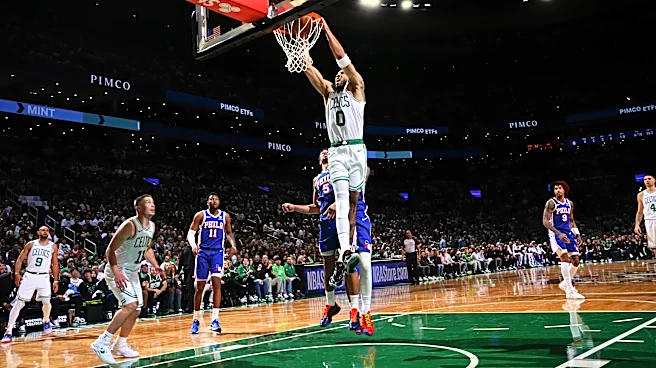
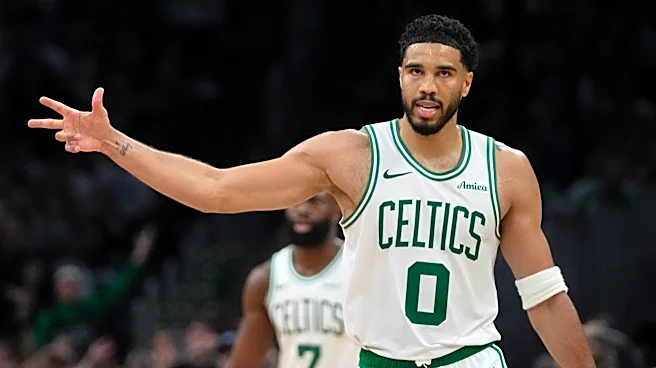
BOSTON — Neemias Queta just wanted to watch film.
Moments after the Celtics’ painful 111-97 loss to the 76ers, the Portuguese center stood in the Celtics locker room surrounded by reporters, fielding question after question about what went wrong in Game 2.
Queta was asked about what allowed Tyrese Maxey to get going after a quieter Game 1; the Philadelphia star exploded for 29 points and 9 assists on Tuesday night.
And, he paused for a moment to consider the question.
“I’m not sure,” Queta said. “Gotta
watch film tomorrow.”
It was his first of four times bringing up film in his postgame media availability. Safe to say, he was eager to review the footage.
Jaylen Brown, who was relatively upbeat at the podium, was also eager to review what went wrong in a game that saw Philadelphia hit 19 three-pointers (on nearly 49% shooting) and explode for 37 second-quarter points (a number that Queta deemed a “death sentence.”)
“Obviously, it wasn’t the best showing for us,” Brown said. “But, we’ll watch the film and see where adjustments need to be made.”
Film, after all, has been the crux of the Celtics’ season. Jaylen Brown has deemed the group’s consistent in-depth film study ‘Celtics University.’
“This year, our margin for error has been slim,” Brown said earlier this season. “If we don’t come to play, if a team wins the margins, you see, we’ll lose games that you know we’re supposed to win. So, those film sessions that we’ve had, I call them Celtics University. It’s like a classroom.”
“Everybody’s got their notepads, asking questions, we’re breaking down the film and the details of everything. Because the details are most important. The difference between good and great players is the emphasis on the details. There’s no detail too small. So, the film room has helped me elevate my game, and it’s helped elevate our team as well.”
So what does a film session look like after a disappointing loss in the NBA playoffs?
Players filed into the Auerbach Center on Tuesday morning, just hours removed from a loss that saw them score just 39 second-half points.
Film, like it has been all year, was important. Nikola Vucevic explained that, immediately after the final buzzer, it can be difficult, as a player, to process what went wrong.
“Right after a game, it’s hard to have a clear picture of what exactly happened,” Vucevic said. “I think that’s why film is good, because you have time to kind of cool down after the game, let the emotions settle, and then you go back and watch and get a clearer picture of what happened, because in the moment of a game, it happened so fast. You’re in full-on competition mode, and you’re trying to win. And sometimes your emotions get involved, and you can’t have a full, clear picture.”
That’s why Wednesday’s film session was illuminating. Vucevic said that the coaching staff and the players communicated well and discussed things openly. He also acknowledged that players can have a tendency to think a particular coverage or scheme is to blame for defensive shortcomings, whereas in reality, a lot of the time it’s more about their own execution of the coverages.
“Today, in the film session, they showed a lot of stuff that we could have done differently, that could have helped us in certain situations,” he said. “But I think it’s just natural — when a player you’re guarding gets going, you’re always trying to figure out, why is it? And I think it’s natural for players to think, ‘Oh, maybe schemes.’ But then, when you go back and watch the film, you realize there’s so much more that goes into it, and there are definitely things last night that we could have done better, that we could have controlled, that would have helped.”
After reviewing film, players were able to clearly identify where individually they could be sharper ahead of Friday’s Game 3.
“A lot of times, it’s little details like, ‘Oh, maybe if, for example, if I was there to help in the right, if I wasn’t late on that help, maybe the other guy wouldn’t have to help on my guy, [and they] wouldn’t [have] gotten the corner three,’ for example — things like that.”
Joe Mazzulla said he identified three main areas where the team could control their own destiny.
He pointed to how they closed the first quarter; after leading 26-13, the 76ers went on a 10-0 run that included multiple let up offensive rebounds, live ball turnovers, and missed free throws.
He also pointed to the 76ers’ 37-point infamous second quarter, a quarter that Brown, Jayson Tatum, and Neemias Queta all spoke to after the loss.
“Losing a quarter of 37-26 is tough to overcome in a playoff game against a team like that,” Mazzulla said. “And I think that stems from some missed shots, but also things that we can be better and things that we can control on the margins — live ball turnovers, offensive rebounds, and things of that nature.”
Finally, there were personnell tendencies the Celtics didn’t pay close enough attention to — 6 to 8 times where the Celtics defended without accounting for a 76ers’ player’s offensive tendency.
The Celtics will look to turn the page when they travel to Philadelphia on Thursday.
But in a way, Wednesday’s film session was therapeutic, too — because it helped understand just how much is in their control.
“When you lose a game in the playoffs, you feel like it’s the end of the world,” Derrick White said. “And so you see that there are these little pockets of the game here – this is why we are losing, or why they want to run. And so, just kind of see what plays that we should have made or could have made that might have changed the whole game. And I mean, you can get that from a win, but I feel like it’s just probably — they say it’s easier to learn from a loss. And so, it’s just all those little plays, all those little things that go into winning and losing.”