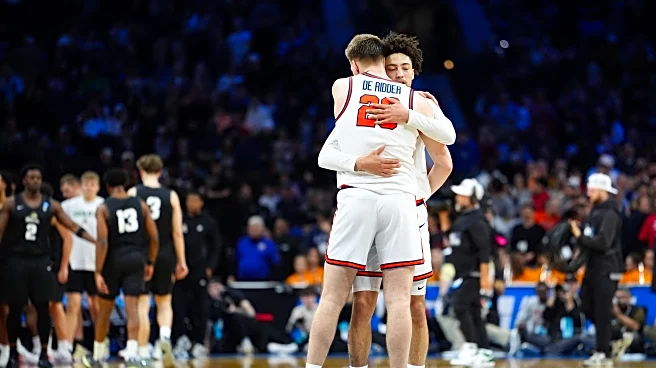




Virginia is moving on, but not without making its fans sweat for most of the afternoon.
The third-seeded Cavaliers beat fourteenth-seeded Wright State, 82-73, on Friday in Philadelphia, but this was no comfortable first-round cruise. UVA trailed 43-38 at halftime, spent much of the game looking like it was one bad stretch away from another March horror story, and had to survive a truly strange shooting performance from the Raiders, something Virginia fans are all too familiar with this time of year,
before finally pulling away late. Still, survive and advance is the name of the game this time of year, and Virginia did more than enough offensively in the second half to keep its season alive.
Jacari White saved Virginia’s season
If Virginia had lost this game, the story would have been another NCAA Tournament flameout. Instead, the story starts with Jacari White.
White was magnificent off the bench, pouring in 26 points in just 24 minutes on 10-of-12 shooting and 6-of-8 from three. It was the exact kind of microwave scoring burst Virginia had to have in a game that never really settled down. Every time Wright State threatened to turn the afternoon from “uncomfortable” to “disaster,” White had an answer. His late bucket after the Raiders had cut the lead to five felt like the exhale moment and the shot that finally told everyone in orange and blue that this one was not going off the rails.
What made White’s performance even bigger was the context around it. This was not one of those games where Virginia’s defense completely strangled the underdog and let the offense coast. The Cavaliers needed real shot-making, and White provided almost all of it in the biggest moments. He had a season-best 26 points, and it certainly felt like a career-defining NCAA Tournament moment for a player who has been a key part of this team’s depth all year. Virginia’s bench outscored Wright State’s 33-14, and White was overwhelmingly the reason why.
Virginia’s size forced Wright State out of its comfort zone
This is where the game ended up following the script outlined in my preview article, even if the scoreboard made it look far messier than expected. Wright State did not enter the tournament as a typical small-school Cinderella built entirely on hot three-point shooting. The Raiders had spent the season winning with physicality, interior scoring, and a style that often made them the stronger team. Against Virginia, though, that formula was always going to be much harder to sustain.
And that is exactly what happened. Wright State took 31 threes out of 61 field-goal attempts on Friday, just over half of its shots. Over the full season, the Raiders had taken 667 threes against 1,996 total field-goal attempts, which was only about a third of their overall shot diet. Virginia’s front line changed the geometry of the game. Kellen Pickett, one of Wright State’s key interior pieces, finished with just two points on 0-for-3 shooting. The Raiders were also outrebounded 39-24. Even without posting some absurd block total compared to their typical standards with just five, UVA’s size clearly pushed Wright State away from the version of itself it usually prefers to be.
Wright State answered with absurd shot-making
The problem for Virginia is that Wright State adapted, and for long stretches, adapted brilliantly.
The Raiders finished 13-for-31 from three-point range, good for 42 percent, which was a huge reason this game stayed tense into the final minutes. Solomon Callaghan hit 4-of-6 from deep. TJ Burch knocked down 2-of-5. And then there was Michael Imariagbe, who turned into a completely different player from the perimeter for one afternoon. Imariagbe scored 19 points, grabbed 10 rebounds, and somehow went 5-for-9 from three. That alone would have been a great upset-story stat line. It becomes even crazier when you realize he had made just one three-pointer all season coming into the game, on only six total attempts.
That is what made this one feel so uncomfortable. Virginia’s process was mostly fine. It won the glass, denied Wright State’s preferred playstyle, and forced the Raiders into a much more perimeter-heavy game than usual. But that is why March Madness is a different beast, one whose wrath the Virginia faithful have felt far too frequently over recent years. Sometimes a 6-foot-7 forward who entered the day as a 16.7 percent three-point shooter suddenly turns into a sniper for 40 minutes and gives Virginia fans flashbacks to every bad NCAA memory at once.
This Virginia team can survive a non-Virginia game
For years, the national caricature of Virginia basketball has been simple: if the game gets fast or high scoring, the Cavaliers are in trouble. This team may not fully erase that reputation in one afternoon, but it did push back on it.
Virginia won a game in which Wright State scored 73 points, hit 13 threes, and led at halftime. The Cavaliers also committed 14 turnovers, which is not exactly the formula for a calm, methodical March win. And yet UVA still put up 82 points, shot 52 percent from the floor, 50 percent from three, and 13-for-14 from the free-throw line.
After trailing 43-38 at the break, Virginia responded by outscoring Wright State 44-30 in the second half. That is not the old-school rock-fight Virginia under Tony Bennett that many Cavalier fans like me grew up on. This is a team with enough offensive juice to survive a game when a mid-major center suddenly goes 5-9 from three after hitting one all season.
That matters going forward. There will still be matchups where Virginia wants to shrink the floor, dominate defensively, and turn things into a grinder. But Friday showed this group is not trapped in one identity. When the underdog got hot, when the game got noisy, and when the stress level rose, the Cavaliers still found another gear offensively.
The Cavaliers finally have an NCAA Tournament win again
This one may sound obvious, but it is critical for a team and fanbase that has endured so much disappointment over recent years.
Virginia had not won an NCAA Tournament game since the famed 2019 national title run. Since then, the Cavaliers had been bounced by Ohio in 2021, Furman in 2023, and Colorado State in the 2024 First Four. That history hung over this game, whether anyone wanted to admit it or not. The moment Wright State started raining threes and carrying a halftime lead, every one of those old March scars came rushing back.
So no, beating Wright State does not erase everything. It does not rewrite UMBC, Ohio, Furman, or Colorado State. It does not guarantee a deep run. But it does matter that Virginia did not blink its way into another headline about disappointment. Ryan Odom, of all people, now has this program into the second round in his first season after taking over for Tony Bennett, and there is something undeniably fitting about that.
For at least one afternoon, Virginia did not become the story. It survived being pushed, answered late, and finally gave its fans a March result that didn’t leave them with a sick feeling. That is not the end goal for this team, but after the last several tournaments, it is a start.