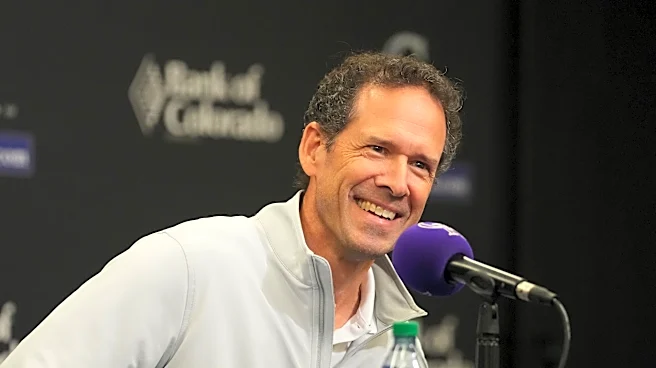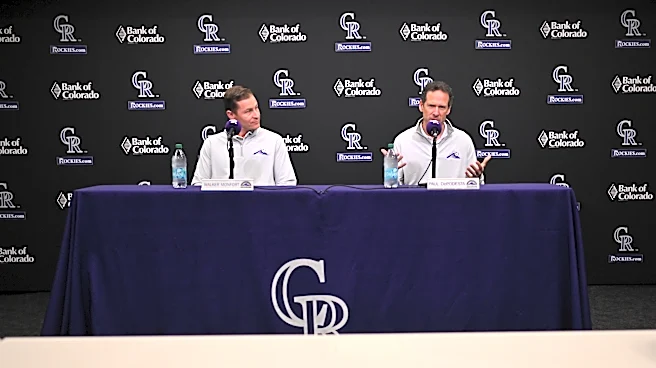

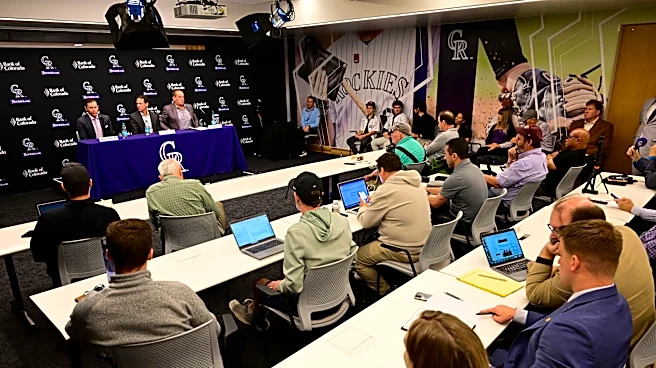
On Tuesday afternoon, Colorado Rockies President Walker Montfort and President of Baseball Operations Paul DePodesta met with media to answer end-of-the-year questions. The conversation was wide ranging.
Below are excerpts from that conversation, which has been lightly edited for clarity.
On their assessment of the 2026 season and their goals going forward
Depodesta: When I think about our season, I have conflicting thoughts.
On the one hand, I feel good about some of the progress you made. On on the other
hand, sort of very dissatisfied with some of the results. So (I’m) wrestling with those two thoughts at the same time, which I think probably a lot of our fans are as well. We went into this season with dual goals. We wanted to win more games at the major-league level, and we wanted to also continue rebuilding the foundation organization and beefing up our farm system. A lot of teams are faced with a choice of trying to win more now, or are you going to try to win more in the future? We really wanted to try to do both.
In some respects, I’m really pleased with what we’re able to do. But ultimately, our real goal is to win games at the major-league level, and on that level, or on that score, I was not pleased with how things ended up, and I think we made real progress through the course of the year. And there were times when we were feeling really good about it. But the last six weeks, I think, left a bad taste in our mouths certainly about how we were able to perform, and I think it sort of sullied how we all feel about the season to some degree, like having a having a good meal and waiting 45 minutes for the check. When it ends badly, it just leaves a bad taste, and I think in some respects that’s what happened to our season.
But as we unpack it, which is what we’re doing now, I think there are a lot of things that we feel good about that we can build on, and a lot of things that we learned. So for all those reasons, I’m incredibly encouraged going forward, but to be honest with you, I wish the 2027 season were starting, like, next week because I want to get going already and implement some of the things we have learned and, again, get moving forward because I think we know the opportunities that are available in front of us, and we want to go grab them.
Monfort: I would say last year when when we introduced Paul here, progress was the main thing that we were committing to, and what level I think we had high ambition, but I think we also were in position at that point in time to manage our expectations, and I would say there are a ton of examples of significant progress made.
One of the things that we talk about frequently is run differential. We made some great strides in that. Still not where we where we want it to be. We played — I think I looked today — 79 games that were decided by a margin of two or less runs. We won 37% of those games. I think the key is that we played a lot of closer games.
But on the other side of the spectrum, we have to figure out ways to win more of those games and hopefully even decrease the number because we’re winning by a wider margin.
So I would say, all things considered, when you look at last offseason and everything that took place from a change perspective, our organization adapted to that change well. Not only our front office, but people out in the field, our players, everyone’s bought in. I think that’s one of the things that I’m really excited about. We’ve got great leadership in place throughout our baseball operation. We’ve got a lot of innovation and ideas that are already being thrown around as to how we can get better.
But I think from our standpoint, in short order here, we’re going to raise our expectations. I mean, we felt we should have achieved more in the win-loss column than what we did this year. The last six weeks were difficult to go through, but at the same time, I think it established a pretty good roadmap on what we need to focus on. So that’s where we’re at this offseason. We’re trying to figure out how we can make the Rockies in 2027 better, and then just continue that progress forward.
On what they learned through the struggles of the last six weeks of the season
DePodesta: I think you know what happened the last six weeks also was happening at times throughout the course of the regular season, so it wasn’t only in that time frame.
But I think it was pretty clear what our biggest hole was. Our starting pitching, I think after the trade deadline, had a 7.00 ERA right? For the year as a whole, our run differential was worse in innings one and two than innings three and beyond combined. There were way too many games where we just got into a hole within the first two innings, and we were in chase mode at that point.
Now, to our team’s credit, especially the offensive players, I think that they did an amazing job fighting for 27 outs, and they never gave up, played hard all the way. We came back in some games. We made it tough for people to beat us, even at the end. Or we turned a 5-0 game in the second into a 5-4 loss or something like that.
But those are games that we have to figure out ways to win, and part of that’s by not falling down 5-0 in the in the first two innings. So I think starting pitching was certainly the biggest factor.
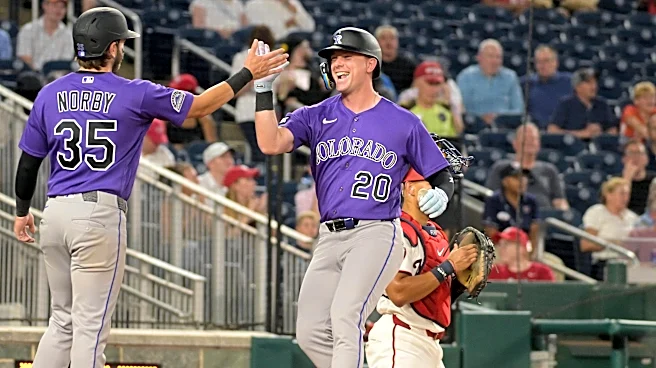
I think one of the most frustrating things about the final six weeks is that we had a lot of really good performances over that time. Cole Carrigg won Rookie of the Month in September. TJ Rumfield was playing terrific. Jake [McCarthy] played well. Hunter Goodman ended up hitting 40-plus homers. Basically everybody we traded for at the deadline came in and contributed. Connor Norby played great. [Adael] Amador came up and played really well. So to have all these things going well, but then to have a systemic failure was probably the most frustrating part.
But clearly, starting pitching is the thing that we weren’t able to improve upon as much this year as we were able to do in other parts of the club. Our offense got significantly better. Our bullpen was improved. The starting pitching, while better, wasn’t nearly what it needs to be ultimately.
On their relationship with the Penner Sports Group and whether the Monforts would continue to own the Rockies
Monfort: There’s not a plan [to sell the Rockies]. Our relationship as it exists has been publicly explained, not only by our end but by the Broncos and the Penner Sports Group as well.
From our standpoint, they’re partners. One of the key things and key reasons we entered into this partnership was to help clear ourselves of debt that we took on from the COVID days and then the loss of our RSN. And we’re in a much better financial position today because of that partnership than we would have been had we not entered into it.
And so, as we talk about things that we can do this offseason, it just gives us a ton more flexibility compared to where we were positioned last year.
Follow-up question: So the Monforts will remain the majority owners?
Monfort: Correct.
Follow-up question: What is your kind of week-in, week-out interaction with Greg and his team, and and what does that kind of look like for you?
Monfort: We keep in touch with them. But obviously right now they’re very heavily focused on the Broncos, which we’re constantly rooting for. But we have a good working relationship with them and meet on occasion. But I would say over the past couple weeks, it’s been lower because of the Bronco stuff going on.
On the status of Kris Bryant
DePodesta: There’s nothing new at this point. Obviously, Kris wasn’t able to wasn’t able to play this year, so we just have to continue to stay in touch with him and see how things progress through the course of this offseason. I think we have to continue to move forward from a roster-building standpoint as if we’re not going to have him, and if we do, then that’s a great bonus.

On what they learned about pitching and how they’ll approach 2027
DePodesta: I wouldn’t say we were seeking out low velocity. We certainly were seeking out strike throwing.
If you look at the teams really from 2023, 2024, 2025, especially, we just didn’t throw enough strikes. And in this ballpark, especially, we don’t want to be giving up free bases. We thought that was something that the market last winter sort of offered us is that there there were pitchers out there that were much more efficient strike throwers. We wanted to be in a position where we forced our opponent to beat us by swinging the bat, and figured that that would at least do something to improve our overall pitching performance, and in some respects we did.
We were much better strike throwers. We did walk fewer hitters. Our strikeout-to-walk ratio was better than it’s been in four years. That did not make nearly as much of an impact as we would have hoped in terms of our overall outcomes. Was some of that unlucky? Was some of it tied to other things going on with the club, even, like, usage? Was it sequencing? There are a lot of different things that we’ve sort of talked about, but I think we we certainly learned a lot through the exercise.
I think the biggest thing was that last winter we decided we need to do things from a pitching staff standpoint to make hitters more uncomfortable in the box. What was available was guys who had deep mixes, and we still think that that can be an element of what it is we’re looking for. But that’s not the only thing, and I think each year, the market will actually offer up probably different types of pitchers, and we just need to decide whether or not we think those will fit here in Coors.
But I think we’re going to continue to seek out different types of pitchers that we think have a chance to have some success here.
—
I think we have to be open to anything really.
This environment certainly is different, and I think in some respects almost necessitates an open-minded approach as to how you build it.
One of the things we’ve been talking about for the last few months was “Let’s think about 27 outs times 162, and you’ve got 13 slots, right? How do we do that? Let’s let’s start with a blank piece of paper and try to build it from scratch.”
It’s also, though, going to be heavily predicated on the players that we have in any given time. So I don’t think we would have a plan right now for 2027 without knowing what free agents we might be able to sign because that could dramatically affect our plan.
We were able to add a couple of pitchers at the trade deadline, a starter and a couple of relievers. That certainly changes things. Who’s available for us in Double- and Triple-A that we think have a chance to come up and help us in 2027? So all those things are going to matter.
I think it’s interesting even right now as you watch the playoffs, different teams are doing different things based on the personnel that they have and the off days that they have available to them, which are more plentiful in the playoffs. But I think we have to take a similar approach. Given the talent we have available to us at any given time — and that may be different in April than it is in July — how are we going to adjust and do our best to get 27 outs six or seven days a week?
—
We had our best month of pitching in April — it was really March, and then into April — and we probably had the most length on our pitching staff during that time. So, not only did we have our sort of traditional five starters, you also had Chase Dollander, Antonio Senzatela, Zach Agnos were all in the bullpen, and available to pitch not as traditional long men, but as guys who could go win a game. “Hey, this game is 4-4 in the fifth. Go take us to the finish line. Win us this thing.” And those guys were able to do that.Now, I think in May, in a span of — what a week or 10 days? — we lost both José Quintana and Dollander, and I think that exposed some of our lack of depth. Certainly, Senzatela was also pitching so well that he ended up pitching in somewhat shorter and higher-leverage roles as the season rolled on, and so it really took away from some of that strategic depth we tried to build up at the beginning of the season that did work pretty effectively.
I think the short answer is we have to look at everything, and we also have to be creative in terms of how we do it, and it may look very different throughout the course of the season depending on what pitchers we have available to us. But I think going with five starters and eight relievers, and expecting the five starters to all go six innings every time out, that’s probably unrealistic here, or at least less realistic here than it is in most other places.
On looking to the Chicago White Sox as a possible model
DePodesta: Sure, and I think this year certainly, just objectively, if you look at a lot of the different underlying metrics, was a pretty significant leap forward.
But obviously, with the win-loss record, there are more leaps that need to happen going forward for us to ultimately be where we want to be. The time frame of when those can happen — it’s hard to say because we don’t know necessarily what opportunities could present themselves to us.
As I sat up here last November, I couldn’t have told you that TJ Rumfield would be a Rockie or that Jake McCarthy would be a Rockie. Going forward, those opportunities presented themselves over the course of the next couple of months, and they had a significant impact on our team, not just in 2026, but hopefully for a number of years going forward. And there are lots of others. Obviously, those are just two examples.
But we are not only determined, but our expectation is that there will be a significant leap next year. How far that takes us, I think, is again really, really hard to say. But we’re again, as I said at the beginning, our focus here is winning at the major-league level. I mean, yes, we want to do everything we can to be building up our farm system, and that’s a concurrent goal. But it’s not going to be something where we’re going to take the next four years to build up this farm system and wait for those players to get here.
There was a reason at the deadline that in all four of the trades we made, we acquired a Triple-A player in addition to a much younger player, and all four of those players were on our team in August and September. We want to get better now, so I think we absolutely have that drive to do that, and hopefully we’ll be able to create more opportunities that will accelerate that path as much as possible.
On plans for front-0ffice expansion
DePodesta: I would say we made pretty significant investments into the front office and coaching staff this past offseason. I think we’re going to make probably equal, if not even larger, investments this coming offseason, that’ll [be] not as much with the major league coaching staff because they’re largely in place, but throughout our player development system, through our scouting operations, and then also in our front office.Living this cycle for a year has been really valuable. There are a lot of things coming in that we thought we could change and hopefully improve, but when you actually go through everything, you realize like, “Oh, there’s so much more we could do to get better.” So, living through the offseason, living through spring training and roster building, living through the draft, the prep for the draft, living through the trade deadline, even living through like pre-game prep every day for 162 games. In every single one of those areas, we made changes that we thought were improvements, and in every single one of those areas, I think there are even more improvements we can make going into 2027 and beyond.
And some of that requires real investment, both in people and technology, and we’ve been given the green light to pursue each and every one of those things, so I’m excited about the possibilities going forward and how many things we’ve already identified that we know we can do better.
On raising prices for season ticket holders after four 100-loss seasons
Monfort: It’s never fun, and there’s never a right time, right?
I guess if you go out and win the World Series, maybe 12% is okay. But in the end, over the past, as you mentioned, three, four years, it’s been difficult baseball, and even prior to that, I think we, for the most part, kept our season tickets flat, while others were increasing at — I think it was like a four-and-a-half-percent rate on average in MLB. So we didn’t increase over that period of time.
We met internally, probably three or four months ago, about what our plan was, and ultimately it’s about bridging the gap between where the Rockies are at from a revenue perspective to closer to league average or even the average of our mid-market peers.
Obviously our season ticket holders are tremendously important to us. It’s definitely not like we don’t think about that, but, really, we believe in where we’re going. And obviously, coming off of another 100-loss season, that’s not easy to justify, but even when we actually sent out that notification, we were trending towards — I think — 66, 67 wins at that time.
In the end, we want people to be part of this with us. We appreciate and value their support, but as it comes down to it, we have to position our business better over the course of our future, the near future, probably in a better way than what we’ve done the past few years. Everything that we do from a business perspective, it’s about becoming more competitive on the baseball field.
On manager Warren Schaeffer
DePodesta: I think Schaeffer did a really nice job this year.
Last winter, one of the things we talked about that was critically important in terms of a goal for 2026 was reinstilling belief in our clubhouse, that “Hey, every single game, we can go win that game. It doesn’t matter who we’re playing, we can go win that night.” And I think not only Schaeffer but our coaching staff in general did a really, really good job of creating that atmosphere.
Obviously, it got challenging toward the end, and they still maintained it, and our guys still played hard, like all the way through that final game in Chicago. I think that was a pretty massive accomplishment because that’s, I think, a real shift in mindset in terms of actual game strategy.
I think there are a lot of things he did well throughout the course of the year, but the bottom line is we need to get him more talent. We need more talent on this team to compete at the highest level.
Like I said, there are a lot of things that were directionally positive this year, but still not good enough. We’ve talked about progress, and I do think it’s important to talk about progress. Let’s not mistake it for being good, right? And we’re pleased with the progress, but we’re not pleased yet with where we are.
But I think Schaeffer and his guys did a really, really good job of at least setting the foundation for and really the expectation for where we want to be going forward.
One of the things that was hard to talk about through the course of the year, but he did it consistently, even when we were playing pretty well, was the standard is the standard. Even if we think we’re doing pretty well or we’re doing way better than we did last year or the year before, it’s still not where we ultimately want to be. And he consistently held guys to a much higher standard than just better. And I think that’s certainly what we want to continue to do going forward.
On revisiting Schaeffer’s contract
DePodesta: I think with all of our staff, we’re constantly looking at it, not just the major league coaches, but even throughout the rest of the organization. I think we are trying to build. With some of the changes and with some of the additions, we also want to reestablish the stability that’s been here for a long time as an organization. I do think it’s a hallmark of this organization and a real strength if utilized the right way. I certainly value that not just in Schaeffer but in a lot of the folks that we have here. So again, it’s not something where “Oh, we’re just going to look at it we look at this offseason, or you’re a year out, so we’ll look at it.” I think it’s just something we’re constantly looking at for all of our people.
On the effect of a possible lockout
DePodesta: I think for us, we just need to be ready. We don’t know what’s going to happen, so I think we just have to be prepared for any eventuality. And even in terms of timing, we need to be ready.
Whenever we’re trying to make a deal with another team or with a player, we’re always dealing with a counterparty. We want to be able to move at whatever speed they want to move at, and to do that, you just need to be incredibly well prepared. So that’s what we’re taking advantage of the time now to be able to do.
Last year I came in what —early November? — and we spent most of November and December hiring coaching staff, hiring a front office, etc. So I think we’re excited this year to get a jump on the offseason and be ready to attack it aggressively, not only major league free agency, but even things like roster protections and whatnot that we had to do last year, and we did, but I think we didn’t have as much time to prepare as we will this year.
Monfort: From the business standpoint, we’re operating business as usual until we know something different. Obviously, there’s the Players’ Association and the owners and Major League Baseball that are constantly having discussions on what will come this December. But really, in the end, we’re going to operate our business as if we’re planning for a standard regular season next year. And obviously, if we were to lose baseball games, it would have a negative impact. But in the end, we’re really just trying to focus on what we can control, and then hopefully maximize this offseason for Paul’s point.

On what they learned in 2026
DePodesta: I think there there are a lot of things that we learned. And by the way, it’s not just going to be this past year. I hope it’s that way every year.
I think we tested a lot of things intentionally. Our process was to test and learn, right? So we’re going to try lots of different things. We did some in the minor leagues. We did some certainly at the major-league level. I mean, I won’t go into all of them . . . . I’ll give you an example. One of the things we wanted to try was pitch calling from the dugout, and we did it quite a bit early. We did it some sort of throughout the course of the rest of the season, and I think we learned a lot.
I think one of the things that became a challenge here is that, again, this is a tough environment to pitch in, and if you’re going to do something different, like pitch calling, or even if you use a different type of pitching rotation or whatever it might be, you’re going to give up runs. And when you do, it’s probably pretty easy to then blame whatever it is you’re doing that’s new or different than what someone else is trying. And then does that impact the credibility of that person or those people that are in charge that sort of implemented that change? How does it affect their relationships with the players? You know, et cetera.
Those are real challenges. So that’s just one example of things that we learned and said, “Okay, now as we go forward and we are going to try things differently, what do we need to do ahead of time to try to ensure that something like that doesn’t happen?” Or “Are we putting people in the best possible chance to succeed, not just players, but even coaches?”
That was part of the discussion for pitch calling in particular. That was part of the discussion in spring training, but in retrospect, probably should have been the even bigger part of the discussion. So I think a good learning for us going forward — that’s just an example, but there are probably at least a dozen of those, from player development, scouting, and the big-league club throughout the year.
Monfort: From my standpoint, I would say best practices. I think we ended up hiring 20, 25, we’ll call it, people from outside the organization into our baseball operations.
Obviously, I’ve been here at the Rockies my entire career, and I think bringing on different perspectives really depending on every area of the operation, it just brings unique approaches and unique ways of doing things, or things that we didn’t realize we could improve upon. We have the different perspectives, and bringing everybody in over the course of last offseason, and even over the course of the season, I feel like we’re a lot better positioned to narrow any gap that would remain operationally between the Rockies and everybody else. And so I think that was a key finding from my perspective.
I would also say bringing so many people on board here to merge with those that already existed, I would say it actually went really, really well. These guys, as leaders, have done a great job on the baseball operations side. We have folks on the business operation side that are in new roles that have really embraced those roles to help grow the Rockies in every aspect of our operation, and I think just in general, it’s gone really well.
And the amount of knowledge that we’ve brought into the Rockies over the past 12 months, there’s a lot to learn from it. So we’re constantly learning something new every single day, and we’re trying to activate that knowledge to improve our chances on the baseball field.
DePodesta: Just one final thought on that. One of the things we talked about internally is “Don’t ever let a bad outcome go to waste.” If you have to live through it, let’s learn from it. Let’s increase our chances that it doesn’t happen again, or that we can get some sort of better outcome going forward. Baseball is a game of failure. There are going to be things that we try that don’t work out. But then let’s get the most out of that attempt, so that actually really propels us going forward.
On the role of a closer
DePodesta: I think Jordan Romano really helped to stabilize our pen. I think we saw it some again at the end of the season. It was really helpful. We had Jaden Hill back. I think Juan Mejia was pitching the best he had pitched all year. Mark Manfredi and Nick Frasso both came in and did a really nice job. So I think when you do have an established closer, it can help define other roles in the pen and make others more comfortable.
That being said, you don’t always have it, right? I don’t think you have to have it. There are good teams that have used lots of different guys that end up racking up saves. But I think if you have the right guy in the right situation, it can be helpful. And I think Jordan was that for us this season.
On finding more players and coaches willing to take on the challenges of baseball at elevation
DePodesta: I think so. I think the mindset’s actually incredibly important.
Last year when we did go out and sign those starting pitchers, people asked me how did I convince them to come? I said, “Well, that was sort of the point was that we didn’t. We didn’t even try.” We wanted it to be somewhat a self-selecting group of people who wanted to take on this challenge.
I think if you’re trying to convince people to do this, it’s probably not going to work out really well for them or for us. So we want people who are going to be running toward the challenge, and that’s true for players, for scouts, for coaches, you know, etc.
Does that mean it’s always going to work out perfectly? Unfortunately, not. But I think it does give us a much better chance. And even among those starting pitchers, if you look at them, we certainly had a cross section of results. I think Tomoyuki Sugano pitched really well for us, gave us a chance to win a lot of games. We had a good record in the games that he started. Quintana pitched well for us, and unfortunately, we lost him for the better part of four months. And then Michael Lorenzen didn’t work out as well as he would have hoped, or we would have hoped. I think that’s just kind of baseball.
But I think pitching here does take a certain type of mindset, and we’re going to continually seek those folks, and hopefully they’ll seek us out.
Closing thoughts
This is long — I know — but I wanted to provide the clearest sense I could as to what Monfort and DePodesta said.
One thing has become clear to me over the past couple of weeks, and I did not put it together during the last offseason. In an interview Sam did with Chris Forbes a couple of weeks ago and one I did with Warren Schaeffer (that hasn’t been published yet), I came to appreciate how chaotic the last offseason was for the Rockies. All they did was hire staff and try to get organized — while building an MLB roster. It was time-consuming, and it required a lot of attention. I think — and this is just me — they now have a staff in place, and they intend to grow it this offseason and begin to assess and apply what they’ve learned so far.
I expect them to be aggressive about signing starting pitchers, but I do not expect a lot of turnover in the front office and coaching staff.
That’s just what I think, and I’m eager to hear what you all took away from this.
Let us know in the comments.
Join the conversation!
Sign up for a user account and get:
- Fewer ads
- Create community posts
- Comment on articles, community posts
- Rec comments, community posts
- New, improved notifications system!
Download the SB Nation app on iOS or Android.
Please keep in mind ourPurple Row Community Guidelines when you’re commenting. Thanks!