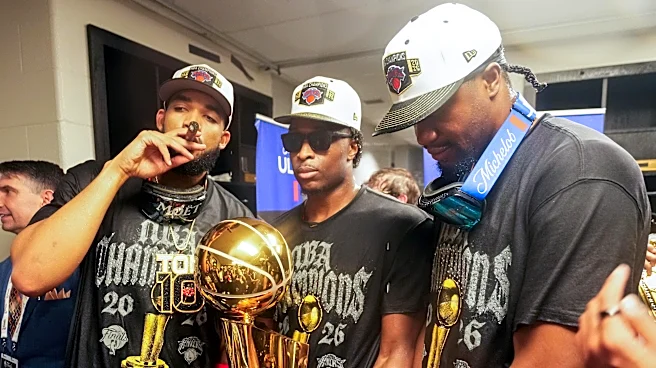





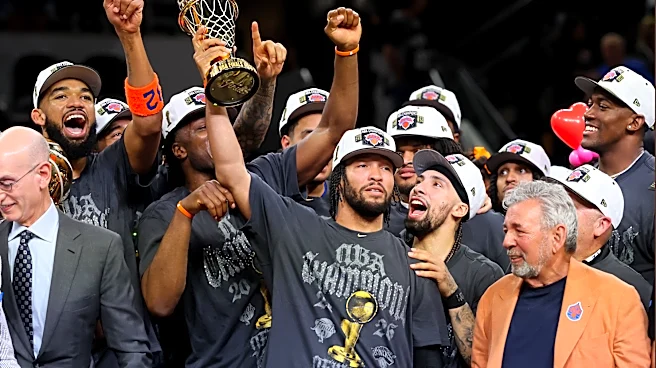
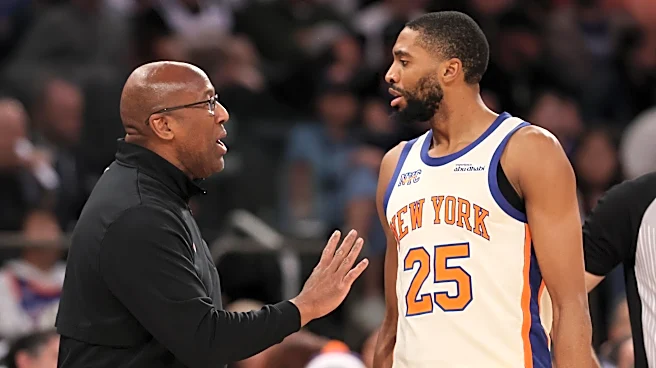


The New York Knicks are the 2026 NBA champions, which is a sentence that still feels a little strange to type, even after watching the confetti fall and Karl-Anthony Towns finally get his hands on the Larry O’Brien Trophy. After 53 years of waiting, after decades of false starts, front-office chaos, tabloid drama, and Madison Square Garden turning into the world’s most famous therapy session, the Knicks finally reached the top of the mountain. For Wolves fans, there was something satisfying about
seeing KAT standing there at the center of it all. He was no longer the guy who couldn’t quite get over the hump, no longer the talented big man forever followed by questions about postseason winning, but a champion.
Towns becoming the latest former Timberwolves cornerstone to win a title elsewhere could easily send Wolves Nation into a dark corner. We have seen this song before. Kevin Garnett gave Minnesota everything he had, left, and won a championship in Boston. Kevin Love put up monster numbers in Minnesota, left, and won a championship in Cleveland. Now Towns, two years removed from being traded out of Minneapolis, has joined them. If you wanted to be miserable about it, nobody would stop you. You could turn the whole thing into another chapter in the franchise’s long-running book of “Why Can’t We Have Nice Things?”
But that would be the wrong lesson to take from this.
The better lesson is that the NBA has changed. New York’s title marks the eighth straight season in which a different team has hoisted the Larry O’Brien Trophy. Eight years, eight champions. That is not how this league used to work. Historically, the NBA has been the sport of dynasties, superstars, and teams that grabbed the wheel and refused to let anyone else drive for half a decade. The 1990s belonged to Michael Jordan and the Bulls. The early 2000s belonged to Shaq, Kobe, Duncan, and the Spurs. Then LeBron bent the league around his will for more than a decade, while the Warriors arrived and turned basketball into a three-point fever dream. For most of NBA history, parity was something the league pretended to want while the same three or four teams passed the trophy around like a family heirloom.
The 2020s have been different. There has been no repeat champion. There has been no unstoppable machine that simply shows up every June because the rest of the league has already accepted its fate. Instead, the championship has gone to teams that found the right mix at the right time, stayed healthy enough, caught a heater, survived the attrition, and threaded the needle through a league that has become more balanced, more fragile, and more unforgiving than ever. The second apron has made it harder to stack rosters without consequences. Injuries have mattered. Matchups have mattered. Timing has mattered. The champion has not always been the team that looked most inevitable in January. It has been the team that was still standing, still connected, and still dangerous when the lights got brightest.
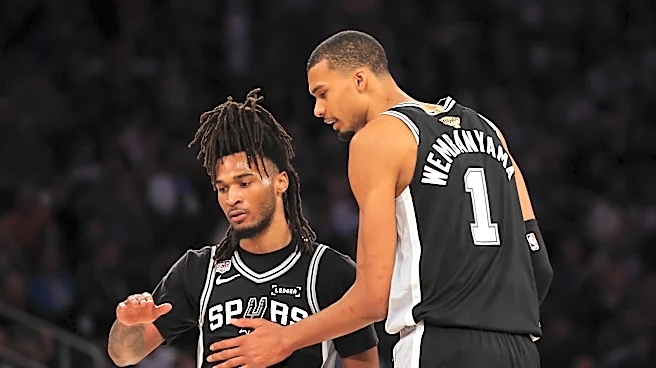
That should matter to Timberwolves fans, because it is very easy right now to talk yourself into despair. The Wolves were eliminated by San Antonio in the second round after back-to-back trips to the Western Conference Finals, and the ending did not exactly inspire a lot of confidence. It was not just that Minnesota lost. It was the way the Wolves lost. Victor Wembanyama looked like the future had arrived ahead of schedule, and the Spurs looked like a team that might spend the next decade ruining everyone else’s plans. Oklahoma City, meanwhile, is still sitting out West with Shai Gilgeous-Alexander, a back-to-back MVP, a title of its own, and enough draft capital to classify Sam Presti as a hoarder. If you want to look at the Thunder and Spurs and decide the Wolves’ championship window is already closing, the argument is sitting right there waiting for you.
But this is where the Knicks’ title should jolt everyone back to reality. If eight teams can win in eight years, if the NBA has truly entered an era where the trophy is no longer reserved for dynasties and preordained superteams, then why exactly are we acting like Minnesota has no path? Why are we treating Oklahoma City and San Antonio like immovable monuments instead of extremely talented teams that still have to survive the same brutal playoff minefield as everyone else? Why are we assuming that the Wolves, with Anthony Edwards not yet in his prime, a talented core around him, and a front office that has already shown a willingness to be aggressive, are somehow locked out of the conversation?
Why not the Wolves?
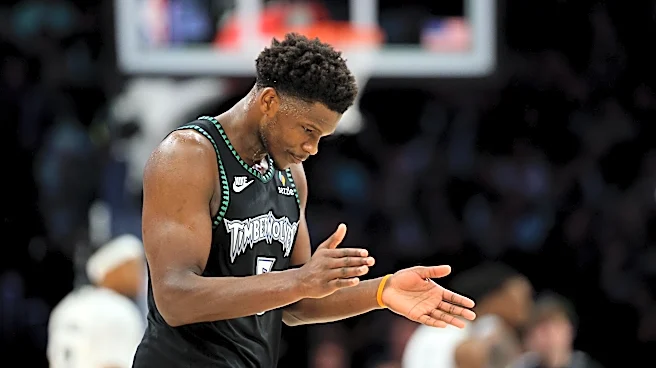
That is not blind homerism. That is not pretending the roster is perfect or ignoring what happened against San Antonio. It is simply acknowledging the reality of the current NBA. The Wolves have what every team in the league spends years trying to find: a true superstar. Anthony Edwards is not a theoretical franchise player anymore. He is the franchise. He is the kind of player who changes the trajectory of a team’s future, the kind of player who gives you permission to think bigger than “maybe we can win a round.” He has already been through real playoff wars. He has already stared down Kevin Durant, Nikola Jokic, LeBron James, Luka Doncic, SGA, and Wembanyama. He has taken hits. He has played hurt. He has failed. He has learned. And he is still climbing.
That last part is the most important part. Edwards is not some veteran star with one last clean shot at a championship before the window slams shut. He is still approaching his prime, still refining the balance between scoring and playmaking, still learning how to control a playoff series possession by possession. If the Wolves had a 29-year-old Edwards and had just watched their best chance slip away, maybe the panic would feel more justified, but that is not where they are. They are building around a superstar who should be better next year, and the year after that, and the year after that.
Around him, the Wolves still have a core that is much better than the mood of the fan base currently suggests. Julius Randle can be maddening at times, and the anti-Randle bandwagon has filled up so quickly it probably needs a second bus. The San Antonio series was not good enough. The OKC series the year before was not good enough. There are fair questions about whether he can be the reliable second option the Wolves need when the playoffs tighten and the margins shrink, but we also should not pretend that peak Julius does not exist. When Randle is engaged, decisive, attacking downhill, and using his gravity to create for others, he gives Minnesota a level of offensive force that is difficult to replace. We have seen stretches where Edwards and Randle together make the Wolves look like a title-level offense. The problem is not that Randle cannot help a championship team. The problem is figuring out whether the Wolves can consistently get the version of him that does.
Rudy Gobert remains a Defensive Player of the Year-level anchor, and while his limitations will always create debate in certain playoff matchups, the Wolves are not the Wolves without the foundation he provides. Jaden McDaniels is still the kind of defensive bulldog every contender wants, a wing who can swallow up elite scorers, tilt a series with his length, and occasionally remind everyone that there is more offensive juice in there than he always shows. Naz Reid is a luxury most teams would love to have, a floor-spacing big who can bomb away from deep, attack mismatches, and swing games when he catches fire. Ayo Dosunmu showed enough after arriving to make you believe there is real playoff value there, especially when you remember that this is a guy who dropped 43 points in a postseason game and gave Minnesota a burst of creation and confidence when injuries had gutted the rotation.
That is a real group. It is not flawless, but nobody in this league has a flawless group anymore. That is the entire point. The champion Knicks had holes. The Spurs had holes. The Thunder had holes. Every contender has something that keeps its fans awake at night. That is life in the second-apron NBA. The question is no longer whether you can build a perfect roster. You cannot. The question is whether you can build a roster with enough high-end talent, enough matchup flexibility, enough health, and enough belief to survive four rounds when everyone else is dealing with their own problems.
The Wolves’ playoff loss to San Antonio was disappointing, but it also needs to be viewed with some perspective. Minnesota was not close to whole. Edwards was playing on two bad knees and was clearly limited. Donte DiVincenzo was sidelined with an Achilles tear, removing a player whose shooting, toughness, and connective tissue would have mattered enormously. Dosunmu was banged up. Naz was dealing with a shoulder issue. This was not the Wolves at their apex. This was a compromised version of the roster trying to solve one of the hardest puzzles in basketball, and even then Minnesota took two games and reached a 2-2 tie before the wheels came off. That does not mean the Wolves were secretly the better team. They were not. San Antonio deserved to advance. But it does mean the gap is not some uncrossable canyon unless you choose to see it that way.
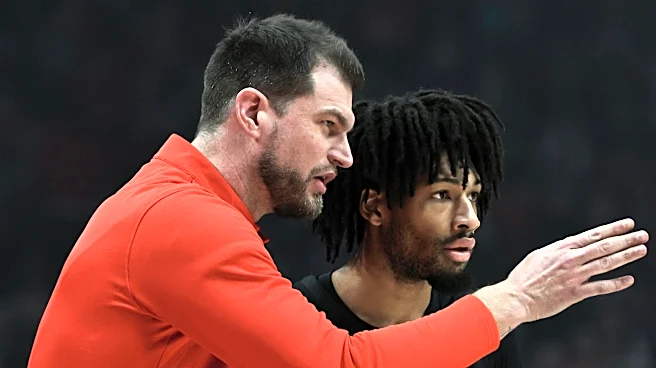
The point guard issue remains the biggest flashing red light, and if Tim Connelly does nothing else this offseason, he has to address it. We have beaten this topic into sawdust already, but it remains true. Minnesota needs another player who can handle the ball, organize the offense, create a shot, and take pressure off Edwards. That is why the Kyrie Irving idea keeps lingering in the background. It is risky, complicated, and not without plenty of reasons to hesitate, but the basketball logic is obvious. A player like Kyrie would give the Wolves a level of late-clock creation and half-court shot-making they sorely missed when defenses loaded up on Edwards. He would change the shape of the offense. He would make opponents pay for sending extra bodies at Ant. And if the price is Randle, or a Randle-centered deal, you at least have to explore whether that recalibrates the roster in a way that makes Minnesota more dangerous.
At the same time, this is where Connelly has to be careful. The Knicks just won a title, but that does not mean the lesson is “panic trade for the flashiest name possible.” It means the lesson is that the right team at the right time can break through. Sometimes that requires a major move. Sometimes it requires patience. Sometimes it requires the move you do not make. Randle may be the clearest path to changing the roster, but moving him only makes sense if the return actually solves a problem and raises the ceiling. Trading him just because fans are frustrated would be the kind of reactive decision that bad franchises make. The Wolves are no longer supposed to be that franchise.
DiVincenzo’s injury complicates everything. Maybe 2026-27 is the year Minnesota is one player short because DDV is rehabbing a torn Achilles. Maybe he returns late and is not quite himself. Maybe he is not truly back until 2027-28. That is a real blow, because his shooting and competitiveness were exactly the sort of traits that translate in the postseason. But even that should not turn next season into title-or-bust hysteria. This is not a one-year chase. This is a multi-year fight through Edwards’ prime.
That is why the proper response to the Knicks winning the title is not jealousy. It is not fatalism. It is not panic. It is belief sharpened by urgency. New York just showed what can happen when a talented team catches the moment and a franchise with decades of baggage finally stops acting like history gets a vote. The Wolves have baggage too. Nobody needs to remind this fan base of that. Garnett had to leave to win. Love had to leave to win. Towns just left to win. It is tempting to turn that into a curse, to treat Minnesota as the place where stars are forged for someone else’s parade.
But Edwards gives the Wolves a chance to change that story.
He is the difference. He is the reason this does not have to become another chapter in the same old book. The Wolves have the superstar. They have the core. They have the defensive infrastructure. They have enough talent to be dangerous. They need the right adjustment, better health, more consistency, and a little bit of the timing that every champion needs. That is not some impossible formula. That is how teams win in this era.
So take a deep breath, Wolves fans. The Thunder are scary. The Spurs are scary. Wembanyama might spend the next decade making everyone feel like they are playing NBA2K on the wrong difficulty level. Oklahoma City might have enough picks to keep adding reinforcements until 2047. Acknowledge it, respect it, and then stop acting like the Wolves should be terrified.
Eight champions in eight years tells us this league is open. It tells us the next team is not predetermined. It tells us that if you have a superstar, a real core, a smart front office, and the courage to keep pushing, you have a chance.
The Knicks got theirs. KAT got his. Good for him. Truly.
Now the Wolves need to chase theirs.
Eight teams. Eight years.
Why not nine?
Why not us?